
WE INVEST NOT IN SQUARE METERS, BUT IN UKRAINE’S FUTURE
Ukraine’s real estate market is going through the most challenging period in its history. Developers are operating amid an unpredictable economy, labour shortages, energy disruptions, and elevated risks. Yet the Turkish company Bosphorus Development has not only maintained its operations in Ukraine – it sees long-term growth potential here.
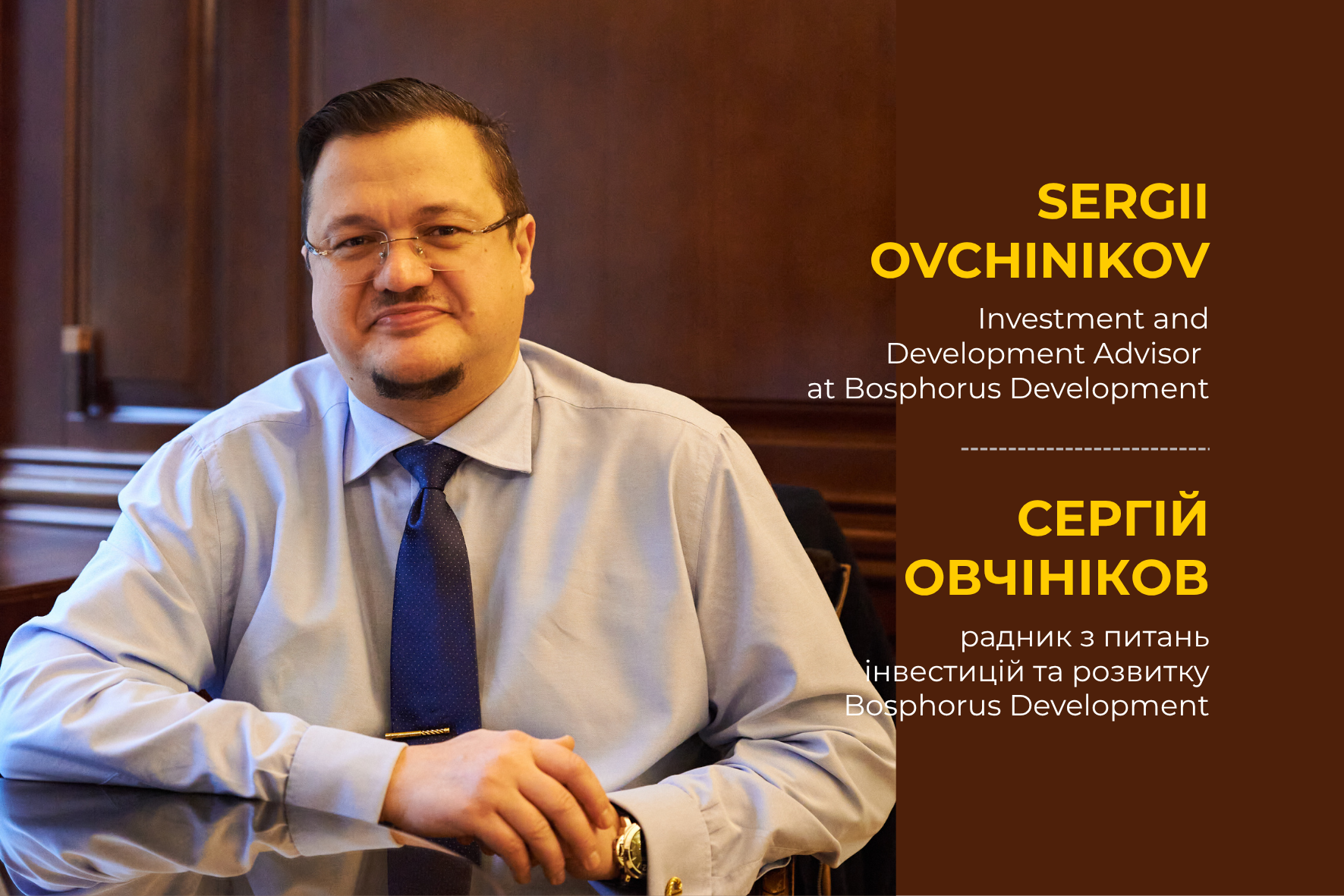
About the economic front, the logic of investing during wartime, and the “window of opportunity” for strategic players – in an interview with SERHII OVCHINIKOV, Investment and Development Advisor at Bosphorus Development.
ON THE DECISION TO STAY
What was the key argument for Bosphorus Development not only to remain in Ukraine, but to continue seeing growth potential here?
In development, the hardest part is not starting a project – it’s completing it. That is why our fundamental decision was to honour all our commitments to clients.
We are continuing the development of the residential complex Maxima Residence in Kyiv’s Pecherskyi District together with the Ukrainian company RIEL. It is one of the most ambitious residential construction projects of wartime. In September 2025, we launched the third stage of sales – a clear signal of market trust and sustained demand for high-quality housing even under current conditions.
The construction business has become more complex and less profitable than before the war. But the economic front is no less important than the military one. A functioning business means taxes, salaries, and support for the national economy. We cannot afford to stop what we have started.
Ukraine has endured – and that in itself is already a victory. We believe that after the war, the country will enter a phase of large-scale reconstruction and economic growth. Today’s investments should not be viewed through a short-term lens, but as a contribution to a future European Ukraine.
WAR AS A STRATEGIC FACTOR
How has the war changed the approach to development?
It has fundamentally disrupted the logic of forecasting. The labour market has become extremely complex: a shortage of men, mobilization, and rising living costs force us to constantly revise salary levels and actively search for workers. Otherwise, there simply won’t be anyone to build.
Construction materials present another challenge. Fixed – or even predictable – pricing practically no longer exists. This directly affects the cost per square meter and project timelines.
Energy is a separate factor. Construction often runs on generators. Electricity supply is irregular and more expensive, creating an entirely new project economics.
But what matters even more is this: the market understands that the end of the war will not automatically mean an immediate return to stability. As a result, working with risk – unfortunately – has become the new norm for Ukraine’s construction sector.
INVESTMENT LOGIC: RISK OR OPPORTUNITY?
Why might a “window of opportunity” be forming right now?
Some international investors have pressed pause. And the reason is not only the physical risks of war. To a large extent, it is about the quality of the regulatory environment, the predictability of mortgage legislation, and the effectiveness of public governance.
For international capital, clear rules of the game are critical: transparent financing mechanisms, investor protection, stable tax policy, and clear procedures for interacting with public authorities.
The mortgage market requires systemic solutions – long-term programs with predictable rates and real access to financing for buyers. For example, project financing for developers simply does not exist in the Ukrainian market today. Equally important are issues such as utility administration, grid connections, and permitting procedures – all of which shape the true cost of a project and the level of risk for a developer.
Therefore, Ukraine’s investment attractiveness today depends not only on the security situation, but also on how quickly the state can build a modern, competitive, and predictable economic policy. That will be the key signal for the return of large-scale international capital.
The market is currently in stagnation. For a strategic investor, it is essential to look beyond the short term and focus on the recovery cycle. But the state must do its part – systemic decisions here are critical.
A NEW PORTRAIT OF THE BUYER
How has demand for residential real estate changed over the past two years? What criteria are decisive today – safety, autonomy, price, trust in the brand?
The war has transformed the very philosophy of buying a home. Real estate is no longer perceived simply as an asset or an investment.
Today, the key criteria are safety, developer reliability, and construction progress. Trust is built on reputation and on the tangible fact of completed and commissioned projects.
Demand for autonomy and technology has increased significantly: energy efficiency, security systems, digital solutions. People are not just looking for an apartment – they are looking for a complete living environment: infrastructure, medical and educational facilities, public spaces. Today, a residential complex is no longer just a building – it is an ecosystem.
TURKISH EXPERIENCE, UKRAINIAN SPECIFICITY
What does Bosphorus Development bring to Ukraine?
Our approach is comprehensive development – not simply the construction of square meters. For us, it is essential to deliver a complete, fully realized product: a property that is ready for living from day one. We commission projects with full connection to all external utilities – electricity, water, and heating – without “temporary solutions” or hidden nuances. The buyer should receive not a promise, but a result.
At the same time, every project is adapted to Ukrainian realities. This means accounting for climate conditions, regulatory requirements, local market trends, and – especially today – safety and autonomy standards. We do not mechanically transfer the Turkish model; we integrate our experience into the context of the country where we operate.
Turkish development is traditionally distinguished by speed of execution, financial discipline, and a high level of organization in construction processes. These are the standards we bring to Ukraine: structured project management, cost control, systematic work with contractors, and responsibility for the final outcome.
At the same time, our strategy extends well beyond residential development. We are already exploring opportunities to enter EU markets and are assessing potential expansion in Ukraine within the banking and energy sectors. Our vision is long-term presence and a diversified investment portfolio. We aim to be not just a developer, but a strategic investor in Ukraine’s future.
PERSONAL POSITION
What message would you like to send to international investors?
Ukraine is an exceptionally promising market. I say this not emotionally, but as someone with many years of international experience working across different countries. In terms of scale of opportunity, human potential, and future demand, Ukraine has all the prerequisites for a bright future.
I am a citizen of Lithuania, but I have lived in Ukraine for more than 20 years. My family is here. My children were born and raised here. This is our home. In 2022, we did not leave – not because we lacked the opportunity, but because we had no doubts. We believe in this country.
Ukraine has already proven its resilience. It endured the hardest years – and so did its businesses. Yes, today it is a high-risk market. But those who invest in Ukraine now are not investing in a crisis – they are investing in the future. Such investors are true patriots of Ukraine.
However, without systemic legislative changes and full alignment with European standards – without political gamesmanship or half-measures – the Ukrainian market risks remaining in stagnation even after the war. Both the executive and legislative authorities must understand that the right structural decisions are essential.
There is no need to reinvent anything. Simply adapt proven global practices and put an end to bureaucratic inertia. Otherwise, the country’s prospects will remain just that – prospects and hopes that never materialize.
#BosphorusDevelopment #RealEstate #Development #Investment #Construction #Economy #Ukraine