
THE RULE OF LAW AS THE INFRASTRUCTURE OF RECONSTRUCTION
TRANSPARENCY, TRUST, PREDICTABILITY
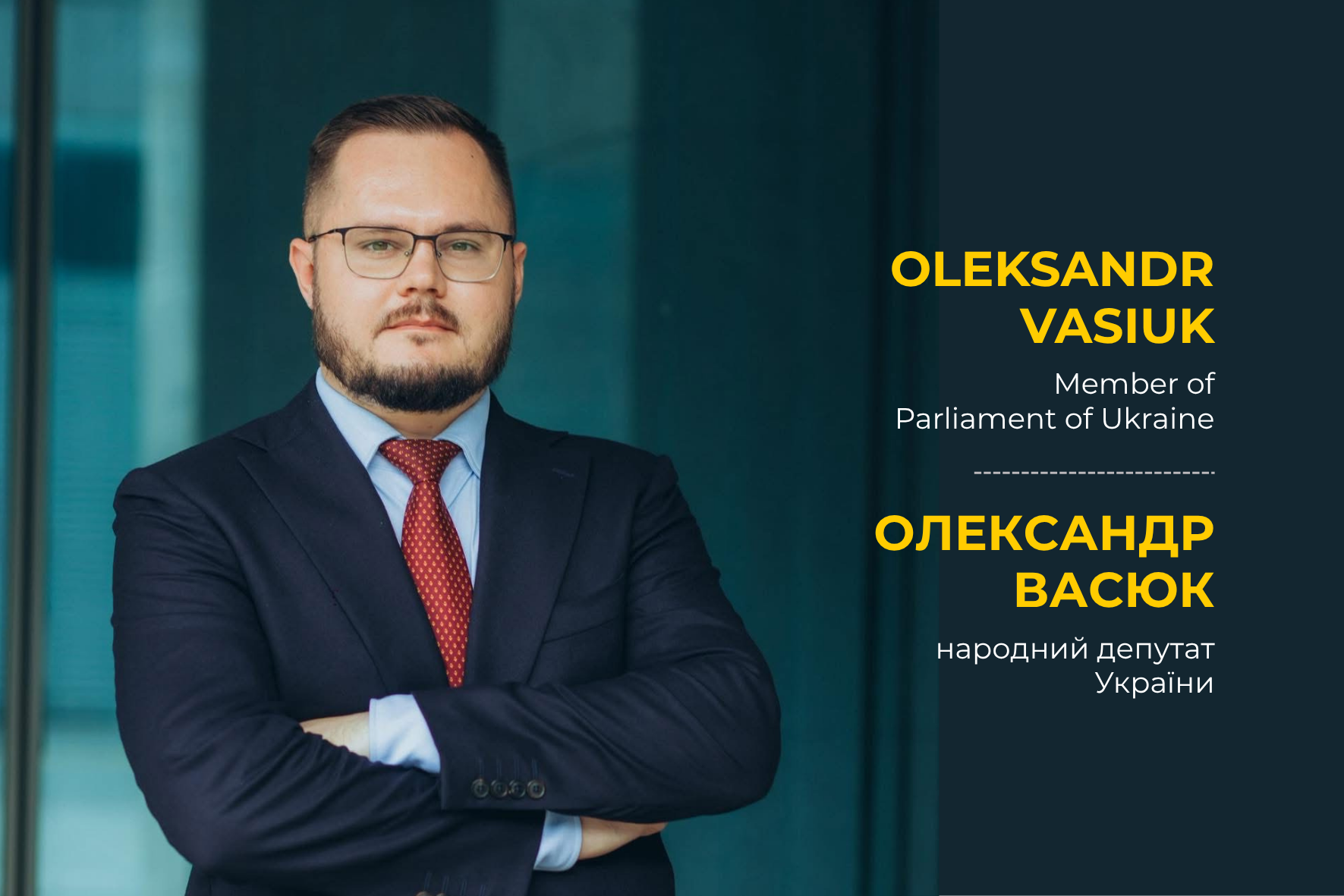
When we speak about Ukraine’s reconstruction, most people imagine cranes, new bridges, and modern residential districts. This is the visible dimension of our revival. However, this process must be viewed more broadly and pragmatically. Any physical structure is reliable only when it stands on a solid foundation. About the rule of law as the foundation for a state that is at war while simultaneously preparing for an unprecedented leap in development – in an interview with OLEKSANDR VASIUK, Member of Parliament of Ukraine.
THE JUDICIARY: FROM PROCESS TO RESULTS
We must recognize that law is not stacks of papers in offices. It is critically important infrastructure. Without a fair judiciary, without an effective anti-corruption system, and without digital transparency, we will not be able to build anything sustainable. Large-scale investments require security and predictability, while donor resources require accountability that can be verified.
The first question a foreign investor asks is: “What will I do if my rights are violated?” And the answer «Go to court» must inspire confidence, not skepticism. Judicial reform is the heart of our transformation.
We have already come a long way: the High Council of Justice and the High Qualification Commission of Judges of Ukraine have been rebooted. This was a difficult but necessary stage of institutional cleansing. However, reconstruction poses new, highly specific challenges:
● Specialization and arbitration.
We need to introduce effective mechanisms for investment protection. This may include the creation of specialized investment chambers or broader use of international commercial arbitration. If businesses see that disputes are resolved professionally, swiftly, and according to clear standards, the entry threshold for Ukrainian projects will be significantly lowered.
● Digitalization of the judiciary.
We must fully implement a comprehensive electronic court system. This is not only about the convenience of filing claims. It is about eliminating the risk of losing evidence, ensuring automated case allocation that excludes manual interference, and guaranteeing openness of court proceedings. Digital tools reduce corruption in the courts far more effectively than any inspections.
● Human resources shortage.
We need to fill thousands of vacancies within the judicial system. And these must be people with a new mindset – those who understand that they are delivering a fair public service on behalf of the state.
ANTI-CORRUPTION ARCHITECTURE
Ukraine’s reconstruction is impossible without trust. And trust rests on a simple principle: the rules apply to everyone, and violations have consequences.
Ukraine has already established an institutional framework that serves as a critical safeguard of integrity and accountability: NABU, SAPO, and the HACC. This is one of the most significant reforms of the past decade. It has entrenched the principle of inevitability of responsibility, strengthened professional investigations, and ensured specialized judicial review of corruption cases. In the context of reconstruction, it is fundamentally important that these institutions operate consistently and without any attempts to weaken them – as a key guarantee of trust in the state.
Going forward, reconstruction requires that every decision be as transparent and verifiable as possible. When data is open and the logic behind decisions is clear, trust grows. Both international partners and Ukrainian hromadas must be able to see that funds are used for their intended purpose and that responsibility for results is clearly assigned.
To achieve this, three layers of safeguards must be in place.
First, the legislative filter. Every draft law and every decision related to reconstruction, budgetary spending, or state programs must undergo high-quality anti-corruption review. We must eliminate «grey zones» where ambiguous provisions and opportunities for manual interference still exist.
Second, institutional resilience. Anti-corruption bodies must have proper conditions to exercise their mandates, and their work must remain protected from political fluctuations. This is a strategic prerequisite for trust on the part of both international partners and citizens.
Third, public oversight. We must support and safeguard access to open data. Civil society in Ukraine is a key partner in monitoring the quality of decision-making. When a journalist, activist, or local resident can verify a project’s budget and implementation status, this becomes a real mechanism of accountability and a powerful tool for preventing abuse.
DIGITALIZATION AS A TOOL OF RADICAL TRANSPARENCY
Ukraine has already become a global GovTech phenomenon. Our Diia platform serves as a benchmark for many developed countries. In the context of reconstruction, we are leveraging this experience to build the DREAM ecosystem (Digital Restoration Ecosystem for Accountable Management).
This is not merely a database. It is a single window for the entire recovery process – from the moment a hromada records damage to the moment a facility is commissioned.
- Donors can see exactly where every dollar is going.
- Contractors receive transparent tenders through Prozorro.
- Citizens can track the status of their homes.
Such a digital vertical minimizes intermediaries. And fewer intermediaries mean fewer kickbacks. Our goal is to make paper documentation in the construction sector a relic of the past. Only a digital footprint – one that cannot be forged or erased.
PREDICTABILITY: LAW AS A GUARANTEE OF THE FUTURE
Investment does not flow into environments where the rules change midstream. Legislative stability – particularly in taxation and land regulation – is critical for large developers and industrial investors.
In this context, the rule of law means the state honoring its own commitments. If we promise incentives for investors in industrial parks, those incentives must remain in place for years, regardless of political shifts. If new energy-efficiency standards are introduced, businesses must be given a reasonable transition period.
Predictability is when the state consistently adheres to the rules it has established itself.
INTEGRATION INTO THE EU LEGAL FRAMEWORK
Ukraine’s reconstruction is inseparably linked to European integration. The Ukraine Plan under the €50 billion Ukraine Facility programme is not merely a list of intentions, but a detailed roadmap for reforms. Each tranche of funding is tied to specific steps in the area of the rule of law.
We must harmonise our legislation with EU law. This applies to the protection of intellectual property, competition policy, and environmental standards alike. Once Ukraine’s legal framework becomes identical to that of the European Union, barriers for Western businesses will disappear on their own. We will no longer be a terra incognita, but a clear, predictable, and reliable partner.
THE ROLE OF LOCAL SELF-GOVERNMENT AND HROMADAS
The rule of law does not begin in Kyiv – it begins in every village and city affected by destruction. Decentralisation has provided hromadas with resources, but it has also placed a significant responsibility on their shoulders.
We already see how successful hromadas are developing their own anti-corruption programmes and involving independent supervisory boards in municipal enterprises. This is the construction of the rule of law «from the bottom up. » However, this process cannot stop here. Parliament must provide hromadas with clear legal instruments to support it.
What is needed are fast and lawful procedures where speed is essential, and inevitable accountability where rules are violated. Land allocation procedures for reconstruction projects should be simplified, while responsibility for violations of urban planning regulations must be strengthened at the same time.
JUSTICE AS A NATIONAL IDEA
Ukraine’s reconstruction is a marathon, not a sprint. And to complete this marathon with dignity, we need a second wind – public trust. People will return from abroad not only to places where there are jobs, but to places where they feel protected. Where they know that if they open a café or a factory, it will not be shut down by a corrupt official. Where, if they buy an apartment in a new building, it will be completed on time and in accordance with proper standards.
The rule of law is our ticket to the club of successful nations. It is an infrastructure that does not fear missile strikes, because it lives in our laws, our institutions, and our shared determination to live by principles and integrity.
We will rebuild Ukraine. And we will make it not just new – but just.
#RuleOfLaw #UkraineRecovery #Investment #Transparency #Trust #Reforms #Ukraine