
ROAD INFRASTRUCTURE AS A STRATEGIC ASSET
WAR, RISKS, AND NEW MARKET OPPORTUNITIES
In wartime, road infrastructure has ceased to be merely a part of the economy – it has become a strategic asset of the state. Roads determine the resilience of logistics, the speed of response, and the country’s ability to maintain momentum both on the frontline and in the rear. At the same time, the sector faces chronic underfunding, mounting debt, and a growing load unprecedented in Ukraine’s recent history. Despite these risks, road construction companies today are effectively shaping a new standard of infrastructure resilience.
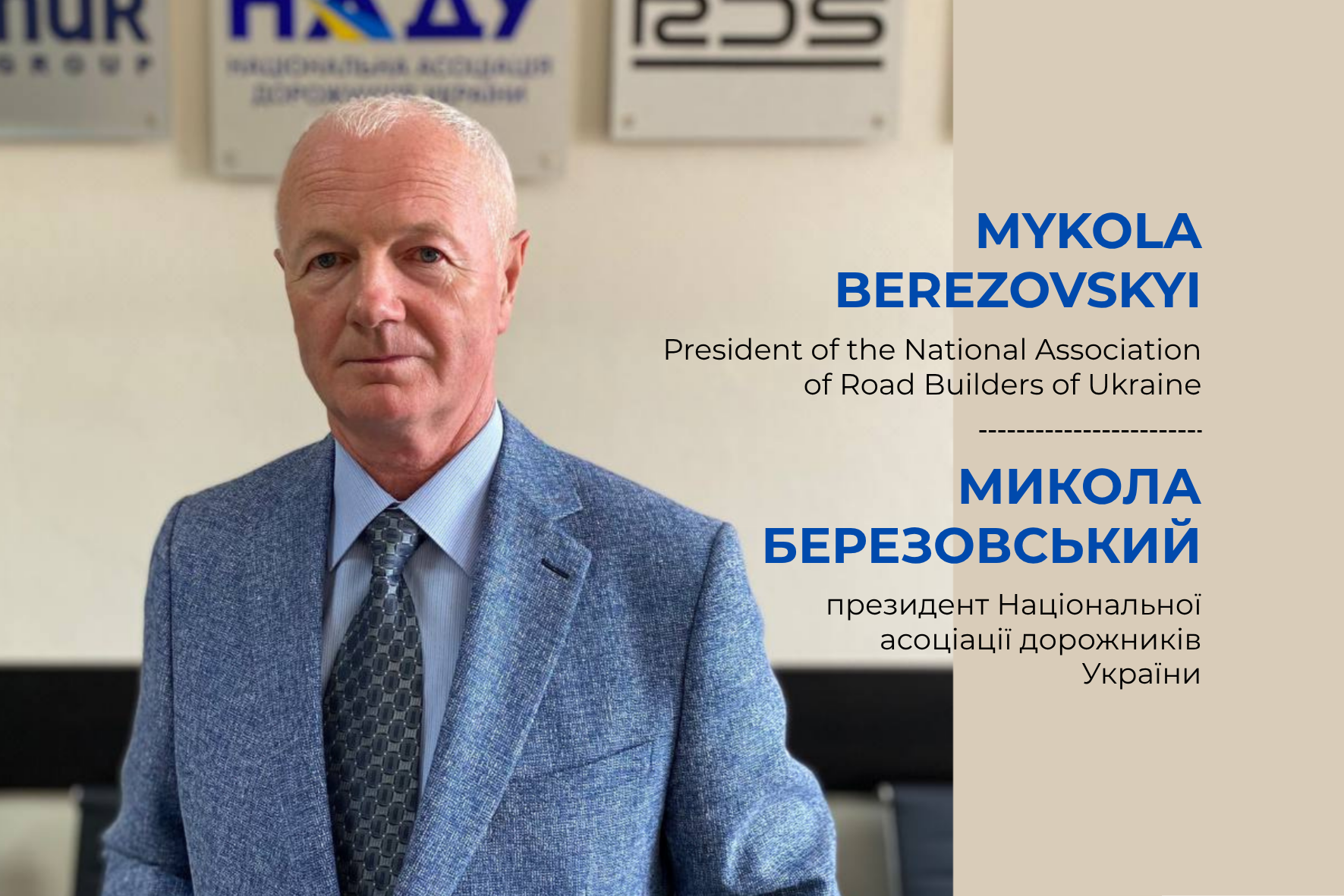
About how the sector has changed since 2022, what is happening behind the scenes of road reconstruction, and what decisions the state needs to make today – in a conversation with MYKOLA BEREZOVSKYI, President of the National Association of Road Builders of Ukraine (NADU).
Tell us briefly about the state of the road construction sector during the full-scale war. How has the role of road companies changed since the beginning of 2022?
The full-scale invasion has radically changed the role of the road construction sector in Ukraine. Roads have ceased to be just infrastructure – they have become a core element of the country’s defence capability. Today, roads are logistical arteries that determine the speed of military transportation, evacuation of the wounded, and delivery of ammunition, fuel, and medical supplies. In war, the side with better logistics prevails, and road builders are literally ensuring its uninterrupted functioning.
At the same time, the sector is operating under double pressure: roads are exposed to extreme loads, climate-related damage, and remain potential targets for the enemy. As a result, the condition of the network is deteriorating rapidly, while the need for emergency repairs and restoration work continues to grow.
During the first two years of the war, road construction companies literally carried the system on their shoulders – operating with their own funds and bank loans, and performing routine maintenance and winter services without adequate financing. For example, in 2023 the state’s debt to contractors exceeded UAH 5 billion, which critically undermined their liquidity: delays emerged in tax payments, salaries, and settlements with suppliers. Unfortunately, the situation has not improved today. Despite this, companies continue to operate and perform functions far beyond what was envisaged in their «peacetime» role.
However, a real threat is emerging on the horizon: if outstanding debts are not settled and stable funding is not secured, companies may be forced to suspend road maintenance during the most challenging period – the transition out of winter and the spring operating season. This would pose a direct risk to public safety and the country’s defence capability.
Of course, fully aware of the situation the country is facing, large and responsible Ukrainian businesses are willing to meet the state halfway – but that does not mean their resources or patience are limitless.
No one would dispute that today most road construction companies have effectively become part of the country’s defence infrastructure. How have NADU member companies adapted to these new challenges?
The adaptation was rapid and often took place under extreme conditions. First, companies expanded their role far beyond traditional road construction. In addition to maintaining and repairing highways, they took on new areas of work: construction of water supply systems, fortifications, protection of energy facilities, restoration of bridges and other critical infrastructure. In effect, they have become universal engineering and construction units operating in a constant state of readiness.
Secondly, the sector adapted financially, often out of necessity. In essence, the work relies on the professionalism, patriotism, and responsibility of the business. When discussing finances, one must also consider the need to update the material and technical base or replace what has been lost due to the aggressor’s actions. For example, by early 2023, road companies in Ukraine had lost 200 production facilities due to the war. This includes 40 asphalt plants, each worth tens of millions UAH. Around 500 vehicles of various types and more than 300 units of specialized equipment have been damaged or destroyed, each valued at no less than 3–4 million UAH: rollers, graders, loaders, manipulators, tankers, and so on. Unfortunately, these numbers continue to rise today.
Regarding upgrades, companies are often forced to invest in new specialized equipment and high-capacity concrete plants, which allow them to build robust protective structures, military facilities, and large-scale artificial constructions. In wartime conditions, foreign companies are not coming to Ukraine, so these projects must be implemented immediately, as they are critically important.
Thirdly, companies have optimized logistics, personnel, and technical capacities. Wartime conditions require rapid mobilization of machinery, quick response to damage, and the ability to carry out work in frontline and near-frontline regions. Many enterprises have established round-the-clock shifts, set up emergency response teams, and implemented new safety protocols for their staff.
Most importantly, road builders have become a crucial link in military logistics. Their work ensures access for ambulances, evacuation of the wounded, and delivery of ammunition and humanitarian aid. This has made their role both critical and strategic.
In other words, road construction companies have not merely adapted – they have restructured their operations to meet the demands of wartime and to ensure the uninterrupted functioning of both the state and the frontlines.
I would like to focus specifically on work in frontline and recently liberated areas. What challenges do companies face, and what are the main obstacles during clearing and construction work in such conditions – technical, logistical, or safety-related?
The first days after an area is liberated are a real test for road construction companies in terms of speed, professionalism, and human endurance. Road crews move in almost immediately after the military, often under the threat of mines and with logistics completely destroyed. In these areas, many roads are damaged by shelling, enemy machinery, or blocked by debris, and it is necessary to ensure at least minimal access literally within a matter of hours.
The most challenging work takes place in areas where bridges need to be urgently restored or temporary crossings installed. Often, the access roads are mined, and load-bearing structures are partially destroyed. Despite this, emergency teams from road construction companies work without days off, in all weather conditions, using all available resources.
However, the difficulty is not only technical. Workers carry out their tasks under psychological pressure: shells may still be exploding nearby, and people are waiting for the road to become passable to receive aid or reach safe areas. At the same time, road crews must simultaneously handle other critical tasks – strengthening infrastructure, constructing fortifications, and restoring energy facilities.
This is not just construction work – it is a real frontline, where road workers operate under constant shelling, risking their lives. Unfortunately, companies continue to suffer losses: workers have been killed and injured, and equipment has been destroyed. Despite this, the work goes on and is carried out to the highest standards.
It is also important to emphasize that employee safety is a top priority for the companies. All workers operate wearing body Armor, helmets, and other protective gear, and concrete shelters are installed on site to ensure their protection.
This is precisely the kind of work done not for contracts or payments, but to enable territories to live again: so that ambulances can reach people, the military has reliable routes, and humanitarian convoys do not get stuck in mud or on destroyed bridges. That is why the first days after de-occupation became a vivid demonstration that the road sector is not only about asphalt, but about the real resilience and security of the state in wartime.
In your opinion, will the experience gained by companies after 2022 become a driver for developing new areas in the future?
Yes, undoubtedly. The experience road construction companies have gained during the war is unprecedented. In effect, the sector has undergone an accelerated transformation – from specialized road-building contractors into universal engineering and construction structures capable of operating across multiple areas of critical infrastructure.
Bridge construction in high-risk areas, the restoration of water supply systems, the building of fortifications, and the protection of energy facilities are not just isolated episodes of work. They represent a new level of expertise that cannot simply «disappear» after the war. On the contrary, this experience is shaping the foundation for the companies’ future development.
In essence, these enterprises have gained practice that is impossible to replicate in peacetime: working under extreme time pressure, in highly challenging conditions, and under constant stress, where the cost of a mistake is measured not in financial terms, but in safety. This has created a unique competitive advantage – the companies have proven their ability to deliver complex infrastructure projects at a level that meets the highest standards.
For example, during the war, Highway-South rebuilt more than 30 bridges in the Kyiv, Chernihiv, Sumy, Kharkiv, Kherson, and Mykolaiv regions.
At the same time, since the start of the full-scale invasion, ONUR GROUP Ukraine was forced to suspend around 90% of its road construction operations. Despite this, the company managed to complete several key projects. Among them were the reconstruction of the Stryi – Ternopil – Kropyvnytskyi – Znamianka (M-30) highway, which connects the western and eastern regions of the country, as well as sections of the Kyiv – Kharkiv – Dovzhanskyi (M-03) motorway. Both projects were financed by the World Bank.
ONUR GROUP was also among the first road construction companies in Ukraine to begin work in de-occupied territories, particularly in the Kharkiv region. In the area around the city of Izium, the company carried out emergency works, restoring road surfaces, public transport stops, and street lighting.
Equally important is the implementation of one of the country’s large-scale recovery projects – the construction of the Marhanets – Nikopol – Pokrov main water pipeline, delivered by the RDS Group, a consortium of road construction companies. Another significant example is the reconstruction of the bridge in Voznesensk – one of four bridges whose destruction in 2022 halted the enemy’s advance into the Mykolaiv region.
In fact, there are many such examples. That is why, yes – this experience will become a powerful driver of further development. After the war, demand for infrastructure solutions will only increase, and it will be precisely those companies that worked on the front lines of recovery that will be best prepared to take on large-scale projects. They have already proven their capacity – and this is the strongest reputation one can have in the context of Ukraine’s future large-scale reconstruction.
How acute is the workforce shortage in the road construction sector today?
The workforce shortage is significant. At the beginning of the war, when employee reservation mechanisms were not yet in place, many company workers were mobilized – at least 20–25% of total staff. However, since construction volumes declined in 2022, companies were able to partially offset these losses.
Today, most companies have access to employee reservation, but this addresses only part of the problem. The second and more critical issue is the severe shortage of specialists – especially highly skilled professionals such as machinery operators who work with road construction equipment, as well as experienced construction workers.
One of the ways to address this challenge is cooperation with educational institutions to attract and train new specialists. This system existed even before the war, but it has now become especially relevant.
However, even with a sufficient number of qualified professionals, it remains quite difficult to persuade them to work in regions close to the frontline, such as Kharkiv, Kherson, or Zaporizhzhia.
Today, there is growing discussion around the launch of the «Design – Build» system. Is it truly experimental? What are its advantages for Ukraine, and where have its weaknesses emerged?
This system is referred to as experimental mainly because it is being applied on such a large scale for social and critical infrastructure for the first time – including housing, schools, and hospitals. However, it has long been known globally and is not new to the road construction sector. In fact, it began to be implemented in Ukraine as early as 2019, and by now there is substantial practical experience in its application.
Under this system, numerous infrastructure projects have already been completed, are currently under construction, or are being restored. These include the construction of the new N-31 Dnipro – Tsarychanka – Kobyliaky – Reshetylivka highway; the repair of key sections of national roads; the restoration of road bridges destroyed during the war; the implementation of an experimental project to build main water pipelines in the Dnipropetrovsk and Mykolaiv regions; as well as the construction of other infrastructure facilities.
The experience accumulated by companies within the National Association of Road Builders of Ukraine, as well as other companies, demonstrates that a major advantage of this system is the significant acceleration of construction and infrastructure restoration processes. Primarily, this is achieved by shortening project timelines through the integration of design and construction into a single contract and assigning responsibility to a single contractor. This approach helps to avoid many delays and rework that frequently occur under the traditional model.
However, there are also some «bottlenecks» in the «Design – Build» system. The most significant, in my opinion, is the lack of regulatory guidance for accurately determining the cost of a construction project by the client. Additionally, when fixed-price contracts are used, there are differing interpretations of their components by contractors and clients on one side, and oversight bodies on the other, which leads to conflicts.
One can only hope that the positive and negative experiences accumulated by road construction companies in implementing the «Design – Build» system will be taken into account by the relevant government authorities in regulatory documents, and that clear rules of conduct for each participant in the process will be established.
Thus, the model has significant potential for Ukraine, but its success depends on the professional readiness of government clients, clearly defined initial project data, and the implementation of robust control procedures. If these conditions are met, the «Design – Build» system can become one of the key mechanisms for fast, error-free, and economically efficient reconstruction of the country.
Overall, I am confident that Ukraine’s road construction sector, having withstood the most challenging conditions of the war, has gained invaluable experience in rapid mobilization, innovative approaches, and cooperation between the state and business. Therefore, it does not matter which approach becomes central – the most important thing is that the state does not change the «rules of the game» without consulting with the industry, and that everyone works together as a single unit.
#RoadInfrastructure #RoadConstruction #Reconstruction #Infrastructure #Logistics #UkraineRecovery #Ukraine