
RECONSTRUCTION BETWEEN ‘US’ AND ‘FOR US’
HOW TO PREVENT UKRAINE FROM BECOMING AN OUTLET
The Ukrainian cement industry has the capacity for large-scale reconstruction. But future investments will work for the national economy only if the state combines openness to partners with localization, fair competition, and long-term industrial policy.
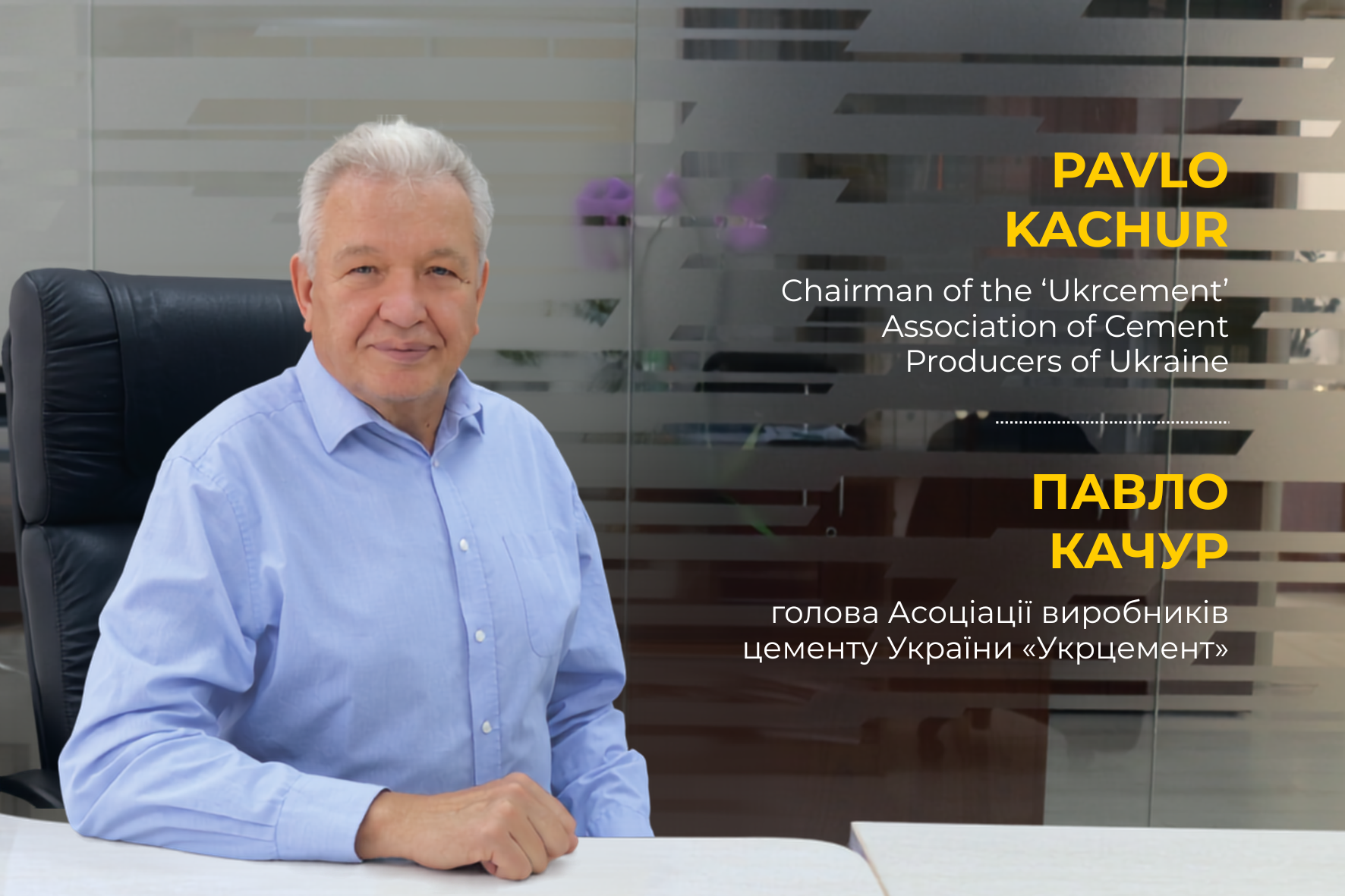
PAVLO KACHUR, Chairman of the ‘Ukrcement’ Association of Cement Producers of Ukraine speaks on weak domestic demand, CBAM, road infrastructure, alternative fuels and the choice between two reconstruction models: ‘we build’ and ‘they build for us’.
THE INDUSTRY CAN PRODUCE MORE BUT THE MARKET IS NOT YET CREATING DEMAND
The scale of the future reconstruction is no longer abstract. According to a joint assessment by the Government of Ukraine, the World Bank, the European Commission and the UN within the framework of RDNA5, the country’s recovery over the next decade will require almost USD 588 billion. The largest long-term needs fall on transport, energy and housing – precisely the sectors that form the basic demand for construction materials.
The Ukrainian cement industry is technically ready for much higher production volumes. Enterprises continue to invest in modernization even during the war and can increase production along with the increase in orders. The main constraint today is not a shortage of capacity, but weak domestic demand.
According to the Ukrcement Association, over the past three years, cement consumption in Ukraine has been maintained at 6.2–6.5 million tons per year – about 60% of the 2021 figure. Part of the demand is formed by fortifications, protection of critical energy infrastructure, and emergency restoration of destroyed facilities. However, these orders are mainly spot-on and do not replace systemic residential, commercial, and infrastructure construction.
At the same time, wartime costs are rising. Cement production is energy-intensive: electricity and fuel are becoming more expensive, enterprises are investing in backup power, security, and repairs. At the same time, transportation is becoming more difficult, and the shortage of process line operators, electricians, mechanics, and automation specialists is already affecting not only operational stability but also the pace of modernization.
Therefore, the discussion about cement goes far beyond the boundaries of one industry. In fact, it is about a much broader question: what will be the model of post-war reconstruction of Ukraine and who will receive the main economic effect from it?
Cement in this system is only one of the basic elements. Along with it are concrete, metal, glass, thermal insulation materials, road construction, logistics, design and the work of Ukrainian contractors. All these segments today operate in an environment that cannot be called a normal market. Therefore, the formal application to the war-torn economy of the same rules as to producers from safe neighboring countries does not create equal competition. On the contrary, it opens up the possibility of gradually crowding out Ukrainian products from the Ukrainian market.
LOCALIZATION WITHOUT ISOLATION
Reconstruction could become the largest modernization program for the Ukrainian economy. Or a large-scale source of orders for production abroad. The difference will be determined not by the origin of the capital itself but by the structure of each project: where the materials are produced, who is involved in the work, where the added value is created, and to which budget the taxes go.
A scenario in which a foreign company brings its own materials, equipment and key specialists can give Ukraine the necessary facility, but leave most of the economic effect outside the country. That is why localization does not mean market closure and should not turn into an automatic advantage for an inefficient manufacturer. Its meaning is to give competitive Ukrainian companies real access to demand created by the government and international partners.
The formula allies in war – partners in reconstruction may be a political guideline, but its practical implementation must comply with the rules of competition and the conditions of donor funding. The rational model is international capital and technology combined with Ukrainian materials, local contractors, labor, and taxes in Ukraine.
The experience of Poland is illustrative. In 2024, Ukraine supplied Poland with 854 thousand tons of cement while Polish production amounted to about 17.7 million tons. Despite the relatively limited scale of supplies, the topic quickly became the subject of public and political discussion about the protection of Polish industry. As a result – in 2026, the export of Ukrainian cement to Poland was suspended. This is an important lesson for Ukraine: industrial diplomacy and protection of the legitimate interests of national business should be part of the state's economic policy.
The same logic should be applied to anti-dumping instruments. Their goal is not to ban imports, but to restore a level playing field if an investigation confirms unfair pricing and injury to a domestic producer. Without such protection, recovery demand may load foreign plants, while Ukrainian plants will remain underloaded.
CBAM: CLIMATE REGULATION SHOULD NOT BECOME A TECHNICAL EMBARGO
From January 1, 2026, the EU’s Carbon Import Adjustment Mechanism – CBAM – has entered a permanent phase. Its goal is clear: to equalize the carbon cost of imported products with that paid by European producers. For Ukrainian cement, the risk arises not from the principle itself, but from the starting conditions for its implementation.
The problem lies in the practical application of the mechanism to a country at war. According to industry representatives, the use of a default emission indicator for Ukrainian cement at the level of 1518 kg CO₂ per ton of clinker is almost twice as high as the actual indicators of Ukrainian enterprises. An additional obstacle is the inability to involve European specialists to work on site in Ukraine on verification of emissions. Due to security risks, they refuse to go to Ukraine. And there are no EU-certified Ukrainian verifiers.
Please note. We are not talking about abandoning European climate rules. We are talking about equal competition. Therefore, we need a proactive negotiating position: correct default values, a realistic transition regime for a country at war, and a procedure that will allow manufacturers to prove the real carbon intensity of their products. Otherwise, the decarbonization tool will de facto limit market access for companies that are physically unable to complete some of the procedures within the established deadlines.
EUROPEAN STANDARDS ARE A CONDITION FOR ACCESS TO RECONSTRUCTION
In parallel, the Ukrainian construction market should complete the transition to European standards. For projects financed by international partners, compliance with European requirements will not be a competitive advantage, but a basic condition for participation.
Cement companies can already produce products according to European standards. The transition of the entire system is more difficult: designers, contractors, laboratories, conformity assessment bodies and customers. It is necessary to change not only the names of cement classes, but also technical specifications, design solutions, control procedures and digital traceability of products.
At the same time, European rules do not stand still. While Ukraine is completing adaptation to some requirements, the EU is already moving to new regulations with higher requirements. Therefore, the task is not to switch to European standards once. The Ukrainian market must learn to work in a constant regulatory update mode. Companies that expect that new requirements will bypass them risk simply being left out of the reconstruction.
LOGISTICS EATS AWAY AT MANUFACTURING ADVANTAGE
Cement and clinker are heavy bulk goods with a relatively low cost per ton. Therefore, the transportation component directly determines the radius of competitive delivery. Even a moderate increase in tariffs can completely absorb the advantage that a plant has due to efficient production.
Not only is the price of transportation critical, but also its unpredictability. An enterprise cannot enter into a stable long-term contract if it does not understand the future cost of delivery. The industry needs predictable tariff solutions, long-term contracts and a separate logic for basic industrial cargoes. This is not a requirement to artificially reduce the cost of transportation, but a request for a model in which the tariff takes into account the economic effect for the entire system, and not just the short-term income of the carrier.
ROADS NEED TO BE COMPARED ACROSS THEIR ENTIRE LIFE CYCLE
Road infrastructure is one of the largest potential markets for Ukrainian construction materials. According to RDNA5, transport forms the largest share of long-term rehabilitation needs. However, the choice of technology for years has often come down to initial cost and speed of demonstration of results, while maintenance costs have remained in the background for decades.
Cement concrete is not a universal replacement for asphalt concrete. Both technologies have their own areas of application. However, on routes with high loads, industrial and port entrances, in military and agricultural logistics, a hard surface can have an advantage due to its resistance to rutting, high temperatures and repeated loads. Its economics should be assessed not only at the construction stage, but also over the entire life cycle – including repairs, downtime and maintenance costs.
An additional argument is the local raw material base. The main components of cement concrete roads are produced in Ukraine, while bitumen is largely associated with imports and foreign exchange costs. This is not a reason to administratively choose concrete in every project, but it is a sufficient reason to demand a technologically neutral comparison of alternatives according to the same criteria.
The main customer for road construction remains the government, therefore it is it that shapes the demand structure. If a long-term program for cement-concrete roads appears, contractors will invest in equipment and competencies. The regulatory framework and companies capable of performing such work already exist. What is lacking is a consistent portfolio of projects and political responsibility for the result over the horizon of not one budget year, but decades.
For some local and regional routes, a promising solution may be rolled concrete – a mixture with a low water content, which is laid by asphalt pavers and compacted by rollers. In terms of driving comfort, it does not always compete with high-quality asphalt on a highway, but it can be rational for industrial zones, agricultural routes, warehouses, military logistics and roads with moderate speeds and high loads.
RDF: WITHOUT AN ECONOMIC MODEL, THE CIRCULAR ECONOMY WILL NOT WORK
Another potential for modernization is the use of alternative fuels, in particular RDF, produced from the prepared energy fraction of waste. In many EU countries, cement plants are integrated into the waste management system: they replace part of the fossil fuel and, depending on the market model, may receive a fee for the disposal of sorted material.
For Ukraine, this potentially means less landfilling, lower dependence on fossil fuels, and a new segment of processing infrastructure. But there is still no full-fledged RDF market. It is held back by weak sorting, unstable raw material quality, lack of long-term contracts, regulatory and tax uncertainty, and the high cost of equipment modernization.
Reform is further hampered by opaque economic interests surrounding the current waste management system. That is why it is not enough to simply allow the burning of RDF. What is needed is transparent accounting of flows, fuel quality requirements, clear disposal fees, environmental monitoring, and the prevention of double taxation.
GOING BACK TO 2021 IS NOT ENOUGH
The post-war strategy of the cement industry should not be limited to restoring pre-war volumes. Reconstruction provides an opportunity to reduce the carbon intensity of production, develop composite cements, alternative fuels, self-generation, automation, and digital quality control.
However, multi-million dollar investments are possible only with clear rules. A manufacturer will not invest in decarbonization and new lines if it does not understand whether it will have access to reconstruction projects, how tariffs will change, and whether the domestic market will be protected from proven dumping. Industrial policy should be formed before the distribution of major contracts, not after it.
THE CHOICE BETWEEN ‘US’ AND ‘FOR US’
In the end, it is not about privileges for the cement industry but about the architecture of the post-war economy. The ‘us’ model would mean: Ukraine attracts international capital and technology and produces a significant part of the materials, designs, builds, creates jobs, and keeps taxes within the country.
The ‘for us’ model means something else: the infrastructure is created mainly by external companies with their own materials and teams, and the Ukrainian economy receives the facility, but loses a significant part of the multiplier effect. It would be unwise to completely abandon foreign business. It is also unwise to give it the entire future market without requiring local participation.
Ukraine needs a pragmatic balance: open competition, partnership with allies, access to advanced technologies – and at the same time the most economically viable use of Ukrainian materials, companies and workers. Reconstruction should not simply restore what was destroyed. It should create an industrial basis for the next stage of the country’s development. This choice must be made before large-scale financing begins, because once contracts are signed it will be too late to change the economic model.
#Ukrcement #CementIndustry #UkraineRecovery #Localization #CBAM #Industry #Construction