
INFRASTRUCTURE OF THE FUTURE
HOW SCIENCE, INNOVATION, AND MANAGEMENT SHAPE UKRAINE’S RECONSTRUCTION
The full‑scale war has posed unprecedented challenges to Ukraine’s infrastructure – from the urgent restoration of logistics to the development of long‑term solutions for post‑war recovery. In these conditions, science and innovation are no longer “background factors” – they become instruments of state resilience and economic growth.
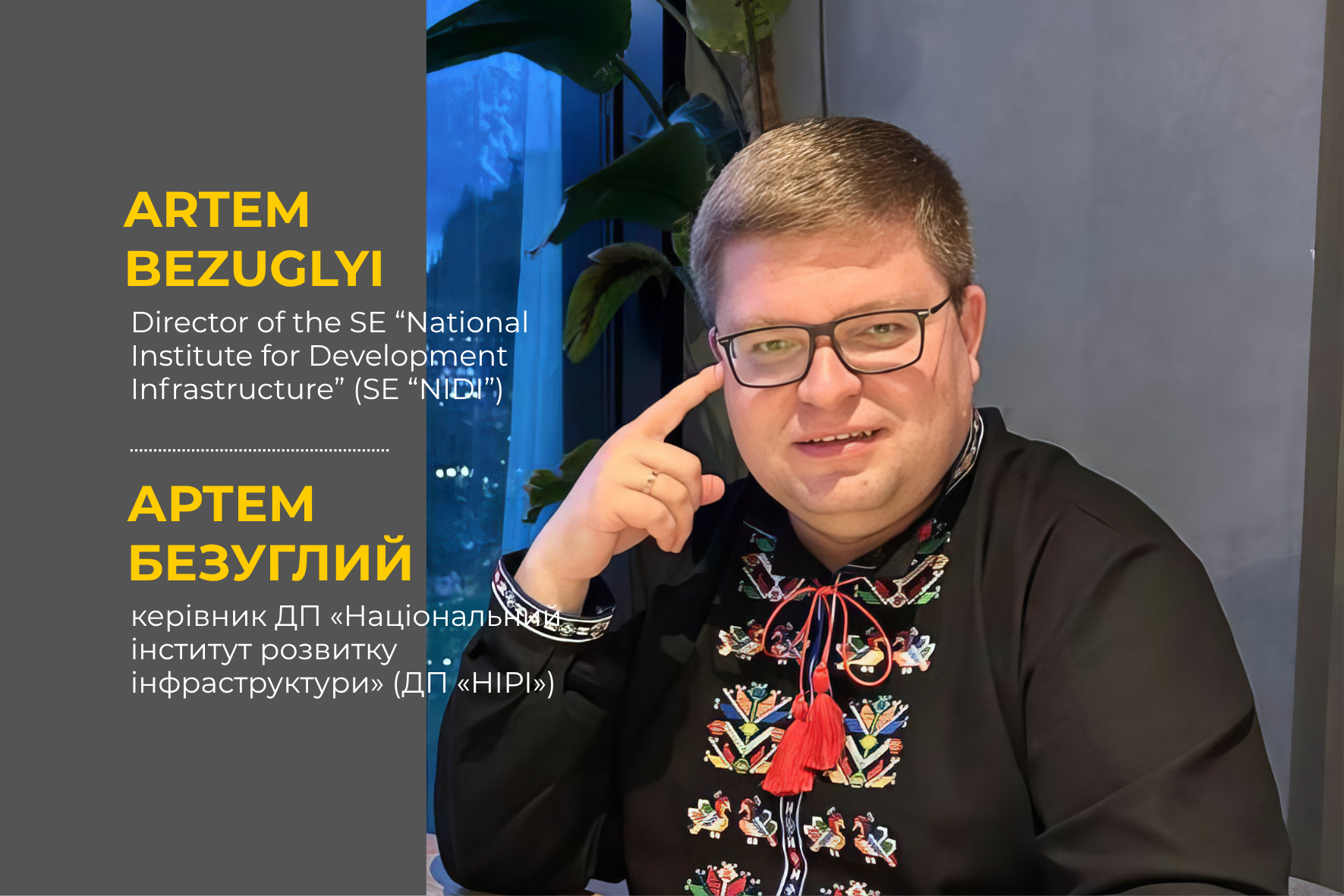
We speak with ARTEM BEZUGLYI, Director of the SE “National Institute for Development Infrastructure” (SE “NIDI”), about how the role of scientific institutions is changing, why infrastructure solutions must outpace the regulatory framework, how the balance between the state, business, and science is being built, and what it means to be a reformer in times of constant crisis.
What innovative approaches currently shape the work of SE “NIDI”?
At the core of SE “NIDI’s” activities today are digitalization, open communication, and human capital development. Digital tools are central to our work – particularly the principle of paperless operations. All documentation has been transferred into electronic format, and all reports are digitized, which increases transparency, speed, and efficiency.
The second key element is an active communication policy. For us, it is essential to understand the real needs of the market and to listen to key stakeholders, because this directly determines the effectiveness of any decision. Among our main partners are the Ministry for Communities and Territories Development, the State Agency for Restoration and Development of Infrastructure, local governments, regional military administrations, contractors, private businesses, as well as design and engineering organizations. We maintain ongoing dialogue through conferences, industry events, and tools such as the “Portal of Innovations” and the “Platform of Innovations.”
Equally important is the development of our employees’ competencies. Human capital is the institute’s key resource. We invest in staff training, including participation in programs offered by international partners, and we systematically work with young professionals. Senior students undertake internships with us, write their theses based on SE “NIDI’s” projects, and often stay on as employees. Today, the average age of our staff is about 40, which is a significant competitive advantage for a scientific institution.
How does your approach to infrastructure development differ from classical models?
Our key distinction from classical approaches lies in how we treat innovation. Where others often respond with arguments like “this is impossible,” “it hasn’t been tested on real projects,” or “we need to wait five to ten years,” we don’t look for reasons to say no – we look for ways to make it happen.
SE “NIDI” provides comprehensive scientific and technical support for infrastructure projects: from testing new materials and technologies on specific sites to analyzing their compliance with existing regulations. If the necessary standards do not exist, we develop them. If they exist but are outdated, we initiate their revision. In this way, innovation does not remain just an idea – it gains a legal and practical path to implementation.
Classical models often operate on the principle of “time first, solutions later.” Our approach is different: we immediately take innovation into practice, test it under real conditions, and at the same time adapt the regulatory framework. This allows infrastructure to grow not with delays, but in step with modern challenges and technological change.
What specific innovative solutions have already been implemented in the road or transport sector thanks to SE “NIDI’s” work?
In fact, there are already many examples of innovations that have been put into practice. Virtually all modern solutions currently applied in Ukraine’s road construction are introduced with the active scientific and technical support of SE “NIDI.”
This includes the use of modifying additives in asphalt and concrete mixtures, geosynthetic materials in pavement structures, continuous reinforcement technologies for concrete surfaces, soil stabilization methods, as well as the reuse of materials – for example, by incorporating by-products from thermal power plants into road construction. All these solutions not only improve the durability and efficiency of road infrastructure but also meet modern sustainability requirements.
At the same time, the institute systematically works on updating the regulatory framework. Over the past three years alone, SE “NIDI” has developed 13 construction codes – both national and sectoral, 117 national standards (DSTU), and 20 regulatory and technological documents governing the development and maintenance of road infrastructure, aligning them as closely as possible with European and American standards.
Another important area of work is direct support for infrastructure projects. In the past five years, SE “NIDI” has provided scientific and technical support for 164 road construction projects, 27 bridge structures, five fortification facilities designed to protect energy infrastructure, and two tunnels.
In addition, 591 bridges have been inspected and documented, including those damaged by russian aggression – a critical task for ensuring both civilian and military logistics.
In the end, we are not talking about isolated experiments, but about the systematic integration of innovation into practice – from scientific ideas and regulatory approval to real-world application on construction sites. This approach allows infrastructure to develop quickly, safely, and in line with today’s challenges.
The team of SE “NIDI” created and continues to develop the Portal of Innovations and the Platform of Innovations. What was the main purpose behind their creation, and who is the primary target audience: researchers, business, or government institutions?
One of SE “NIDI’s” key objectives is to bring together all participants in the construction process on a single platform: researchers, businesses, designers, contractors, and public authorities. This was the main reason for creating and continuously developing the Portal of Innovations and the Platform of Innovations.
The Portal of Innovations is an open resource that allows all market participants to freely share scientific and technical information about new materials, technologies, and engineering solutions. Its core function is to accumulate and systematize knowledge, creating a unified database of innovations accessible to the professional community.
The Platform of Innovations, on the other hand, is not just a database but a dynamic communication space. It enables developers, manufacturers, and businesses to present their innovative solutions free of charge to an audience of interested stakeholders: asset managers, clients, designers, contractors, experts, and researchers. What matters most on the Platform is not only the presentation of ideas but also professional discussion – open, practical, and results-oriented.
The fundamental difference of the Platform is in its focus on interaction. It is not a “listen and leave” format, but a space where some solutions are developed that can be implemented in practice. The synergy between those who order the work, perform it, supply materials, and shape the regulatory framework makes it possible to move from ideas to real-world application.
SE “NIDI’s” experts also actively participate in these discussions. Their role is to assess the depth of the proposed solutions, identify practical cases and specific applications, and highlight issues that require further refinement before implementation in Ukraine. This approach is already producing tangible results, because practical experience is always more effective than theory alone.
How do you see the development of SE “NIDI” over the next five years? Can the institute become a national innovation hub in the field of infrastructure?
In fact, SE “NIDI” is already performing the role of a national innovation hub in the field of infrastructure. Therefore, when speaking about development in the next five years, I see us primarily as an institution that builds the scientific and analytical foundation for reconstruction – from modeling solutions to creating a high-quality information base for the state and communities.
It is crucial for me that the institute operates in line with modern economic and social trends. This means professional project management, a clear KPI system for researchers and teams, digitalization of processes, and the use of artificial intelligence tools.
Ideally, all processes should be automated so that the institute, as a scientific organization, can objectively monitor performance.
Another important focus is international cooperation. Today we are actively working on joining grant programs and competitions, particularly those organized by the European Commission and other international partners. Modern research in the field of reconstruction almost always takes place within consortia, and I see SE “NIDI” as an active participant in such international collaborations.
My ambition is that within the next five years the institute will become a powerful scientific and expert center not only in the field of road construction or individual infrastructure projects, but in the construction sector as a whole. This is a challenging but entirely achievable goal.
A key role in this process is played by the renewal of our technical base. We already have a successful example of cooperation with the Japan International Cooperation Agency (JICA): in 2025 we received unique, cutting‑edge laboratory equipment for bridge inspection, currently unavailable anywhere else in Ukraine. This allows us to reach a fundamentally new level of research, and I want to continue developing such cooperation – not only with JICA but also with other international partners.
And, of course, the most important resource for development is people. For me, it is essential that our specialists constantly improve their competencies, feel the value of their work, and remain motivated to stay in science. We have many young professionals, and I consider this one of our greatest assets for the future.
You took charge of the institute during a difficult time. What was your main task at the very beginning?
I have been leading the institute for eight years now, and SE “NIDI” in 2017 and SE “NIDI” in 2025 are essentially two different organizations. At the start, my main task was to preserve the team and restore people’s confidence in the institute. It was crucial that specialists wanted to work here, felt professional dignity, had decent income, recognition, and authority in the field.
At that time, the institute was not as well known to the construction community as it is today. Therefore, the second key challenge was diversifying sources of funding. We needed to reduce our critical dependence on contracts financed solely from the state budget and begin developing new areas of activity. SE “NIDI” used to be associated almost exclusively with roads and bridges. That was part of our history, but we deliberately expanded our focus and redefined the institute’s role.
Today we are leaders in the scientific field of infrastructure recovery and development, with a professional, young, and ambitious team. Our specialists inspect bridges in the hottest frontline areas, working immediately after de‑occupation. In Kyiv region, particularly in Bucha and Irpin, we were among the first to arrive on site – sometimes even before full demining – risking our lives to quickly assess the state of infrastructure and determine what solutions the state needed next.
At the same time, we worked on upgrading our technical base. Laboratory equipment was outdated, and working conditions were far from modern standards. Therefore, another strategic priority was investing in technical re‑equipment and creating proper conditions for scientific work.
In short, my main tasks at the beginning came down to three things: people, financial stability, and modernization. This foundation allowed the institute to undergo transformation and become the SE “NIDI” we know today.
What motivates you to work specifically in the field of infrastructure and innovation?
In this field, it is impossible to work formally – you have to live it. Today the country is going through an extremely difficult stage, and everyone has their own front of responsibility. Some fight with weapons in hand, while we, in the rear, must do everything possible to ensure the state endures and develops.
What motivates me most is the sense of usefulness. I am proud that together with my team we have managed to build a strong national institute for infrastructure development – one that operates effectively, pays taxes, supports the military, and addresses critical tasks of reconstruction. Some of this work we cannot even make public.
We have no right to waste time. Our duty is to be as effective as possible for the state right now.
Where is it most difficult to find a balance between the interests of the state, business, and science?
Balancing the interests of the state, business, and science is always challenging, but we see this as one of the institute’s key roles. We often act as a kind of arbiter, providing objective, professional information and helping all sides reach a common solution.
Sometimes our conclusions may not be welcomed by business, and sometimes by government or law enforcement agencies. But it is precisely for this independence and impartiality that all parties value us. They know that SE “NIDI’s” position is based not on the interests of individual players, but on facts, science, standards, and professional responsibility.
Business often does not trust state institutions. How do you personally convince the private sector to cooperate with SE “NIDI”?
In fact, the key instrument is communication. We constantly engage with businesses through seminars, conferences, professional discussions, and our platforms. When there are open dialogue and clear rules of the game, trust forms naturally.
After that, reputation begins to work. Businesses exchange information quickly, and the institute’s name is of unquestionable value to us. We are known as an independent and objective expert institution. That is why cooperation initiatives often come directly from the private sector – with requests for research, expertise, or scientific and technical support.
You often talk about innovation. But which innovation has impressed you personally the most in recent times?
Without a doubt, the innovation that has impressed me most recently is artificial intelligence. My main scientific focus is cost estimation in construction, and today AI is already capable of preparing budgets, selecting price lists, and automating part of the work.
At the same time, it is a tool that requires careful use. It is important to formulate tasks correctly and to control the results – only then does artificial intelligence become not a threat, but a powerful driver of efficiency and quality in decision‑making.
What has been your biggest failure at work that you managed to turn into experience?
One of our early mistakes was being overly open. At times we encountered unscrupulous partners who exploited the institute’s name, which later created reputational risks.
This experience taught us an important lesson: trust must go hand in hand with responsibility. Today we are much more careful in choosing partners and we clearly define the framework of cooperation. This helps us preserve SE “NIDI’s” professional reputation and maintain the trust of all stakeholders.
Are you more of a reformer or a crisis manager?
It is difficult for me to choose just one, because over this period I have had to be in both roles. The institute went through the COVID‑19 pandemic, when we first faced complete uncertainty and lacked the tools for remote work, and later through the war, when at certain moments we did not even have access to our building.
Under such conditions you automatically become both a crisis manager and a reformer at the same time, while also being a researcher and an administrator. This is not a matter of choosing a role, but of experience and responsibility that had to be taken on in each specific situation.
What personal values do you try to instill in the SE “NIDI” team?
First and foremost, I try to instill the value of constant progress – the readiness to learn, to experiment, and to take on complex tasks even when not all answers are clear from the start. But above all, it is respect for people and for the team.
Equipment can be purchased, premises can be renovated, but real results are created by people. That is why it is fundamentally important for me not to treat them as a mere “resource.” Resources get depleted, while People grow if you invest in them. When the team feels support – including on a personal level – they work with a different motivation and deliver far stronger results. Sustainable and effective organizations begin precisely with trust, mutual respect, and investment in people.
#Infrastructure #Reconstruction #Innovation #Science #UkraineRecovery #InfrastructureDevelopment #Ukraine