
HEAT AS A COMPONENT OF NATIONAL SECURITY
WHY UKRAINE NEEDS A HYBRID HEATING SYSTEM
Russian attacks have changed how Ukrainians see heat. Once a municipal utility, it is now a matter of national security. Large CHP plants remain the backbone of urban heating, but every strike on critical infrastructure exposes the cost of relying on one source. Demand for modular, backup and local boiler houses is therefore growing.
One manufacturer meeting this demand is the Brovary Boiler Equipment Plant ARDENZ. According to the company, from 2009 to 2025 it produced boilers and complete boiler houses with a combined capacity of more than 500 MW. Public accounts show revenue rose from UAH 150.5 million in 2024 to UAH 471.2 million in 2025; in the first quarter of 2026, it reached UAH 249.5 million.
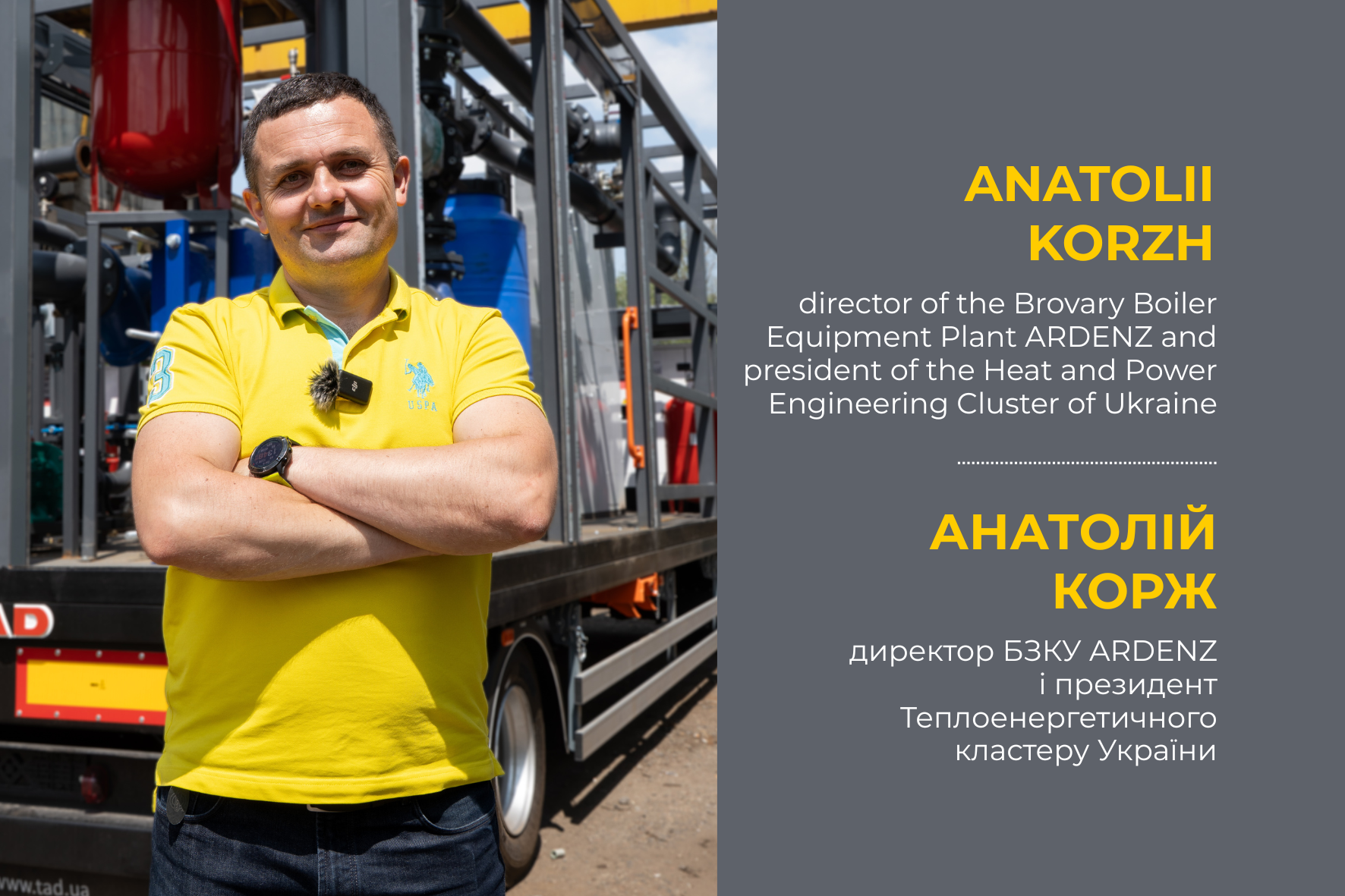
How do you revive a factory when it is easier to import finished equipment? Why can the lowest tender price produce the highest operating costs? And should Ukraine replace district heating with thousands of small boiler houses? We asked ANATOLII KORZH, director of the Brovary Boiler Equipment Plant ARDENZ and president of the Heat and Power Engineering Cluster of Ukraine.
You moved into the heating sector from the automotive business. What made you leave a comfortable, familiar market for a factory that had all but stopped operating?
I trained in vehicle maintenance. I started in sales, later ran the sales department and then the service division of an automotive company. We gradually overhauled the business, and by 2011 the dealership held a strong position in Ukraine’s automotive market.
By 2016, buying, selling and servicing someone else’s product no longer felt enough. I wanted to build something of our own. We were offered the chance to manage a factory in Brovary that was in steep decline. The equipment was outdated, skilled staff were leaving, almost no young people were joining, and wage arrears had piled up for years.
The transition was painful. I went from a bright office with panoramic windows to a cold workshop, where my hands were always dirty and the company could not always afford even my salary. Throughout that first year, I kept asking myself: why am I doing this? The answer came when we began shipping equipment we were proud of and willing to stand behind.
How did you modernise a company with such a long industrial history?
We started with the machinery. You cannot achieve European levels of precision and consistent quality on outdated equipment. We studied how leading manufacturers in Europe and the United States worked, invested in modern metalworking machinery and improved our engineering and production processes.
At the end of 2021, we bought another large site, the former Strila plant. After years of being rented out, the infrastructure was in critical condition: roofs leaked and the utilities needed a complete overhaul. We had barely started planning the modernisation when the full-scale invasion began.
Russian troops were outside Brovary, and only four or five people remained at the plant. Closing the factory was a real possibility. Instead, we kept working wherever possible. The fact that the enemy never reached the city is entirely thanks to Ukraine’s Defence Forces.
Today, our competitive advantage is speed. European manufacturers offer excellent quality, but heavy workloads and more complex procedures often mean longer design and delivery times. Ukrainian manufacturers can move faster, but only if the quality is proven. You need both.
The company’s revenue more than tripled within a year. What changed in your business model?
Before the war, our core business focused primarily on manufacturing boilers. After the first attacks on Ukraine’s energy infrastructure, it became clear that customers no longer needed a boiler – they needed a complete heat source. I had often seen our boilers installed in facilities however, I wasn’t satisfied with the selection of pumps, automation systems, piping, or the quality of maintenance that followed.
That is why we shifted to a comprehensive approach covering the entire project lifecycle – from feasibility studies and engineering design to manufacturing, installation, commissioning, and after-sales service. Customers should receive a fully integrated boiler house with predictable performance, not a collection of components supplied by different vendors, where ultimately no one takes responsibility for the overall result.
The market itself has also changed dramatically. Municipalities and district heating utilities urgently needed backup and decentralized heat sources. We have implemented projects in Kharkiv, Sumy, and Kyiv, and are currently supplying solutions for Lviv. This is not a typical investment cycle. Demand has been driven largely by wartime destruction. Our task, therefore, is not simply to increase production volumes, but to build capabilities that will remain valuable long after the war is over.
Was the project to build 16 mobile boiler houses for Kyiv one of the biggest tests for your team?
Yes. It is a project I am genuinely proud of: diesel-fired emergency boiler houses, each rated at 1.8 MW and financed by Enabel. They can be taken quickly to a hospital or another critical facility, connected to its network and operated independently until the main heat source is restored.
We designed them for demanding conditions. Each unit can be transported on public roads as part of a truck-and-trailer combination at speeds of up to 70 km/h, in line with transport rules. The fuel tanks can be moved while full: while one supplies the boiler house, the other can be refilled or replaced. We even included retractable stairs and handrails, because in a winter emergency such details directly affect staff safety.
During acceptance testing, Kyivteploenergo specialists tested thermal efficiency separately. The minimum requirement was 93%; the measured figure was about 94%. One unit ran continuously for almost two months, confirming the reliability of the design and the soundness of our engineering.
When a boiler house built by our team keeps a hospital warm during an energy crisis, megawatts stop being abstract. The responsibility to those who depend on that heat becomes real. Behind it is the work of designers, technologists, welders, installers, electricians and service engineers. It takes dozens of people to create such a product.
Your solution cost more upfront than the alternative. What justified the difference, and how should customers compare such offers?
Customers should not pay more simply for a brand. But the initial price is only one factor: safety, efficiency, service life, maintainability and total operating costs over the equipment’s life all matter. Two products may meet the same specification yet differ greatly in quality.
Take insulation. The same requirement can be met with materials that have very different properties. Both solutions may comply on paper, yet their actual heat loss, indoor temperature, staff safety and service life may be very different.
The same is true of automation, variable-frequency drives, chassis reliability and ease of maintenance. The lowest purchase price can lead to the highest total cost in use. It is like comparing two cars in the same class: one uses 16 litres per 100 kilometres, the other eight.
We are not trying to be the cheapest supplier at any cost. Our strengths are proven efficiency, safety, high-quality automation, long equipment life, ease of maintenance and responsibility for the final result. Customers should look beyond what appears in a specification and ask how it performs in operation.
Quality has to be measurable and verifiable. That is why the Heat and Power Engineering Cluster of Ukraine, together with manufacturers and engineering companies, drew up guidelines for gas-fired modular boiler houses from 300 kW to 24 MW. Specifications should set functional requirements – efficiency, automation, safety, service life and maintainability – rather than name a brand. That does not restrict competition; it gives everyone the same clear quality criteria.
Financing is another issue. Under international contracts, payment terms and dates are usually predictable once the checks are complete. In public procurement, manufacturers often face payment delays while steel, components and borrowing costs keep rising. If a supplier cuts its price too far simply to win, the project can become loss-making and contract delivery may be put at risk.
How dependent is the Ukrainian market on imported boilers?
In my estimate, imports may account for about 70% of some segments of the industrial boiler market. As Ukraine lost manufacturing capacity, domestic supply narrowed sharply and European brands filled the gap.
Few Ukrainian companies can still produce industrial boilers and complete boiler houses in series; above 10 MW, the number is smaller still.
Technology is only part of the reason. This work requires expensive equipment, a strong engineering base, certification and a long investment cycle, while the market expects quick results. That is why customers often assume from the outset that imported equipment is more reliable.
At the same time, localisation should never mean buying Ukrainian products purely because they are Ukrainian. Domestic equipment must compete on its overall value: price, quality, speed of service and lifecycle cost.
Building high-capacity boilers for municipal and industrial systems is expensive even in Europe. Ukrainian companies can compete by designing, manufacturing and delivering faster.
We have a representative office in Poland and partners in Germany, and we make components for companies in Austria and Estonia. But exports do not begin with an exhibition stand. They begin with certification, local service, reference projects and trust in the brand.
Our next technological step is the serial production and commissioning of boilers rated at up to 20 MW each for large urban heating systems. The first major reference project in this class will open up further opportunities in Europe.
You argue for decentralised heat supply. Does that mean Ukraine should abandon large CHP plants?
No. Treating CHP plants and boiler houses as opposing choices is a mistake. Large heat sources are efficient and should remain part of the system. But no city should depend on one or two facilities whose destruction could leave hundreds of thousands of people without heat.
What we need is a hybrid architecture: CHP plants, district and local boiler houses, cogeneration units, individual heating substations and mobile backup sources connected in one network. In normal conditions, the system would use the most economical configuration; during an attack or major failure, individual districts could switch to backup sources.
Kharkiv, Sumy and other cities have shown that local heat sources can keep supplies running when large generating facilities are damaged. We are providing similar solutions for Lviv. Decentralisation is not about dismantling district heating; it is about removing a single point of failure.
What holds such projects back most: money, regulation or a lack of political will?
All of these factors matter, but the most critical issue is the length of administrative procedures. Connecting a backup gas-fired boiler house requires obtaining technical conditions, resolving land-related issues, completing engineering design, and securing numerous approvals. In peacetime, such procedures may be justified. During wartime, however, communities need a boiler house before the next heating season – not a year later.
Some regulations have already been simplified, but reserve heat sources require a dedicated fast-track framework: technical conditions should either be issued within one or two weeks or accompanied by a justified refusal. Temporary backup facilities should also have a legally defined regulatory regime allowing land procedures to run in parallel with engineering and construction work. Safety and technical requirements must never be weakened. What should be reduced is bureaucratic time.
Another challenge is the lack of coordination between different authorities. A municipality may secure funding for a boiler house but still lack an approved site, access to the gas network, or connection points to the district heating system. As a result, the equipment is delivered, but cannot be commissioned. Resilience begins not with purchasing equipment but with designing the entire heating system.
Recent legislation provides for wider use of individual heating substations. How could this change heating in apartment buildings?
An individual heating substation automatically adjusts heat supply to the outdoor temperature and the building’s needs. With an indirect connection through a heat exchanger, it also hydraulically separates the internal circuit from the external network. Depending on the building and system settings, this can significantly reduce heat use and prevent overheating.
There is an important resilience benefit as well. If a building has a separate circuit and connection points prepared in advance, an emergency boiler house can be connected quickly.
We have developed mobile units rated at 300 kW, 600 kW, 1.2 MW and 1.8 MW. For a single apartment building, depending on its area, heat load and building envelope, smaller units of 150-200 kW may be enough.
If the site, connection points, power supply, fuel arrangements and hydraulic scheme are prepared, a mobile boiler house can be connected within two or three hours. The model could work like emergency generators: a district authority keeps mobile boiler houses ready and sends them to prepared buildings when a failure occurs. It may also make donor funding easier to secure, since international partners are more likely to support municipal or district backup systems than equipment bought directly for private housing.
For now, this remains a concept: no pilot project has yet been completed for an apartment building. It is important to say that openly. The first project is always the hardest. Everyone wants to see a working example, but not everyone is ready to finance it.
Why would a manufacturing executive also lead an industry cluster when its members are, in fact, competitors?
That is precisely why the cluster exists. When a single manufacturer approaches the government, it is naturally perceived as promoting its own commercial interests. When manufacturers, engineering firms, installers, service providers, and legal experts present a common position, that position carries much greater credibility. I joined the Heat and Power Engineering Cluster of Ukraine at the end of 2024. In August 2025, I became a member of its Board, and in March 2026 I was elected President. This is a voluntary position. What motivates me is not the opportunity to increase sales for one factory but the ability to influence industry regulations, engineering education, and export development.
The cluster does not eliminate competition. Instead, it allows competitors to collaborate on technical standards, legislative initiatives, workforce development, export promotion, and other issues that no single company can effectively address alone. One of the greatest shared challenges is the shortage of qualified engineers. Finding an experienced boiler design engineer or thermal engineering specialist has become extremely difficult. We can always purchase another machine tool. What we cannot buy is the expertise required to design a modern boiler – someone who understands thermodynamics, materials science, and real operating conditions. For that reason, together with Igor Sikorsky Kyiv Polytechnic Institute, we launched a scholarship program for students specializing in thermal engineering, and we intend to continue supporting it. People often tell me: “Not all of those students will come to work for ARDENZ.” Of course they won’t. Some will join other companies. Others may simply inspire younger students to choose thermal engineering as a profession. That is an investment not only in our company’s future workforce but in the future of the entire industry.
How do you envision Ukraine’s heating sector after the war?
I hope we do not return to the old model – a single large heat source, aging distribution networks, non-transparent tariffs, and repairs only after failures occur. Ukraine needs a heating system where decisions are based on total lifecycle cost, rather than the lowest procurement price. The future lies in combining centralized generation, local and backup heat sources, Individual Heating Substations, modern metering systems, digital dispatching, and multiple fuel types. Where technically and economically justified, waste heat from industrial processes, cogeneration plants, and local boiler houses should all be integrated into a common district heating network. For Ukrainian manufacturers, this represents a tremendous opportunity – but not a guaranteed market. If domestic companies offer lower-quality equipment under the banner of localization, customers will simply return to imported products. However, if we can consistently deliver European-quality engineering, respond faster than international competitors, and take responsibility for the entire project lifecycle – from design and manufacturing to commissioning and after-sales service – Ukraine can become not only a consumer but also an exporter of advanced heating technologies.
#ARDENZ #HeatEnergy #EnergyResilience #BoilerSystems #UkrainianManufacturing #Infrastructure #UkraineRecovery