
FIDIC IN UKRAINE
INVESTOR CONFIDENCE, AND ITS ROLE IN POST-WAR RECONSTRUCTION
The future reconstruction of Ukraine will require not only resources, but also new rules of the game. Destroyed infrastructure, limited budgets and high risks require standards that guarantee transparency, quality and effective project management. That is why FIDIC international contracts should become a key tool for infrastructure projects in Ukraine.
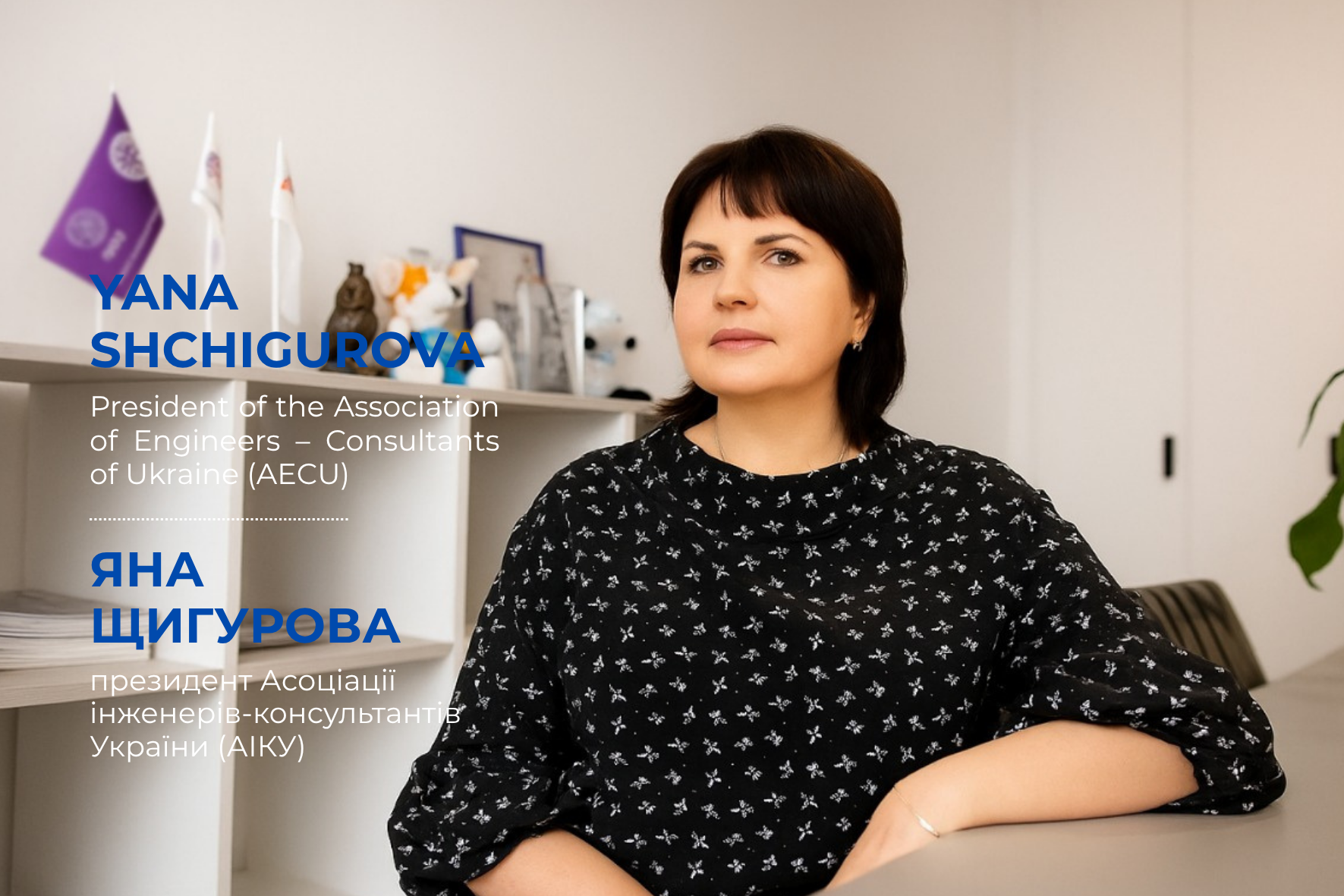
We spoke with YANA SHCHIGUROVA, President of the Association of Engineers – Consultants of Ukraine (AECU), about how FIDIC standards are already changing the Ukrainian market today, what opportunities they open up for future reconstruction, and what barriers still need to be overcome.
Ms. Yana, could you briefly tell us about the Association of Engineers – Consultants of Ukraine? What role does it play in the Ukrainian market?
AECU was established as a platform for the development of the engineer–consultant profession in Ukraine and the introduction of international standards in the field of construction. Simply put, we bring together consulting companies and specialists who are responsible for quality project management, technical supervision, contracting, risk planning, and transparency in the implementation of infrastructure programs.
Our mission is not only to train professionals, but also to create an ecosystem in Ukraine where engineers-consultants are neutral, competent, and influential participants in construction. This is the key to ensuring that projects are implemented on time, within budget, and in accordance with international rules.
What does it mean to be the official representative of FIDIC in Ukraine? What opportunities and obligations does this entail?
The status of an official national member of FIDIC is not just a matter of prestige. It is a responsibility to promote international practices, certification of specialists, training, participation in policy development and even influence on the formation of industry standards.
Being a FIDIC representative means having direct access to global practices: contract terms, ethical standards, engineering methodologies, and recommendations for public procurement. This is critically important for Ukraine, especially during a period of major reconstruction.
How actively are Ukrainian companies integrating into the international community of engineers–consultants?
Over the past two years, we have witnessed a real breakthrough. Whereas FIDIC used to be perceived as something “specifically for donor projects”, Ukrainian businesses now understand that without international standards, they simply cannot be competitive in the global economy and in the post-war reconstruction system.
Integration is happening gradually: there are active leaders who work on international projects and get certified, and many gain experience through donor contracts (EBRD, World Bank, etc.).
However, the presence is still uneven – many companies do not yet have systematic international practices or certified specialists. Coordination, training and state support are needed to transform isolated successes into systematic integration.
FIDIC is not only the “Red” and “Yellow” Books. How would you describe this philosophy in the Ukrainian context?
The philosophy of FIDIC is about a level playing field, clear responsibilities for all parties, and effective risk management. In the Ukrainian context, this sounds extremely relevant, as we strive to move away from manual control, subjectivity, and “traditional” approaches that often slow down construction.
FIDIC is not just contract texts, but a culture of procedural discipline: a clear division of roles, transparent responsibility, systematic change and risk management, early problem prevention (early warning), and procedural pathways for dispute resolution. In the Ukrainian context, this means moving from ad hoc decisions to predictable, well-documented processes that increase investor confidence and reduce risks for all parties.
What are the advantages of using FIDIC contracts compared to traditional Ukrainian approaches?
FIDIC provides a standardized framework for contract management: a transparent procedure for changing scope or prices, a formalized claims-management process, the role of an independent engineer / consultant, and effective dispute-resolution mechanisms. This reduces uncertainty, shortens the duration of conflicts, increases the attractiveness of projects for international financiers, and facilitates the mobilization of private capital. In essence, it is a tool that enables building faster, with higher quality, and with stronger financial discipline.
Which elements of FIDIC enhance transparency and trust in infrastructure projects?
The key elements include: clearly defined roles (Employer, Engineer, Contractor), strict documentation requirements (logs, records, claims register), early warning mechanisms and procedures for contract changes, as well as the use of Dispute Boards / adjudication as a fast tool for resolving disputes. Together, these create a predictable decision-making process and reduce the likelihood of escalation into lengthy court proceedings.
Additionally:
standardized reporting and work acceptance procedures;
a clear decision-making schedule that prevents delays;
a transparent financial model.
These elements provide the level of trust required by the international market.
How ready are businesses and clients today for the systematic implementation of FIDIC?
Readiness varies: large players and international operators have already adapted or are ready to work under FIDIC; medium and small companies are still in the process of learning. State clients are partially ready – especially in projects with international financing – but institutional changes and staff training are needed to apply the standards systematically.
What barriers need to be overcome for FIDIC to become the standard for the domestic market?
The main barriers are: legislative inconsistencies (public procurement and budget rules), a shortage of certified specialists, the absence of national Particular Conditions and official templates, and judicial and audit practices that do not always understand FIDIC.
There is also a cultural barrier – the resistance of “old” approaches, where decisions were made not according to rules, but “as agreed.”
To address these issues, a combination of legal reforms, systematic training, the creation of methodological centers, and pilot projects in the public sector is required. Support from the government also remains a crucial component.
Which countries can serve as examples for Ukraine in implementing FIDIC standards? For instance, Poland, Lithuania, Romania, the Balkan countries – what aspects of their experience should be adopted?
We learn a lot from Poland, Lithuania, Romania, and the Western Balkan countries. These are countries where the use of FIDIC has become significant and from which there is much to learn.
For example, in Poland, FIDIC standards are widely applied in public and international projects, but they are almost always adapted to national law and the client’s position; the key point is the ability to balance international conditions with local requirements (contractual “insertions” from the client, active claims-management practice). They adapted FIDIC to their state procedures – and did so very successfully.
Lithuania demonstrates a high level of professionalization of public procurers, as well as systematic approaches to preparing tender documentation and training staff (OECD / national upskilling reforms in the field of public procurement). This indicates that FIDIC works better in environments with well-qualified contract management personnel.
In Romania, for example, there is successful experience in applying FIDIC forms in road construction; the key lesson is that standard forms are well suited for large infrastructure projects, but they require practical preparedness of the parties and the ability to work with addenda / claims.
The Balkan countries (Serbia, Croatia, etc.) have extensive experience in applying FIDIC in projects financed by international banks; useful practices here include the establishment of dispute resolution procedures (DB / adjudication) and multi-party risk-management mechanisms.
As for what should be adopted (specifically), these include clear rules on price indexation, force majeure, and modification of contract conditions (the Polish experience demonstrates the need for flexible mechanisms during economic fluctuations). Additionally, the introduction of fast dispute-resolution mechanisms (Dispute Boards / adjudication), which have proven effective in projects financed by the IBRD/EBRD.
What is the main difference between Ukrainian construction practices and those in Europe, and how does FIDIC help overcome it?
The difference lies in management culture (more administrative decisions, less proceduralism), a weak habit of documenting and managing claims systematically. FIDIC unifies procedures, introduces documentation standards and roles, which makes processes more predictable and similar to European practices, thus contributing to the elimination of these gaps.
FIDIC changes this logic:
everything is planned before the start;
risks are identified immediately;
changes are implemented transparently;
decision-making is documented.
This disciplines all participants and brings the Ukrainian market closer to European standards.
What changes are needed in legislation or procedures for FIDIC to function fully?
It is necessary to allow the use of FIDIC in public contracts with the relevant Particular Conditions; to establish legal mechanisms for indexation and price adjustment; to recognise Dispute Boards / adjudication mechanisms; to provide methodological guidelines for public customers; to ensure regulatory support for certification and documentation.
In addition, regulate the compatibility of FIDIC with the Law on Public Procurement – allow FIDIC to be used as the main form in public contracts with the possibility of reasonable adaptations, without blocking the mechanisms for agreeing on changes. (Experience of Poland / Lithuania: the application of FIDIC in public projects requires clear integration with national procurement rules).
There should also be legal consolidation of price indexation and force majeure/cost adjustment mechanisms in public contracts to avoid a de facto prohibition on adjustments in case of serious macroeconomic changes; improvement of qualifications and certification
of customers’ personnel (mandatory training programs for employees who prepare tender documentation and accompany FIDIC contracts).
Changing document flow and evidence archiving practices – standards for drawing up acts, work logs, change orders, etc. (FIDIC is very strict about documentation).
In short: what is needed is both legal adaptation (so that FIDIC does not conflict with public law) and institutional transformation (training, unified templates, DB / adjudication).
Will FIDIC become a “common language” for Ukraine’s infrastructure sector?
I believe it will. We are already moving in this direction: the state, businesses, and international partners are gradually transitioning to a unified system of rules.
FIDIC is the universal language of the engineering and construction world. When everyone speaks the same terminology, processes become faster and risks become lower.
What are the biggest obstacles currently hindering the implementation of FIDIC in public and municipal projects?
Briefly: (1) legislative restrictions and the unregulated status of DAAB; (2) low level of training among clients; (3) lack of official templates and National Particular Conditions; (4) judicial and audit practices that do not always take FIDIC into account; (5) lack of certified engineers and financial constraints. It is a complex combination of legal, institutional, and cultural barriers.
Top obstacles to implementing FIDIC in Ukraine:
1. The mismatch between Ukrainian legislation and FIDIC requirements.
The Law on Public Procurement restricts price adjustments and deadline extensions, while FIDIC is based on a flexible change-management model. There is no clear legal status for Dispute Boards (DAAB), so the early dispute-resolution mechanism does not function. Budget legislation often does not allow indexation, cost adjustments or advance payments in the format required by FIDIC.
Consequence: FIDIC contracts are “forced” to fit Ukrainian regulations, which makes them lose their effectiveness.
2. Low level of preparedness among public contracting authorities.
There is a lack of qualified engineers, contract managers, and claims specialists. Contracting authorities simply do not have enough people who understand how FIDIC procedures work (early warning, claims management, variations, etc.). Decisions are made “administratively” rather than procedurally, as FIDIC requires.
Consequence: documentation is prepared incorrectly, and contract management becomes chaotic.
3. Lack of standard documents and national Particular Conditions.
Each contracting authority “creates its own version” of FIDIC, often inconsistent or legally incorrect. There are no official templates of the Red / Yellow / Silver Book for public and municipal projects. Technical specifications are outdated and not aligned with the FIDIC philosophy.
Consequence: high dispute risks, increased costs, and contractors’ reluctance to accept the terms.
4. Ukrainian judicial and control practices are not adapted to FIDIC. Judges are often unfamiliar with the nature of FIDIC contracts, their procedural nature and logic. State auditors may interpret FIDIC procedures as ‘violations’ because they do not fit into the usual norms. Control acts often contradict international contract logic. Consequence: contracting authorities are afraid to use FIDIC for fear of problems with audits or law-enforcement bodies.
5. Cultural barrier: the Ukrainian management model ≠ the FIDIC model. In public projects, the dominant approach is “the client controls everything,” rather than “the engineer–consultant manages the process independently.” Contract discipline is weak: decisions are delayed, documentation is inconsistent, and risk management is underdeveloped. The prevailing logic is often “we’ll sort it out somehow,” rather than “procedures and written records.”
Consequence: FIDIC requires strict procedures and thorough documentation — current practice contradicts this. Insufficient availability of specialists with hands-on experience working exclusively under FIDIC contracts.
6. Unfortunately, Ukraine has a very limited number of experienced FIDIC engineers, Dispute Board (DB) members, and contract managers. Most companies lack practical experience with international contracts, including FIDIC. At the same time, FIDIC is precisely the standard set of contract documents under which all major projects are implemented, primarily financed by IFIs.
Consequence: clients are unable to properly appoint consulting engineers, and contractors are unable to fully and correctly perform their contractual obligations.
7. Financial and budgetary constraints. FIDIC often requires risk reserves, funding for the DAAB, and insurance guarantees. In the public sector, such expenses are often not budgeted or approved by financial oversight bodies. Consequence: Contracts are “cut down” and simplified, undermining the advantages of using FIDIC.
In other words, FIDIC is facing not a single obstacle but an entire set of barriers: legal, institutional, cultural, market-related and financial. Until these issues are resolved systematically, FIDIC will function only partially or formally in public and municipal projects.
How ready are the government and businesses to abandon old approaches and adopt international standards?
There are segments that are already prepared: large companies, international contractors and part of donor-funded projects already work under FIDIC. The public sector is showing interest, but conservatism and internal regulatory requirements slow down the transition. The transition requires leadership at the ministerial level, pilot cases, and guarantees from international financial institutions.
How does AECU plan to expand cooperation with FIDIC, the EBRD, and the World Bank in the context of Ukraine’s reconstruction?
We are working in three key areas:
1. Training and certification of specialists – joint educational programs, training courses, and examinations.
2. Adaptation of contract terms to Ukrainian realities – joint work on guidelines and recommendations.
3. Institutional support for the state – consultations, expert groups, pilot projects, and the integration of FIDIC into reconstruction programs.
Overall, Ukraine has a chance to become one of the most advanced infrastructure systems in Europe – and our partners are aware of this.
#FIDIC #UkraineRecovery #Infrastructure #Investment #Construction #ProjectManagement #EngineeringConsulting