WORKING AGAINST THE ODDS AS A STRATEGY IN A TURBULENT ECONOMY
The full-scale war became not just a crisis for Ukrainian manufacturers, but a true stress test of resilience. For 2D Group – one of Ukraine’s largest producers of insulated glass units and glazing solutions – it meant not shutting down, but restarting.
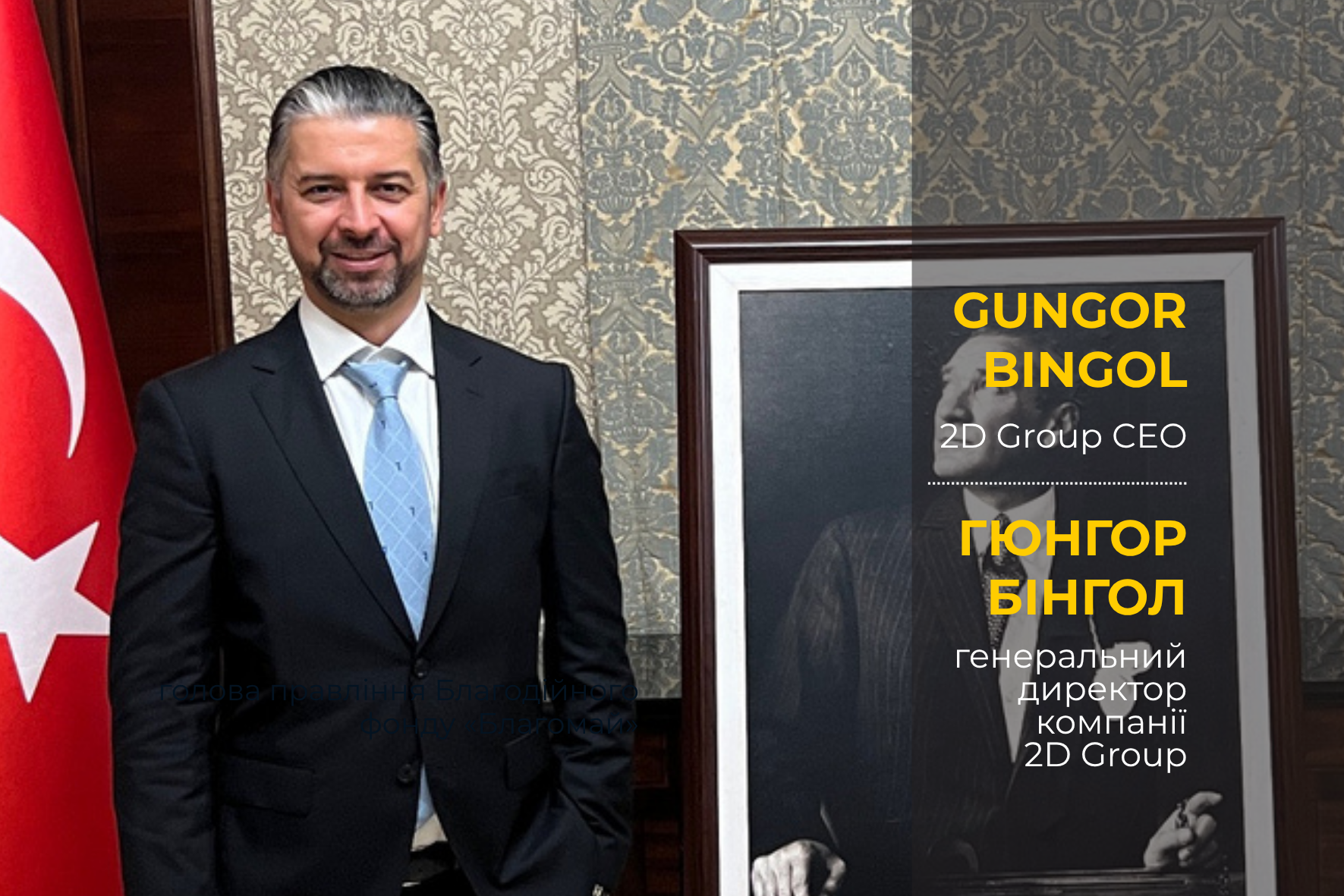
In a conversation with 2D Group’s CEO GUNGOR BINGOL, we discuss short-term planning in a long war, glass inventories as a strategic advantage, and investments built not only on profitability, but also on belief.
ABOUT BUSINESS IN TURBULENCE
How did the full-scale war change your business model – strategically, not just operationally?
We resumed operations already in mid-April 2022 – and haven’t stopped since. The strategy was brutally honest: those who wanted to stay, stayed. If someone chose to move to a safer region, we didn’t hold them back. It was a personal decision. On the contrary, we helped with relocation and guaranteed their job upon return.
What changed the most was planning. Before, we worked with horizons of one, three, or five years. Today, we often plan day by day. That’s not an exaggeration – it’s the reality of a wartime economy. And it’s a constant challenge for management.
The management model also transformed. Hierarchy became conditional. In the first months, everyone did whatever was needed – no division between “my responsibility” and “not mine.” There was especially intense work in the de-occupied areas of Kyiv region. Decisions had to be made fast, with immediate ownership of responsibility.
What decisions had to be made immediately, and which were revisited systematically?
One of our key advantages turned out to be a broad portfolio of standard projects and our own reserves. Until 2022, the main suppliers of float glass to Ukraine were russia and belarus – that’s a fact. When imports stopped, the market was left in a vacuum.
We had around 600 thousand square meters of glass in storage. That allowed us to respond to demand immediately, without pauses to rebuild logistics. Only afterward did we start systematically constructing new supply chains.
The tougher decisions concerned production capacity. Out of our three plants – in Kyiv, Bila Tserkva, and Sumy – we were forced to “freeze” the Bila Tserkva facility due to market decline. The plant in Sumy operates below full capacity because of security risks, but we deliberately continue to support the team there. In these conditions, the human factor becomes decisive.
ON MANUFACTURING AND COMPETITIVENESS
Is Ukrainian manufacturing today about survival – or about competition?
Today it’s about living in both realities at the same time. Survival is the baseline. But if you don’t think about competitiveness, you simply won’t live long enough to reach the postwar market.
The market is setting new demands: energy efficiency, safety, speed of installation. We’re responding technologically – modernizing production lines, developing solutions for complex glazing, and investing in energy independence.
For example, since October 2025, all of our facilities have been fully equipped with generators. This isn’t an option – it’s a condition for uninterrupted operations. In a wartime economy, a manufacturer that doesn’t control its energy supply doesn’t control anything.
Where is the biggest risk for manufacturers today?
The biggest risk is security. We can talk for a long time about logistics, supply disruptions, price volatility, energy issues, or labour shortages – all of these are difficult, but manageable. Businesses have learned to work with alternative routes, diversify suppliers, invest in generators, and build operational autonomy.
But there is one factor that no financial or operational planning can control – the war itself.
No one can guarantee that a missile or drone won’t hit your factory tomorrow. And it is precisely this uncertainty that represents the greatest risk for any manufacturer in Ukraine.
As for staffing, the challenge runs deeper than simple shortages. The issue isn’t only whether specialists exist in the market – it’s what value you, as an employer, are ready to offer. This includes salary levels, working conditions, and corporate culture.
People stay where they are respected, where promises are kept, and where they feel stability even in unstable times. In wartime, human capital becomes not just a resource – it becomes the foundation of business resilience.
ON INVESTMENT AND TRUST
What defines an investment decision today: numbers or belief?
I’m a realist, and as a manufacturer I understand well that business cannot exist on emotions alone. But in today’s Ukraine, numbers by themselves are not enough. Every investment decision here contains an element of belief – in the country, in people, in the future.
I am not a citizen of Ukraine, but I am its patriot. I have lived and worked here for many years, and for me this is not just a market – it is an environment where I see both potential and the meaning in long-term commitment.
So today an investment decision is a balance. It is sober calculation combined with the willingness to look several years ahead. We are ready to wait. And we are confident that those who endure now will emerge stronger under any future market conditions.
How has partners’ trust changed?
We have been operating in the Ukrainian market since 2004. We run a modern, fully automated facility for the production and processing of construction, architectural, and decorative glass, with a capacity of over 30,000 m². Our products are present in every region of Ukraine and abroad — and behind every single project stands trust.
Partners now choose not just a supplier, but a company that will meet its commitments regardless of circumstances: power outages, logistical disruptions, or security risks. We guarantee quality at a fair price – and this is a principle, not a slogan.
For us, one thing matters most: if we enter a project, we finish it. Even when it is economically difficult or unprofitable. Because in the long run, reputation always weighs more than margin.
KEY TAKEAWAY
2D Group is living through the war not as a pause, but as a phase of transformation. Short-term planning, tough decisions, energy autonomy, and preserving the team are no longer just crisis measures – they form a new business model.
You can’t build a business on calculations alone. There has to be an inner foundation: belief in the country, in people, and in your own mission. The war has shown that no strategy survives reality if it isn’t backed by the ability to adapt quickly and take responsibility.
We realized that flexibility matters more than scale, people matter more than equipment, and reputation is worth more than short-term profit. In the Ukrainian market, this is a currency no less important than money.
For those who are only considering investing in Ukrainian manufacturing, I would offer three pieces of advice: First – think long term. Ukraine is not a market for quick returns; it is a market for strategic presence. Second — build a team, not just a structure. People are the key asset in a crisis.
Third – be ready for turbulence, but don’t be afraid of it. Because it is in turbulence that the strongest companies are forged.
There is no perfect moment for investment. There is only the willingness to take responsibility and act amid uncertainty. The war has taught us to distinguish very quickly between what is critical and what is secondary. Plans can collapse overnight – but if the team, reputation, and discipline remain intact, the business will endure.
After Victory, Ukraine will face massive demand for high-quality manufacturing. And those who stayed and kept working through the hardest years will gain not only an economic advantage, but also the moral right to call themselves part of this story.
#2DGroup #Manufacturing #GlassIndustry #Construction #Investment #BusinessResilience #Ukraine