
VETERAN ENTREPRENEURSHIP
IS NOT SOCIAL ASSISTANCE – IT IS UKRAINE’S NEW ECONOMY
According to recent surveys, 65% of military personnel dream of starting their own business after returning home from the front. At the same time, only about half of all veterans return to their previous jobs. Today, Ukraine is home to approximately 1.8 million veterans and more than 180,000 people living with war-related disabilities. This represents not only a major challenge for the state but also a significant opportunity for economic development.
That is why supporting veteran entrepreneurship is increasingly becoming an economic priority rather than merely a matter of social policy. The Verkhovna Rada recently adopted the Law on Veteran Entrepreneurship, and according to the Ministry of Veterans Affairs, veteranowned businesses are already returning three times more to the state in taxes than they have received in grants.
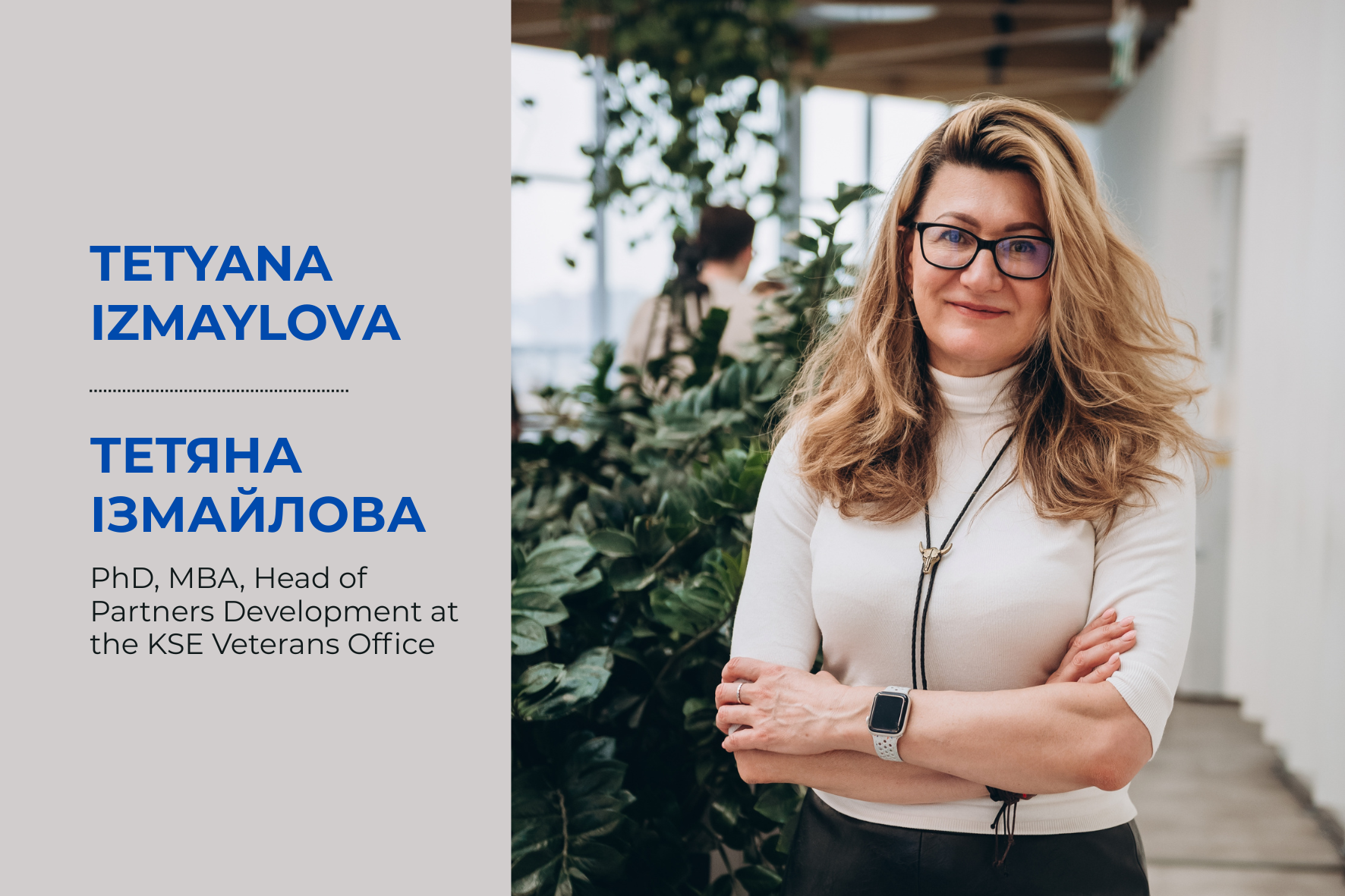
TETYANA IZMAYLOVA, PhD, MBA, Head of Partners Development at the KSE Veterans Office, discusses educational programs for veterans and the development of veteran entrepreneurship in Ukraine.
What kinds of business ideas do veterans most oftenbring to the program?
Small business is the backbone of the economy. Most veterans come to the program with ideas for family businesses or small enterprises they plan to build together with their fellow servicemen and servicewomen. The most common sectors include manufacturing, agriculture, services, and the creative industries.
Veterans are eager to create tangible products and services with high added value, often focusing on import substitution, security, and Ukraine’s reconstruction. Values are at the core of these businesses. They establish companies that solve real societal challenges rather than simply generate profit.
How often do veterans come to the program with analready developed business model?
We work with two types of participants. The first group consists of «Beginners» who come with a business idea. Thanks to our selection process, those admitted to the program already have ideas that have been developed to a certain extent.
The second group is made up of «Experienced» entrepreneurs – owners of existing businesses who are looking to scale and expand their operations. For those who have not yet had the opportunity to fully develop their business concept, the KSE Veterans Office has created a range of supporting resources, including video materials, lectures, practical guidelines, and additional online sessions.
What proves to be the biggest challenge for veteransat the start?
A military mindset is actually an advantage. It instils discipline and helps people operate under pressure. The MIT model, “24 Steps to Disciplined Entrepreneurship,” combines disciplined execution with calculated risk-taking – a way of thinking that resonates strongly with veterans.
One of the biggest surprises for me was hearing participants describe the program as the best form of psychological therapy. When veterans learn alongside peers, openly share their experiences, and work on their own business ideas, new partnerships, opportunities, and a renewed sense of purpose naturally emerge.
For many participants, however, access to financing remains the greatest challenge. Developing a realistic project budget is often the moment when they truly understand whether an idea is commercially viable and capable of generating sustainable profits over the coming years.
How do participants’ business ideas evolve over thethree-month program?
Their ideas become significantly more grounded and marketoriented. At the beginning, many concepts are ambitious and driven largely by enthusiasm. By the end of the program, they have been refined into clearly defined products with identified target customers, validated business models, sound financial projections, and practical go-to-market plans. Most importantly, participants learn to focus on what actually works. That ability to prioritize and maintain focus is one of the most essential skills for any entrepreneur.
What are the most common mistakes veterans makewhen starting their own businesses?
The most common misconception is that securing funding is the first priority. In reality, entrepreneurs need to start by understanding their customers, defining a compelling value proposition, and validating their product-market fit. The first question should not be «What are we building?» but rather «Why are we building it?» Establishing a clear mission, developing a sound strategy, and creating realistic financial, sales, and operational plans are the essential first steps.
The most common mistakes include:
• Focusing on the product rather than the customer.
• Underestimating the importance of sales and marketing.
• Neglecting financial planning.
• Launching with an overly broad product portfolio.
• Assuming that a great product will sell itself.
How important are mentors and expert guidance toparticipants throughout the program?
They are absolutely essential. For many veterans, mentors become the most valuable part of the program. They help participants avoid common mistakes, challenge their assumptions with difficult questions, and give them the confidence to move forward. In many cases, these mentoring relationships evolve into long-term partnerships, and graduates from previous cohorts often return as mentors themselves.
Is there a difference between traditional businesseducation and programs designed for veterans andservice members?
Veterans are an exceptionally committed and highly motivated audience. They are disciplined, accustomed to operating under uncertainty, and driven by a strong sense of purpose. That is why our programs place particular emphasis on practical application – rapid idea validation, hands-on assignments, and continuous feedback throughout the learning process.
Why was it important for the program to combineeducation, mentoring, and grant funding into a singleecosystem?
Because funding without knowledge rarely leads to sustainable results, while education without access to capital often remains purely theoretical. An integrated approach works differently.
Veterans develop their entrepreneurial skills, test and refine their ideas, receive expert feedback, and pitch their projects. The strongest proposals are then awarded the financial resources needed to launch or scale their businesses.
Would you say veterans are shaping a new generationof Ukrainian entrepreneurs?
My dream is for veteran entrepreneurship to become the benchmark for Ukrainian business. Veteran-led companies embody responsibility, the ability to make decisions under pressure, a strong team culture, and values-driven leadership. The most important qualities veterans bring to entrepreneurship – leadership, risk management, adaptability, and genuine care for their teams.
Do you see future leaders of Ukraine’s new economyamong your participants? And how ready is the private sector to partner with veteran-ownedbusinesses?
Absolutely. Even today, some of our graduates have the potential to grow into medium-sized and large enterprises. At the same time, the private sector is becoming increasingly open to partnering with veteran-owned businesses. We are already seeing successful collaborations emerge across manufacturing, logistics, and the service sector.
Veteran-owned businesses are often viewed primarilyas a social initiative. Why is that a misconception?
Because first and foremost, this is about the economy. Veterans create jobs, pay taxes, contribute to regional development, and build competitive companies. The social impact is an important outcome, but the foundation of veteran entrepreneurship is sustainable businesses that compete and succeed on market principles.
Why should support for veteran entrepreneurshipbecome not only a matter of public policy but also astrategic priority for large businesses?
Ukraine is becoming a nation of veterans. Large companies need to start working with veteran-owned businesses as trusted partners. This is not only about corporate social responsibility – it is also about creating a new competitive advantage in Ukraine’s future economy.
What does Ukrainian society still fail to understandabout veterans after they return from the war?
Veterans do not need sympathy – they need respect and meaningful opportunities to build fulfilling civilian lives. They are not a «problem» to be solved, but one of the country’s greatest human assets. Our task is not to reinforce stereotypes or stigma, but to create the conditions that allow veterans to thrive.
What moment in your work with veterans haschanged you the most personally?
The first groups of veterans who joined our entrepreneurship programs back in 2018 changed the course of my own life. When you see people returning from war, building businesses, securing grants, regaining a sense of purpose, and moving forward, it is impossible not to take it personally.
I remember one veteran who, after the final pitch, received UAH 500,000 in funding instead of the full UAH 1 million. His response was: «I’m happy because it means one more of my brothers-in-arms will also get a chance.» To me, those words perfectly capture the essence of the veteran community.
What will be the key measure of success for the“Live towards” program in a few years’ time?
The number of resilient veteran-owned businesses that create jobs, scale successfully, and become an integral part of Ukraine’s economy. Another important indicator will be seeing our graduates return as mentors, supporting the next generation of entrepreneurs.
What legacy should the KSE Veterans Officeleave for Ukraine?
We want to establish a new image of veterans – as a driving force behind Ukraine’s future in business, public life, and leadership. Our goal is to help build an economy that is competitive, values-driven, and resilient. Investing in the development of Ukraine’s defenders is one of the most meaningful investments we can make in the country’s future.
#VeteranBusiness #VeteranEntrepreneurship #KSE #BusinessEducation #Entrepreneurship #UkraineRecovery #Ukraine