
UKRAINE’S FIRST TURKISH BANK
AS A MODEL OF RESILIENT BUSINESS PARTNERSHIP
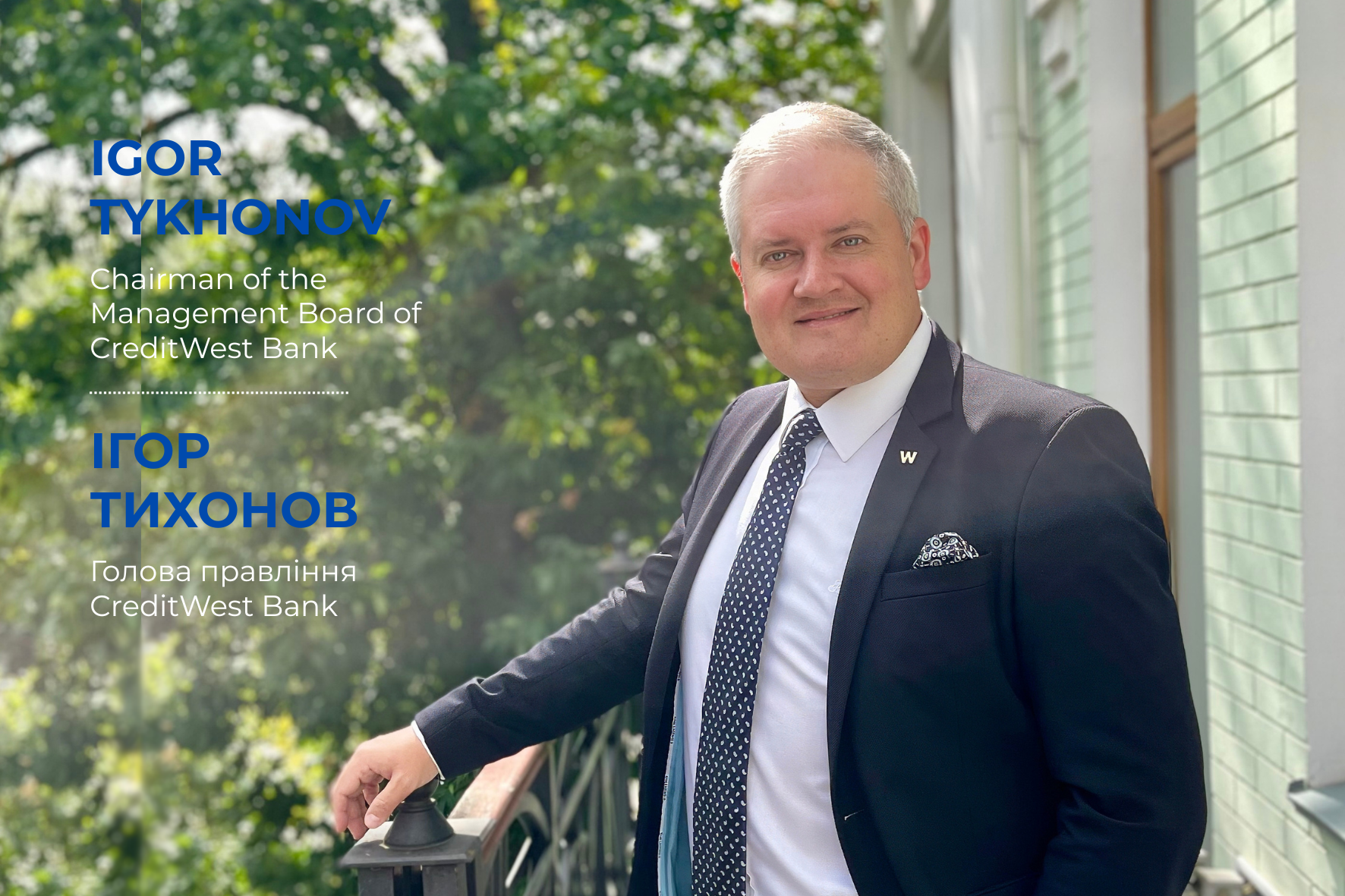
Today, banks operating in Ukraine are no longer just financial intermediaries, but full-fledged business partners that help companies survive, adapt, and grow. CreditWest Bank – the first bank with Turkish capital in Ukraine – has been operating for more than a decade and a half at the intersection of Ukrainian and international business, serving both local entrepreneurs and foreign investors. During the war, this role has become even more significant. In an interview, IGOR TYKHONOV, Chairman of the Management Board of CreditWest Bank, spoke about how the bank builds partnerships with businesses, supports manufacturers and exporters, and prepares for Ukraine’s post-war recovery.
How would you describe the key mission of CreditWest Bank? What is the bank’s main responsibility to Ukrainian business today?
Our key mission is to be not just a financial institution, but a partner for business. CreditWest Bank was established as a universal bank, but over time we realized that real value lies in focus and expertise. That is why we made a strategic choice to serve businesses – primarily small and medium-sized enterprises, as well as corporate clients.
Today, we work with entrepreneurs at all stages of their development – from launch to scaling. For us, a bank is not a “service point,” but a support infrastructure that understands the client’s business model, challenges, and growth potential.
In today’s conditions, the bank’s main responsibility to Ukrainian business is to be a reliable pillar – to support, help ensure stable operations even in crisis conditions, and ultimately contribute to the country’s economic development through entrepreneurship, job creation, and GDP growth.
What challenges became the most serious after February 24, 2022, and how did the bank adapt to wartime operations?
The greatest challenge after February 24, 2022 was uncertainty itself – the need to make decisions when literally everything was changing. At the same time, Ukraine’s banking system approached this moment well prepared. Long before the pandemic, the National Bank introduced business continuity requirements, and since 2017–2018 banks have regularly tested them. During COVID-19, we essentially went through a “rehearsal” of a wartime scenario.
Therefore, on the very first day of the full-scale war, CreditWest Bank immediately activated its business continuity plan. A critical team reported to the office, while the rest of the staff instantly switched to remote work. The bank operated 24/7 without interruptions, providing clients with full access to their accounts and funds.
Our top priority was to fulfill all obligations – to depositors and to businesses. At a time when trust is the most valuable asset, we did everything possible to ensure that clients felt stability and support even in the most difficult days.
What role does CreditWest Bank play in supporting small and medium-sized businesses, especially exporters and manufacturers?
Small and medium-sized businesses – especially manufacturers and exporters – are our strategic priority. Manufacturing forms the backbone of GDP, while exports generate foreign currency inflows that are critically important for the country’s economy, especially during wartime.
CreditWest Bank works systematically with this segment and is an active participant in all key national and municipal business support programs: the “5–7–9” program, Cabinet of Ministers guarantee programs, and regional interest rate compensation initiatives. A special focus is cooperation with the Export Credit Agency of Ukraine. We were among the first to sign the relevant agreements and actively use export contract insurance instruments as collateral for financing.
This allows us to offer businesses effective pre- and post-export financing solutions, reduce risks, and stimulate entry into new markets. In effect, exporters can scale production and turnover while sharing risks with the state.
We are not the largest bank by size, but today we are among the most active participants in ECA programs. This is no coincidence: our typical client is a manufacturer and exporter. We consciously chose this niche and strive to be not just a lender, but a financial partner with deep industry expertise.
Has the bank’s lending portfolio changed during the war? Which sectors became priorities?
Yes, the war significantly changed the structure of our lending portfolio – not toward contraction, but growth. Classical economic theory predicts a decline in lending during wartime, but the Ukrainian banking system has proven far more resilient. Thanks to coordinated efforts by the regulator and state support, banks are not only maintaining activity but expanding their portfolios.
For CreditWest Bank, this period has been one of dynamic development: in 2025 our loan portfolio grew by approximately 45%, and this year we plan an additional 35–40% growth. Essentially, the strongest players remained in the market – businesses that managed to adapt, restructure, and operate under high uncertainty. We build long-term partnerships with such companies.
Priority sectors now include defense and related industries, agriculture, logistics, and transportation. With limited air and maritime connections, rail and road transport has become critical for the economy. Another focus is infrastructure projects, social and residential construction – particularly for internally displaced persons – as well as healthcare, from clinics to rehabilitation centers.
An important trend is the gradual shift away from a raw-material model. Businesses are increasingly investing in processing and value-added production within the country. We systematically support such projects.
ESG is another key focus. We were among the first in Ukraine to develop a sustainable development strategy and now assess businesses not only by financial indicators, but also through environmental responsibility, social impact, and job creation. Companies that share or move toward these principles are a priority for us.
Do you see new demand from entrepreneurs – for working capital, relocation, investments? What has changed most noticeably?
Yes, business demand has changed significantly. For many companies, relocation became one of the most urgent issues. Businesses located near combat zones relocate production or offices to safer regions at the first opportunity. Typically, loans are not taken specifically for relocation, as decisions must be made quickly, so companies use their own resources or existing credit lines.
However, after relocation, liquidity gaps arise. Businesses need to restore operations, pay salaries, and rebuild supply chains. Demand for working capital has therefore increased sharply, and banks play a key role in stabilizing these processes.
We see growing interest in fast and flexible financial instruments, particularly overdrafts. Businesses need access to “short money” – to fulfill contracts or bridge expected inflows. Funds may arrive in a week or two, but financing is needed today. Such solutions help companies maintain operational momentum even under difficult conditions.
Which financial instruments proved most effective for businesses during wartime?
During wartime, businesses operate in a constant adaptation mode. Sales markets, supply chains, counterparties, and logistics have changed – many companies had to rebuild their business models in a very short time. Under such conditions, accessible and predictable financial support became the key to survival and growth.
The most effective tools have been state and municipal business support programs, especially interest rate compensation schemes. They significantly reduce the financial burden on entrepreneurs and make lending viable even during the war.
Thanks to these programs, businesses can quickly reorient, sign new contracts, invest in working capital, and maintain operational stability. For banks, this is also an effective partnership tool, where financing becomes not just a loan but part of a systemic effort to support the national economy.
How does the bank manage risk in an economy experiencing extreme turbulence?
In periods of high turbulence, risk management becomes the bank’s main pillar. Ukraine’s banking system built its risk management framework over many years, following best international practices, and today it proves its effectiveness. However, in wartime, dry figures, scoring models, and ratios are no longer sufficient.
We pay much greater attention to business quality and the people behind it. It is critical for us to understand the company’s owner and management: how they think, what strategy they pursue, how cash flows are structured, and who their partners are. Live communication with the owner often provides more insight than any financial model.
When you see an entrepreneur for whom the business is a life’s work and personal responsibility, it is one of the strongest arguments for cooperation. Conversely, even a formally “ideal” borrower may turn out weak if the business is merely a passive asset without long-term vision.
Our experience shows that more than half of a company’s success – and loan repayment – depends on the owner, management team, and their attitude. In a wartime economy, this matters no less, and sometimes more, than financial indicators.
What does “resilience of the banking system” mean today, and how does CreditWest Bank ensure it? How has client behavior changed?
Today, banking system resilience is not an abstract concept, but the ability to operate continuously even under the most extreme conditions. Its foundation was laid by decisive and timely actions of the National Bank from the first days of the full-scale war. Thanks to strict supervision, the system avoided defaults, maintained liquidity, and proved its viability. The fact that banks have been paying increased profit taxes for several consecutive years is direct evidence of sector stability.
For CreditWest Bank, resilience means uninterrupted service for clients. We invested in infrastructure in advance: participation in Power Banking, backup generators, Starlink, battery systems, and cloud solutions. This allows clients to work with the bank 24/7 regardless of circumstances or location.
The war did not destroy trust – it strengthened it. After a brief period of panic at the beginning of the invasion, funds returned to the system, and clients saw that banks operate, payments go through, and branches reopen. Today, in the fifth year of the full-scale war, trust continues to grow.
We deliberately build relationships with businesses that value reputation and long-term partnership. CreditWest Bank’s philosophy is simple: we do not close the umbrella over a client when it rains. True banking reveals itself in crisis – when the bank stays close and helps overcome challenges together.
Can war become a catalyst for banking innovation? What technologies is CreditWest Bank working on now?
Absolutely. Any crisis – especially war – becomes a catalyst for change. Strong organizations see such periods not only as challenges but as windows of opportunity. That is how we view the current situation.
Over the past two years, CreditWest Bank has achieved more in digitalization and automation than in its entire previous history. We deliberately invested in technology – from fully remote account opening and servicing for individuals and businesses to cloud solutions and backup systems. Our goal is maximum independence from physical location and flexibility for clients and staff under any conditions.
A separate focus is artificial intelligence. We began implementing it about two years ago and found that many routine processes can be automated. This is not about staff reduction, but about freeing time for deeper analysis, skill development, and improved quality of work. Human oversight, expertise, and responsibility remain essential – but why do manually what a system can do more efficiently?
For us, innovation is also about people. We firmly believe that employee well-being, balance, and motivation directly determine the bank’s resilience and future. Thus, despite its hardships, the war has already become a powerful driver of banking’s transition to a more digital and technological phase.
What new products or services does the bank plan to launch to support entrepreneurs in the near future?
In 2025–2026, we are focusing on speed, convenience, and full digitalization of business services. One key product we plan to launch soon is online account opening for legal entities without physical client presence. For sole proprietors and individuals, this is already standard, but for companies it remains a new and complex product – and we want to be among the first to implement it fully.
Another important direction is fast credit decision-making. We developed our own scoring model compliant with Ukrainian legislation and the bank’s risk appetite. Today, using only a company’s registration code, we can obtain a preliminary credit decision within seconds, assess strengths and weaknesses, and analyze key financial indicators. This is made possible by the use of open government data officially permitted by the regulator.
For businesses, this is crucial: in many cases, financing is needed “here and now.” Our task is to give entrepreneurs access to funds exactly when they generate results, not when they get lost in lengthy procedures.
CreditWest Bank is a bank with Turkish capital. Has the war affected Turkish investors’ interest in Ukraine?
The war has not reduced Turkish investors’ interest in Ukraine – rather, it has become more conscious and strategic. Turkey and Ukraine have long shared the same economic and trade space, with close ties and mutual interest. Ukraine has always been and remains important for Turkish business.
Our shareholders have supported CreditWest Bank since the bank's first day of operation in Ukraine, and after February 24, 2022, they even strengthened this support. We share a common vision and already view the post-war period as a window of new opportunities – for the bank and for Ukraine’s economy as a whole.
Importantly, many Turkish businesses operating in Ukraine before the war have not left the market and continue to develop. This is a strong signal of trust. We also feel support from international financial institutions. We have long cooperated with the Black Sea Trade and Development Bank, which maintained support during the war, as well as the European Investment Bank, which provided additional financing after the full-scale invasion began.
All this shows that international partners see Ukraine’s potential, believe in its recovery, and are ready to invest even in the most difficult times.
Does the bank implement social or humanitarian initiatives?
Yes, social and humanitarian responsibility is an important part of our work, especially during wartime. We understand that the country is going through one of the most difficult trials in its history and try to support where we can be most useful.
The bank actively cooperates with universities, implementing student adaptation and employment programs, and finances five education grants for talented youth who cannot afford tuition. Another focus is financial education: our specialists regularly give lectures at universities and schools to improve financial literacy.
At the same time, CreditWest Bank supports the Armed Forces of Ukraine and medical institutions, including the Kyiv Military Hospital, assisting with equipment, renovations, and new treatment facilities. We also support youth sports, client initiatives, and internal social programs for our team.
For us, this is not a set of isolated projects, but a systemic approach: being a responsible business that invests not only in the economy, but also in people and the country’s future.
What was the most important management decision you made after the war began?
The most important decision for me was to preserve the bank and the team. I built this team over many years, assembling it piece by piece since 2009. The idea of layoffs, especially forced ones, was extremely painful. I did everything possible as a leader to retain people, preserve expertise, and maintain team spirit. In a crisis, people are the main pillar of any financial institution, and I sincerely believe we managed to preserve one of the strongest teams in Ukraine’s banking system.
What personally motivates you most to continue working in Ukraine now?
I am motivated by a sense of responsibility – to shareholders for the bank’s capital, to clients for their funds and access to financing, to employees for stable work, decent conditions, and confidence in tomorrow. Through them, I also feel responsibility toward their families.
I am responsible for my own family and parents whom I care for. In such times, this is not just a job – it is a conscious choice to stay, work, and make the bank stronger every day. That is my main motivation to remain in Ukraine now.
How has your view of risk, responsibility, and leadership changed during the war?
The war radically changed our perception of risk. Before February 24, 2022, we mostly discussed financial and market risks. Afterward, new risks emerged: physical safety, military actions, loss of territories and collateral, power outages, staff shortages. Today, operational and technological risk has become the top priority.
At the same time, responsibility – personal, corporate, and social – has grown significantly. Responsibility to clients, teams, partners, and the state is no longer abstract, but a daily practice.
As for leadership, in wartime being just a manager is not enough. One must be a leader who takes personal responsibility and leads by example. At the beginning of the invasion, I essentially lived in the bank for a month and a half to control all processes and ensure we would endure. For me, this is not only a managerial function – it is a life mission.
Which quality do you value most in your team today – and why is it critical now?
Above all, I value commitment and humanity. During war, professional skills are important, but they can be developed. Values cannot. For me, it matters what a person lives by, their life priorities, their attitude toward family, people, and the country.
We are a mid-sized bank, and a healthy internal climate is critical. The team must function as a community – almost like a family – with trust, support, and the ability to go through difficult times together. Conflicts happen everywhere, but the key is the ability to negotiate and find solutions rather than enemies.
That is why humanity, social maturity, and positive thinking are critical today. In difficult times, those who preserve inner resilience and mutual respect are the ones who win.
How do you see CreditWest Bank in post-war Ukraine? And how do you see Ukrainian business after the war?
Ukrainian business that has gone through the war will emerge extremely strong – companies with unique stress resilience, capable of operating under any turbulence. These will be businesses hardened by crises and responsibility.
CreditWest Bank will walk this path together with its clients. Today, we are already a resilient and balanced bank with a high-quality loan portfolio, which we intend to preserve throughout the war without compromising standards. In the post-war period, we see broad opportunities ahead and do not rule out a transition from a cautious model to more active expansion.
Major reconstruction projects lie ahead, and we plan to be an active financial partner in this transformation. This is our economic front. Ukraine is our home – our families live here, and this is where we see our future and the future of the bank.
#CreditWestBank #Banking #BusinessFinance #Investment #Exports #Business #UkraineRecovery