
TRANSPARENCY AS THE LANGUAGE OF TRUST
DIGITAL GOVERNMENT, INTEGRITY, AND PREDICTABLE RULES IN UKRAINE
What does the word trust mean in politics? It is often treated as an abstract concept, measured through opinion polls or reaffirmed by declarations of enduring friendship at international summits. For Ukraine, however, trust has taken on an intensely practical meaning during the war. It has become a matter of state resilience, international support, defence capability, and the country’s ability to build long-term partnerships.
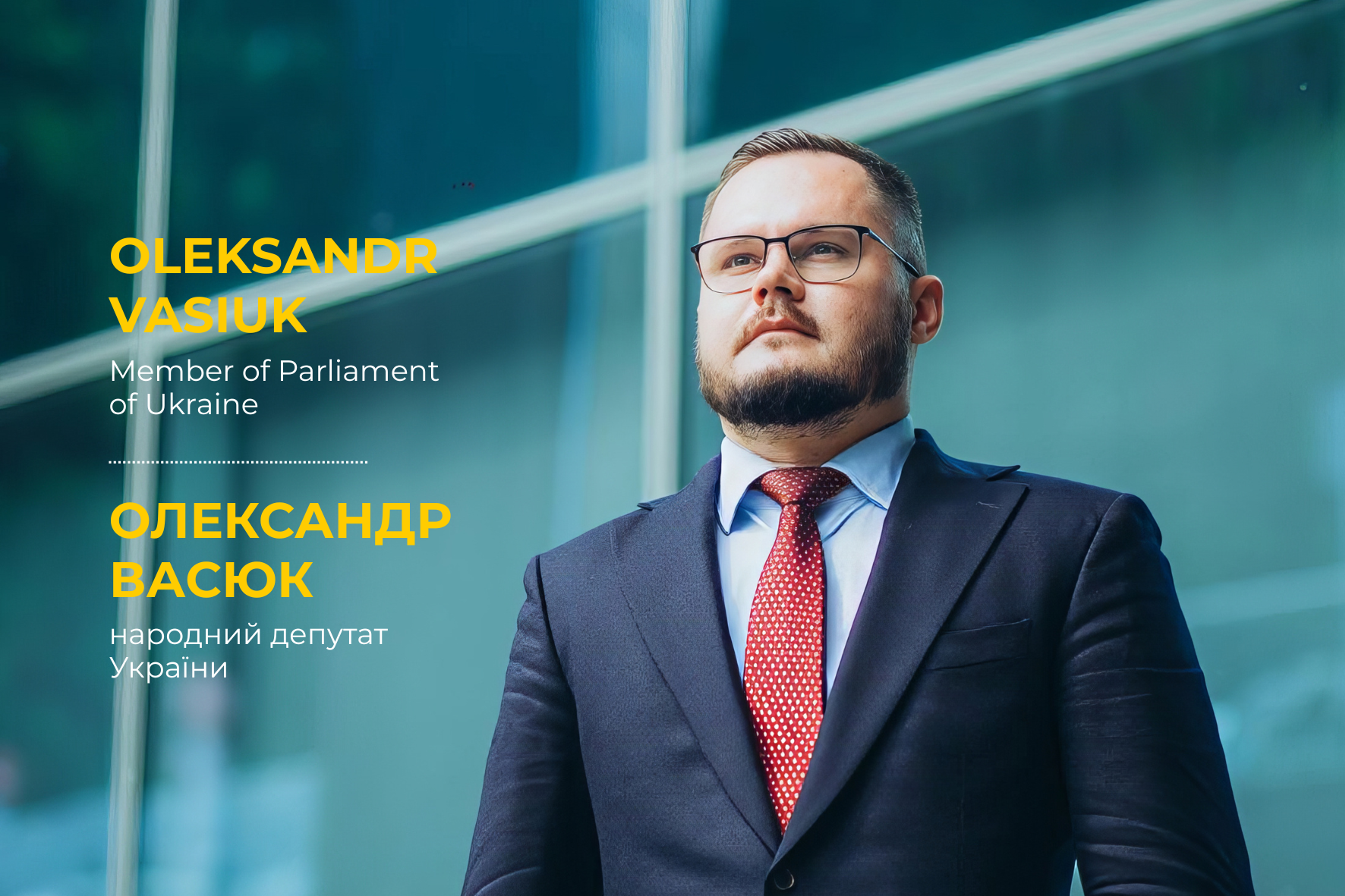
OLEKSANDR VASIUK, Member of Parliament of Ukraine, discusses the role of transparency, integrity, and predictable rules in strengthening the state and reinforcing the confidence of Ukraine’s international partners.
When I speak with foreign colleagues, diplomats, members of parliament, government officials, and representatives of international organizations, I often see the same question in their eyes: how can a country fighting the largest defensive war in Europe since the World War II find the strength not only to hold the front line, but also to systematically reform the way it is governed?
The answer often surprises them. Yes, Ukraine has clear international commitments, a strategic goal of joining the European Union, and a responsibility to the partners who have stood by us during our most difficult times. But above all, we are implementing reforms because Ukraine itself needs them. During wartime, reforms are neither a luxury nor an optional agenda. They are a deliberate choice – a prerequisite for the country’s internal resilience, public trust in its institutions, and its ability to endure a prolonged struggle. Ukraine has already dismantled many of the old corrupt and bureaucratic practices, but our task now is to ensure that they do not return under new names or in new forms.
During this period, Ukraine reinstated mandatory public electronic asset declarations, strengthened the accountability of public officials, and made transparency an integral part of its national resilience. This reflects a clear principle: Ukraine cannot afford to retreat from the transparency standards it has already embedded in its system of governance.
Legislative reform during wartime is not merely about fulfilling international commitments or advancing Ukraine’s path toward European integration. It is a deliberate domestic choice – a choice to build a state that is strong not only militarily, but also institutionally.
WHY UKRAINE’S REFORMSCANNOT BE REVERSED
For international audiences and our foreign partners, it is essential to understand one fundamental fact: reforms in Ukraine enjoy strong parliamentary support and overwhelming public demand. They do not depend on a single individual, one political centre, or a particular stage of the political cycle. They are the expression of the collective will of Ukrainian society.
Public opinion surveys consistently show that Ukrainians rank the fight against corruption and the integrity of public institutions as the country’s second-highest priority, surpassed only by national defence. This sends a powerful message: for Ukrainians, government transparency is no longer an optional reform – it has become one of the foundations of national resilience. That is why Ukraine’s anti-corruption agenda rests not only on institutions but also on broad public support.
Ukraine has long moved beyond the stage of asking for a vote of confidence based on promises or good intentions. Today, we offer the world a fundamentally different approach: a system in which trust is measurable, verifiable, and protected by the rule of law.
A DIGITAL STATE AS THEINFRASTRUCTURE OF TRUST
At the heart of this system lies Ukraine’s digital state. The guiding principle of the country’s digital transformation has been to minimize the human factor wherever it can create opportunities for corruption. The less discretionary decision-making there is in administrative procedures, the greater the predictability, transparency, and equality of the rules for both citizens and businesses.
A clear example is Diia, which has transformed the state into a convenient digital service accessible from a smartphone. Citizens no longer need to navigate unnecessary bureaucracy or collect paper documents when services can be delivered digitally. Instead, they receive public services faster, more conveniently, and with fewer intermediaries.
Ukraine’s progress in this area has been recognized globally. In the United Nations Online Service Index, the country climbed dramatically from 102nd to 5th place. Ukraine also ranked first worldwide in the E-Participation Index. These achievements represent far more than technological progress – they demonstrate the institutional strength and capacity of Ukraine’s digital state.
But digitalization is about much more than having government services on a smartphone. It is also about ensuring transparency and accountability in the use of public funds, including those provided by international partners. A prime example is the ProZorro public procurement system. Since its launch, ProZorro has helped save the Ukrainian state more than US$8.7 billion in public funds. These are resources that have remained in the country and continue to support its defence, reconstruction, and essential public services. The World Bank has approved the use of ProZorro for all projects it finances in Ukraine, underscoring the system’s transparency and credibility.
Today, as Ukraine prepares for the large-scale reconstruction of its damaged infrastructure, the DREAM platform has become a cornerstone of this effort. DREAM is a government digital ecosystem that provides a high level of transparency, accountability, and public oversight of reconstruction projects. Any international partner, donor, investigative journalist, or citizen can access the system and track every key stage of a project – from the identification of a need to financing, procurement, and implementation.
Transparency that can be independently verified in just a few clicks is transparency that truly inspires confidence. Ukraine’s digital infrastructure is increasingly aligned with European Union standards, supporting the country’s deeper integration into the European community.
THE ARCHITECTURE OF INTEGRITYAND NEW RULES FOR BUSINESS
Alongside its digital transformation, Ukraine has built a robust institutional architecture of integrity. This includes a system of specialized anti-corruption institutions – NACP, NABU, SAPO, and the High Anti-Corruption Court (HACC) – each with clearly defined mandates and safeguards to ensure their independence in preventing, investigating, prosecuting, and adjudicating high-level corruption cases. This reflects an important institutional choice: Ukraine’s anti-corruption policy is designed to rely not on the political will of individual leaders, but on stable rules, independent institutions, and transparent procedures.
OFFICIAL RECOGNITION: THE LAUNCHOF EU ACCESSION NEGOTIATIONS
All of these efforts and achievements have now received significant political recognition. On 15 June 2026, Ukraine officially launched negotiations under the first fundamental cluster of the EU accession process, «Fundamentals.» This cluster covers the core pillars of effective governance, including the rule of law, judicial reform, anticorruption policy, democratic institutions, and public administration.
The European Union’s decision to begin substantive negotiations in these areas sends a powerful message: even amid a full-scale war, Ukraine’s institutions have demonstrated their ability to function, reform, and steadily align with European standards. Ukraine has shown that it is capable not only of declaring its commitment to European values, but of translating those values into practical reforms and measurable progress.
Much work still lies ahead – from further strengthening public institutions to refining newly established governance mechanisms. Yet the most important milestone has already been reached: transparency, accountability, and predictability have become integral principles of Ukraine’s public policy.
#Trust #Transparency #RuleOfLaw #Governance #InternationalPartnership #Resilience #Ukraine