
THE DOME NO ONE ELSE HAS
HOW UKRAINE’S WAR IS CREATING A NEW INDUSTRY FOR BUSINESS PROTECTION
While Europe is only beginning to count the drones appearing over its airports, power plants, and industrial facilities, Ukrainian businesses have been living under attack for four years now and they have learned not merely to take cover – but to shoot back.
The result is something no Western security provider currently offers: a field–tested, combat–proven model for protecting civilian infrastructure against aerial attacks. It is a story of how forced wartime experience is becoming an export product.
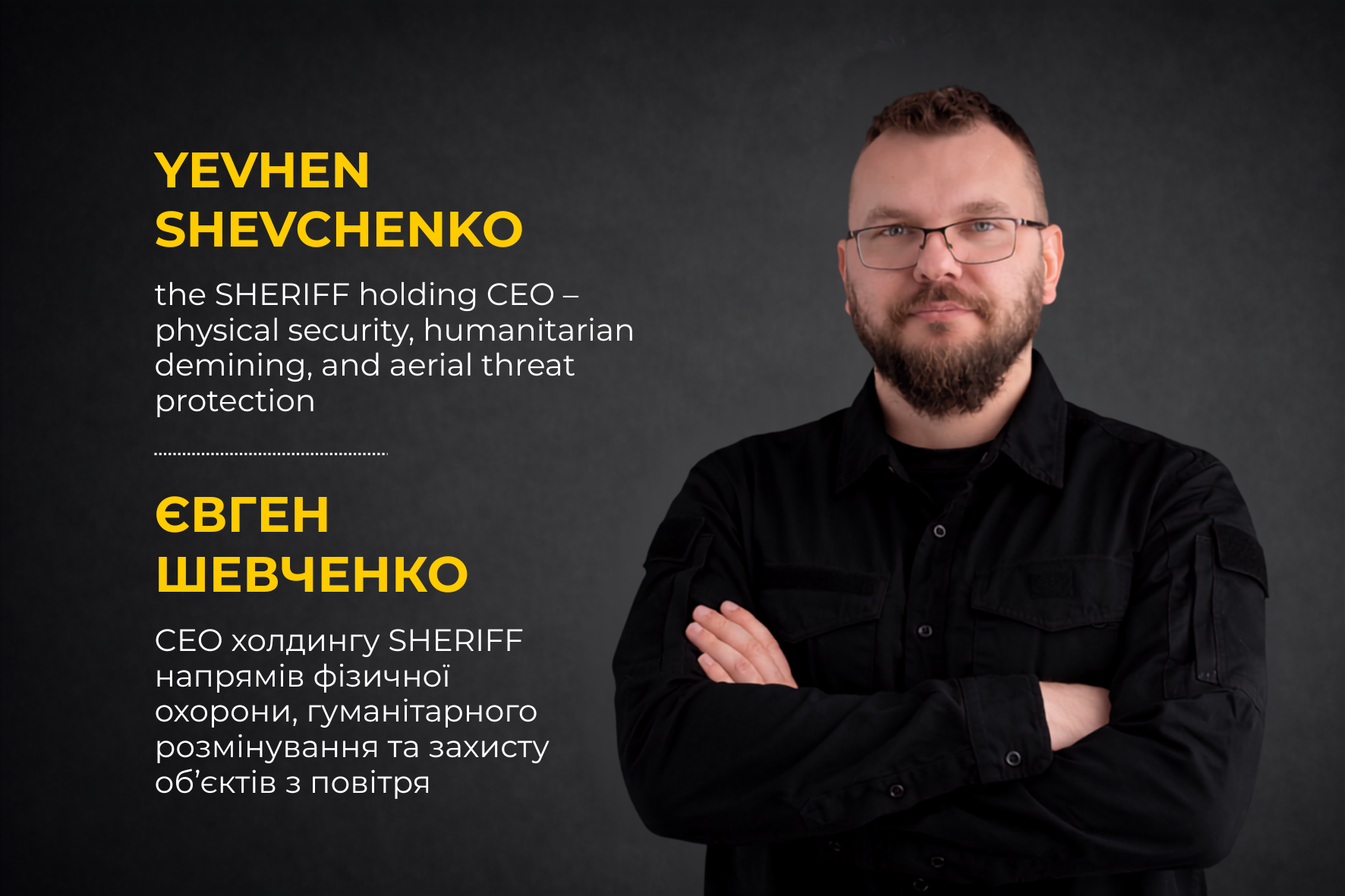
YEVHEN SHEVCHENKO, the SHERIFF holding CEO – physical security, humanitarian demining, and aerial threat protection.
THE REAR AREA THAT NO LONGER EXISTS
55,000. That is how many attack drone launches Ukraine endured in 2025 alone.
This is the new physics of everyday business. A logistics hub, a power plant, a grain elevator, a production line, a data centre – all of them now operate in an environment where aerial threats have become a permanent variable of the operating model rather than a force majeure event that occurs once a year.
The figures behind this reality differ from the familiar wartime headlines. On average, a facility loses between 2 and 6 hours of operation per day due to nationwide air raid alerts, even when no immediate threat exists nearby. Over the course of a year, this translates into dozens of full working days of downtime for which nobody provides compensation.
At the same time, nearly 18,000 facilities across Ukraine have no aerial target detection systems whatsoever. Their security teams simply do not know whether a threat is five kilometres away or fifty.
The most troubling part of this picture for business owners is that traditional security systems are, by definition, powerless against these threats.
An FPV drone is difficult to detect on radar because of its small size and can carry out a precision strike without warning. A civilian Mavic used for military purposes can conduct reconnaissance and target adjustment with little chance of being noticed. A jet–powered Shahed travels at speeds exceeding 400 km/h, and by the time it becomes visible to the naked eye, it is already too late to react.
The rear is no longer the rear not because the front line has disappeared, but because, in the air, there is no longer a front line at all.
WHAT THE GOVERNMENT HAS OPENED TO BUSINESS AND WHAT IT HAS NOT
In November 2025, something happened that only a few years earlier would have seemed like a legal fantasy. Ukraine’s Cabinet of Ministers Resolution No. 1506 authorized enterprises, regardless of their form of ownership, to establish their own air defence units. These units may be equipped with radars, interceptor drones, electronic warfare systems, and anti–aircraft artillery.
In March 2026, Amendment No. 290 made the framework operational. It authorized the temporary transfer of weapons from military unit stockpiles to air defence units protecting critical infrastructure facilities. The first results appeared quickly. As of spring 2026, the Ukrainian Air Force officially reports that 24 enterprises are in the process of forming such air defence units, as well as the first confirmed interception of a jet–powered Shahed drone traveling at speeds exceeding 400 km/h by a private air defence unit. The numbers are still small. The precedent is enormous.
This is where the most important part begins – and where most misunderstandings arise in conversations with business leaders.
Resolution No. 1506 did not create a system of “private air defence,” nor did it legalize a commercial market for shooting down drones. Legally, an enterprise air defence unit is a structural subdivision that operates exclusively under the commands of the military authorities and within the unified command–and–control system of the Ukrainian Air Force. The business finances the system. The business recruits the personnel. The business maintains the equipment. But the order to engage a target is given by the military – and only by the military.
For the owner of a critical facility, the practical conclusion is straightforward: when a provider sells you a “guaranteed safe sky” or a “zone where Shaheds will no longer reach,” they either do not understand the framework within which they operate, or they are deliberately misleading you. An honest promise sounds different: integration of your facility into the national air defence system and a measurable reduction of risk. Anything beyond that is marketing – and the cost of believing it will ultimately be reflected on your balance sheet.
WHY CAN’T THE AIRSPACE BE PROTECTED SEPARATELY: THE LOGIC BEHIND THE ‘SECURITY DOME’
The most common misconception is to think of aerial protection as a separate “service” that can simply be added to an existing security contract as an optional feature. In reality, it cannot function in isolation from the rest of the facility’s security measures. At SHERIFF, we describe this through the “Security Dome” model – four core security layers integrated into a single management and response system:
• Conventional Security – access control, video surveillance, fire protection systems, flood prevention systems, remote monitoring, and facility energy resilience.
• Physical Protection – security posts, patrols, perimeter control, rapid response units, and the protection of personnel and critical areas.
• Digital Shield – cybersecurity for networks, servers, communication channels, management systems, and the continuity of critical services.
• Aerial Protection – detection, identification, and countermeasures against aerial threats in the vicinity of the facility.
The logic is simple: the aerial layer depends on the other three. An interceptor drone without reliable power supply is nothing more than an impressive presentation. An automated turret without a protected communications channel is a target for a cyberattack. An operator without physical perimeter security is simply a person whom someone can walk up to. It is the same risk management discipline businesses have always relied on – only now elevated to an altitude of 200 to 2,000 meters.
THREE DEFENSIVE LAYERS: DETECTION → EW → KINETIC ENGAGEMENT
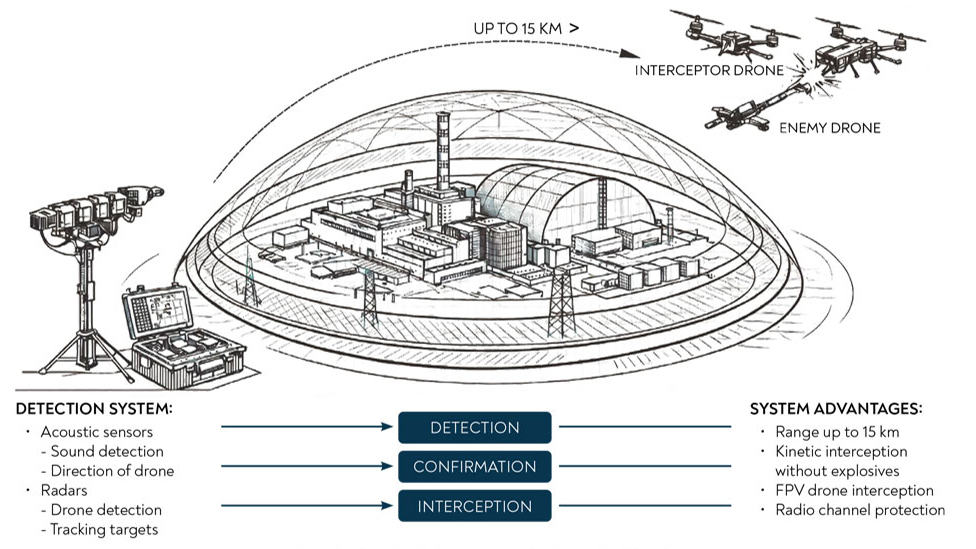
Within the aerial protection layer, the logic is straightforward and follows a funnel–shaped process: detection → confirmation → neutralization. Each layer either eliminates the threat or passes it on to the next one.
1. Detection. Acoustic sensors identify the signature of drone propellers at distances of more than 5 km, while SDR–based radio detection scans FPV control channels across frequencies ranging from 70 MHz to 6 GHz. Their key advantage is that they do not emit signals themselves, making them effectively invisible while allowing them to detect precisely the types of small targets that conventional radar often cannot see.
2. Electronic Warfare (EW). Directional jamming systems prevent drones from approaching the facility without interfering with unrelated frequencies. Importantly, these systems may only be activated following the appropriate authorization. Even in Ukraine, unauthorized jamming remains subject to separate legal restrictions.
3. Kinetic Interception. When electronic warfare measures fail to stop a target, interceptor drones (with speeds of up to 350 km/h and an operational radius of up to 17 km) and automated turrets become the final line of defence. The target is destroyed as it approaches the facility.
Behind all this lies a single digital map: the entire system is consolidated into a single real–time interface, integrated into the national system. Most importantly, the equipment and procedures have been tested not in laboratories, but under real combat conditions. This is an asset that cannot be purchased or accelerated through investment. It can only be developed through experience gained in the kind of environment that, unfortunately, the war has imposed on Ukraine.
There is a temptation to delegate the issue of aerial protection to the technical director or the security department. That is a misunderstanding of the scale of the decision. There are four reasons why this is a matter for the CEO and the business owner:
• The Economics of Downtime. Every air raid alert means hours of disrupted operations. For a logistics hub, a CHP plant, or a manufacturing facility, this translates directly into lost margin that the market will not compensate.
• Legal Liability. Under Ukrainian civil law, liability for damages rests with the party that caused them. If a threat passed through your facility into a neighbouring one without documented evidence that ‘we did everything possible’, the claim will be directed at you.
• Insurance. Critical infrastructure facilities cannot be insured without cover for war–related risks. Without a documented protection system in place, insurance premiums can become prohibitively expensive – or coverage may not be available at all.
• ESG and Reputation. European partners, banks, and rating agencies are placing increasing emphasis on a company’s ability to withstand and manage crises. In 2026, protection against aerial threats is becoming part of the standard due diligence process preceding financing decisions, investment, or strategic partnerships.
This leads to our one practical recommendation for businesses selecting a partner: do not make your first question, “How much does it cost?” Ask a different one: “Show us your post–incident analysis architecture.” The answer to the second question is the real price of the first one. A provider who cannot clearly explain what evidence, records, and documentation they will be able to present to investigators and insurers on the morning after an incident is not selling you security, but an illusion.
UKRAINE IS THE EXCEPTION, BUT EUROPE IS NEXT
The most useful way to understand the scale of Ukraine’s experience is to look at those who are only now beginning to confront the same problem. NATO and the European Union are already recording a growing number of drone–related incidents around critical infrastructure across Europe, including airports, energy facilities, and logistics hubs. The European Commission is developing its own counter–drone initiatives and response frameworks. Yet the authority to neutralize aerial threats remains largely within national legal frameworks. In most European countries, private businesses are not permitted to intercept, disable, or even jam an unauthorized drone flying above their own facilities.
The result is a paradox. A European security provider may possess some of the most advanced technology in the world, yet still lack the one thing that matters most: experience applying it under real attack conditions. Ukrainian teams have gone through this learning curve four years earlier – and within a regulatory framework that no European country had in place when the threat first emerged. We already know what works at three o’clock in the morning when a swarm of Shahed drones is approaching, and what merely looks impressive on a trade show stand.
The global market for private security and military services is estimated at approximately $200 billion annually. In most European countries, companies in this sector operate primarily as security organizations with expanded capabilities, where combat operations are not the primary function but rather the third or fourth layer of service – following intelligence and risk assessment, training, security operations, demining, and critical infrastructure protection. This is the model followed by the leading British, French, and American players in the industry.
And it is precisely within this framework that Ukraine’s experience naturally fits – from enterprise air defense units protecting individual facilities to the broader concept of a comprehensive Security Dome.
In this context, Resolution No. 1506 should not be viewed as a temporary wartime measure, but rather as a pilot project of a much broader significance. If, before the conclusion of the experimental period, the state succeeds in achieving two key objectives – institutionalizing the best practices developed under this framework and adopting a dedicated legal framework for private security companies with expanded capabilities (similar to the approach once taken by the United Kingdom) – Ukraine will gain a unique opportunity to transform its hard–earned wartime experience into a sustainable industry with significant export potential.
LOOKING AHEAD
The Ukrainian rear is no longer truly a rear area, and the country’s documented losses are already measured in hundreds of billions of dollars. Yet from this experience, something is emerging that cannot be purchased from any catalogue: a proven model for protecting civilian infrastructure from aerial threats – one that has been tested not in theory, but under real–world conditions.
For Ukrainian businesses, this means that the “sky above their facilities” is no longer solely the responsibility of the state. It has become a risk domain that can be actively managed, assessed, and integrated into corporate security strategies. For international businesses, the message is equally significant: the threat that Europe is only beginning to recognize and prepare for already has a practical response in Ukraine. It does not need to be invented from scratch. It can be studied, adapted, and adopted – while the window of opportunity remains open.
#SHERIFF #Security #InfrastructureProtection #AerialThreats #Innovation #DefenseTech #Ukraine