NOT JUST A SERIES, BUT BILLIONS OF COMBINATIONS
HOW AUTOMATION IS TRANSFORMING UKRAINIAN MANUFACTURING
At the start of the full-scale invasion, Liberta (based in Dnipro) halted production and focused its resources on evacuating its staff and their families. Within just a few weeks, part of the team was back at work: despite a collapse in demand, a labour shortage and supply chains that had effectively been destroyed.
Today, the company manufactures mirrors, shower enclosures, glass doors and interior accessories. The brand’s products are available throughout Ukraine and are exported to EU countries.
The business model is based not on a standard catalogue, but on the individual configuration of each product. Customers can specify the size, design and additional options, and view the model and cost of their order using a digital calculator. The company emphasises that having its own production facilities means it does not need to apply a separate mark-up for non-standard configurations.
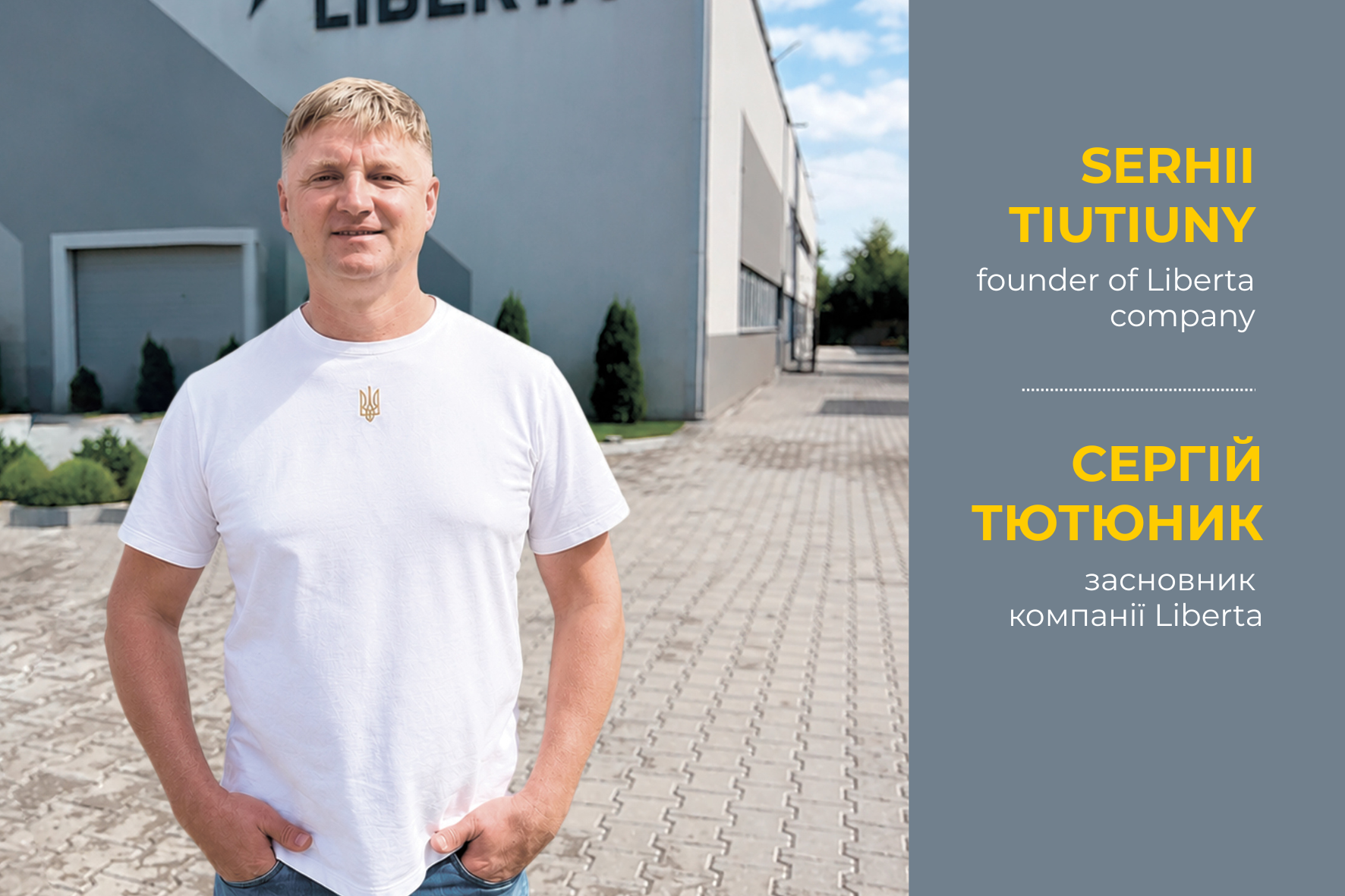
We speak with the founder of Liberta company, SERHII TIUTIUNYK, about how to transform an individual order into a managed industrial process, why it is not enough for a manufacturer simply to purchase new equipment, and why Liberta needs another production facility near the EU border.
What was the most difficult decision you had to make after the full-scale war began?
In the early days, we weren’t thinking about equipment or sales at all. There were over 200 people working at the factory, and the main concern was how to keep them and their families safe.
Dnipro was situated between several dangerous fronts. Nobody knew how quickly events would unfold, so we halted production and channelled all our resources into the evacuation. Some people were taken to western Ukraine, some were taken abroad. We also moved our archives, documents and the most important materials, and mothballed the production facilities.
Around 40% of the team left at that time. Many of the men stayed, and some staff joined the army.
Two weeks later, it became clear that we simply couldn’t afford to wait. We still had a network of partners across Ukraine, and orders began to come in from them. We resumed operations with around twenty people – covering production, the office and logistics. This wasn’t a business strategy, but a way to keep the company afloat and provide people with jobs.
Why didn’t you relocate production straight away?
From the outside, it might seem as though the business could simply be loaded onto lorries and moved. In reality, our equipment required around 40 lorries, a team of mechanics to dismantle it, and several thousand square metres of suitable premises.
We didn’t need just any old industrial building, but a clean production environment with a level industrial floor, the necessary layout, power supply and logistics. In western Ukraine, there were practically no vacant sites of this standard: a significant proportion of industry from the east was relocating there at the same time.
We decided to look for a plot of land and build a new factory. This process took almost a year and a half. During this time, production in Dnipro gradually stabilised, and the relocation ceased to be solely a matter of security. It became a question of development and entering the European market.
Today, there is no longer any point in relocating the existing factory. We need a second production site, which will not replace Dnipro but complement it.
The name ‘Liberta’ translates as ‘freedom’. How does this relate to the company’s business model?
When we first started working with bathroom mirrors, the market was very limited. In shops, customers were offered just a few models in two or three sizes. A non-standard order cost several times more and could take months to produce.
We decided to give people the freedom of choice: any design, the exact size to the nearest millimetre, the positioning of the backlighting, sensors, heating, lenses and other features.
Manufacturing usually strives for standardisation: producing a thousand identical parts is much easier than a thousand different ones. With us, practically every order is different. For one customer, it’s crucial to align with the tile joints; another needs a specific width; a third wants the lens on a particular side.
That’s why Liberta is more than just a factory. Our core expertise lies in the industrial manufacture of individual products without turning every order into a separate, hand-crafted project.
Bespoke manufacturing is traditionally considered slow and expensive. How do you scale it up?
Thanks to our proprietary software. We’ve been developing it for around eight years and have, in fact, rewritten the system from scratch several times.
Once a customer has selected the product specifications, the system automatically generates a production order. A single order can be broken down into approximately 58 separate operations, which are assigned to different workstations either in parallel or sequentially.
Employees do not decide for themselves what to do next. The system specifies which material to take, which operation to carry out, where to send the part and by when. It also monitors stock levels, equipment utilisation, documentation and logistics.
Thanks to this, an individual product can be manufactured in a matter of days. Without automation, managing such a large number of variants would require a large administrative staff, and the number of human errors would be far too high.
Doesn’t this model make the company hostage to complex software?
That is indeed a risk. Automation is expensive, requires constant development and depends on the quality of the data. It’s not possible to simply buy a ready-made programme and install it on the production line. The system must be created by people who understand the technology, the sequence of operations, the materials and the customer’s actual behaviour.
However, manual management would be an even greater risk for us. We have thousands of stock items and a vast number of possible configurations. It is impossible to keep all of this in one’s head or in spreadsheets.
A technological advantage is not permanent. If we stop investing in the system, our competitors will gradually catch up. That is why, for us, software is not a finished product, but an ongoing investment.
What price does the company pay for the ability to manufacture products ‘on the fly’?
The biggest cost is inventory. To guarantee delivery times, we must have virtually all materials and components in stock. Some items are delivered within a few days, whilst others may take several months to arrive from Asia.
This means a significant amount of capital is tied up. A mass-production manufacturer can reduce its product range and work with a few standard configurations. We cannot tell a customer that the option they need is temporarily unavailable if we are building our brand around freedom of choice.
The second cost is the complexity of quality control. With a non-standard product, it is not enough to check a single standard model. We need to check every configuration and ensure all specifications are correct.
After 2022, sales fell by about a factor of four. How did you handle shipping the equipment?
We were looking for a product that could be easily shipped around the world. Mirrors and shower enclosures are tricky for international logistics: they’re bulky, fragile, and their value lies precisely in being made to order.
So we developed a collection of interior accessories and launched it on international marketplaces. To do this, we purchased metalworking equipment under the ‘5–7–9%’ credit programme.
This investment yielded greater results than we had initially planned. Production has become significantly more self-sufficient: we carry out glass and metal processing, assembly, design and most manufacturing operations in-house. We mainly purchase basic materials.
It is precisely this vertical integration that has enabled us to weather the past few years. When order volumes are low, any reliance on external contractors poses an additional risk to lead times and production costs.
You describe autonomy as the main lesson of the war. But could it turn into an economically unviable desire to do everything in-house?
Autonomy does not mean that a company must abandon its partners. It means maintaining control over critical processes. If an external contractor can change priorities at any moment, miss a deadline or compromise quality, a key process cannot be entirely outsourced. At the same time, there is no point in setting up an in-house division for an operation that the market consistently performs better and more cheaply.
We have identified three pillars for ourselves: autonomy, automation and optimisation. Autonomy reduces dependence, automation minimises errors, and optimisation ensures that the first two do not result in excessive costs.
How big of a problem is Ukraine’s reliance on imported raw materials for manufacturers?
For our industry, this is one of the fundamental challenges. Ukraine does not have its own large-scale float glass production, so mirror sheets and a significant proportion of other materials are imported.
A few years ago, I was involved in discussions about the possibility of setting up a modern float glass production line in Ukraine. The country has sand, dolomite, soda ash, limestone and gas. But a plant of this calibre requires hundreds of millions of dollars, a continuous production cycle and guaranteed access to a raw materials supply base.
The problem was not just one of capital. Investors need long-term guarantees of access to deposits, energy, land and logistics. When each resource is controlled by a separate owner and there is no coherent industrial policy, the project becomes far too risky.
For manufacturers, the lack of Ukrainian glass means dependence on foreign currency, more complex logistics and inconsistent quality. Due to defects, a significant proportion of the material sometimes has to be rejected, which directly increases the cost price of the finished product.
Let’s talk about the market players. Where does the line between entrepreneurship and unfair competition lie?
If we’re talking about a small manufacturer, they aren’t a problem in and of themselves. People have the right to work in their own workshop and sell their products.
The problem arises when goods are systematically supplied to shops without proper guarantees, after-sales service, documentation, tax compliance or safety accountability. An official manufacturer employs engineers, designers, quality control staff, runs a service centre, maintains warehouses and owns the necessary equipment. As a result, their product may cost 20–30% more.
To the consumer, two mirrors may look identical, but one is backed by a system of guarantees and accountability, whilst the other is backed by nothing more than a social media page.
I am not in favour of bans. What is needed are consistent rules: if a product is sold on a systematic basis, the buyer must receive proof of origin, a guarantee, the ability to contact the seller and the means to protect their rights.
Liberta has a dedicated service centre and a system for handling enquiries via order number, which forms part of the manufacturer’s formal responsibility towards the customer.
Chinese manufacturers are already offering cheap mirrors with backlighting and additional features. Does this pose a threat to domestic manufacturers?
When it comes to standard products, it is almost impossible to compete with large-scale Chinese production on price alone. If a ready-made mirror of a fixed size suits the buyer, imports can be very attractive.
Our advantage lies elsewhere. We operate in a sector where the product must precisely match a specific space and the designer’s vision. An importer cannot stock thousands of combinations of sizes, designs and options in their warehouse.
However, it would be unwise to assume this advantage is guaranteed forever. A major competitor could purchase the necessary equipment and hire programmers. Therefore, the barrier should not be just the configurator on the website, but the entire system: production algorithms, data, logistics, quality control, service and speed of delivery.
We are not afraid of competition. It forces us to develop our product. But competition must take place within a level playing field in terms of the legal and tax environment.
What government measures do Ukrainian manufacturers need most of all today?
First and foremost, support in entering international markets. There are many manufacturers in Ukraine who have something to showcase, but they do not know how to get into a trade fair in Milan, Frankfurt or Paris. For small and medium-sized enterprises, participation, logistics and stand set-up are far too expensive.
The government could organise joint national pavilions and provide assistance with certification, export documentation, marketing materials and finding partners. This is not charity: exports bring foreign currency revenue, tax revenue and jobs back to the country.
The second area is funding for modernisation. The ‘5–7–9%’ programme has proved an effective tool for us, but large-scale manufacturing projects require longer-term financing, insurance against war risks and the ability to secure loans based on export potential.
The third is predictability. Businesses can adapt to complex rules if they are clear and consistent. The worst scenario is when decisions change without explanation, tax invoices are blocked, or a company has to spend resources not on production but on overcoming administrative hurdles.
Sometimes the best support the state can provide is not through incentives, but by simply not creating additional problems for businesses.
What is the key management lesson you have learnt over the years of the war?
Resilience cannot be built once a crisis has begun. It must be established in advance.
A company must know which processes are critical to its operations, and where it is dependent on a single person, a single supplier, a single bank or a single piece of equipment. It needs contingency plans, data, standardised operations and the ability to rapidly restructure production.
Automation does not replace people. It frees them from routine decision-making and reduces the cost of error. Autonomy does not mean isolation. It enables a company to choose its partners rather than be dependent on them. Optimisation does not mean cutting back on everything – it means investing resources precisely where they create resilience and a competitive advantage.
We cannot predict all future crises. But we can build a system that does not grind to a halt after the first blow. For a manufacturing company, this is more important today than any short-term sales record.
#Liberta #Manufacturing #Automation #Industry #Exports #Innovation #Ukraine