
INDUSTRIAL PARK AS AN ASSET
HOW THE MYKOLAIV HROMADA IS BUILDING A NEW ECONOMY
Despite the war and prolonged uncertainty, the Mykolaiv hromada in Lviv region is demonstrating a model of development that is increasingly being called the new standard of sustainability for Ukrainian cities and towns. Instead of conserving processes, the focus is on growth. Instead of waiting for help, hromada is relying on its own decisions and partnerships.
Today, the hromada is working on a qualitatively new economic model: developing production, infrastructure, stimulating local businesses, and creating a competitive environment for investors. Key elements of this strategy are the development of the ‘Khorvatsky Gostynets’ industrial park and ‘Khorvatska Oselya’ – projects that combine a beneficial transport location, an established production base and the hromada’s desire to create jobs with real added value and to resettle IDPs and combat veterans in comfortable homes.
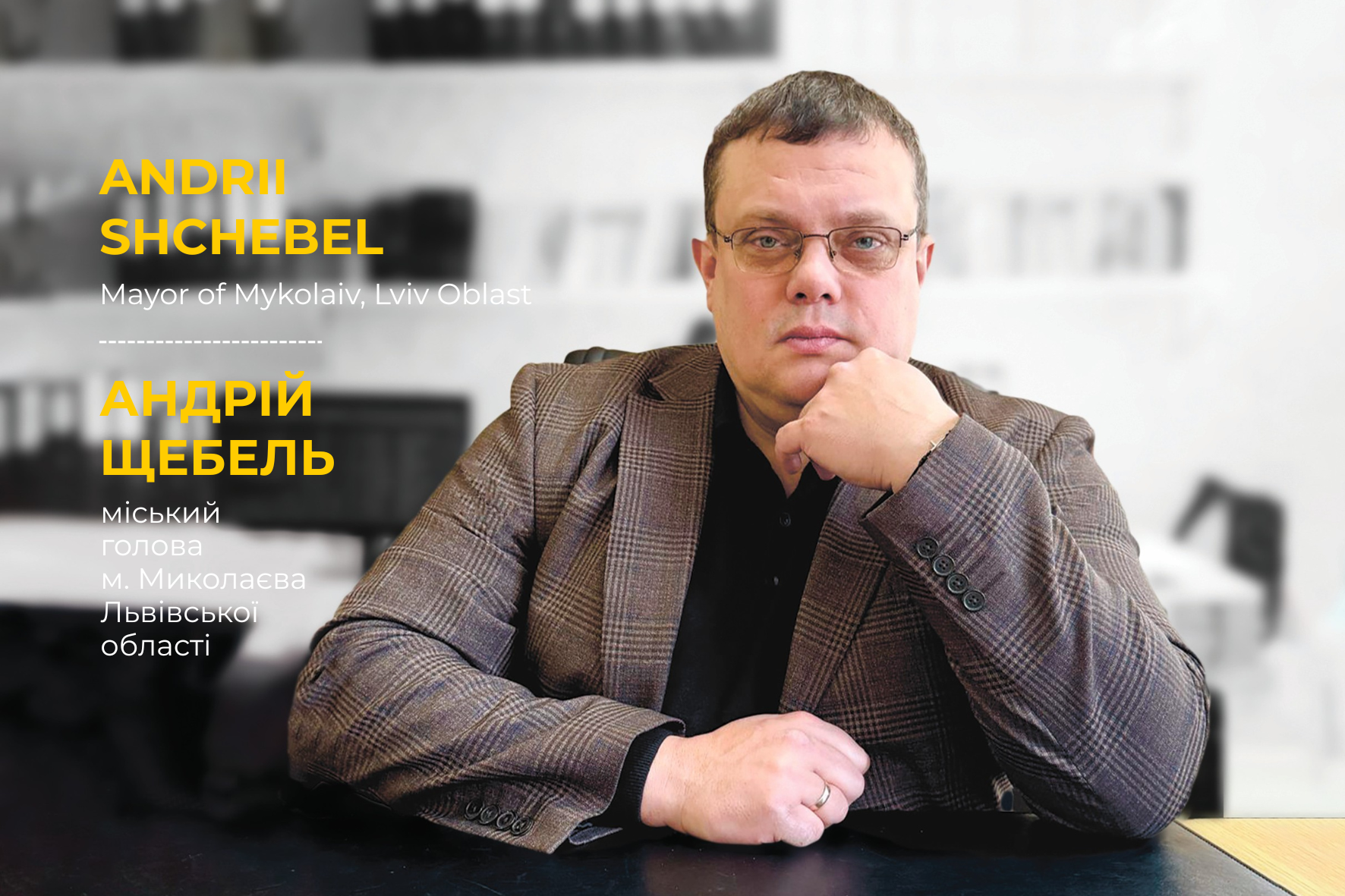
We talk to city council mayor ANDRII SHCHEBEL about how the Mykolaiv hromada survived the first challenges of the war, how it is shaping its economic future today, and why small hromadas could become new centres of development in Ukraine.
Mr Andrii, what were the main challenges facing the Mykolaiv hromada from the start of the full-scale invasion?
The Mykolaiv hromada consists of 10 starosta okruhs (24 settlements), formed on the basis of former village councils and the administrative centre – the town of Mykolaiv. The hromada has a population of around 33 thousand people. Its total area is 301.8 km².
Like everyone else, we were not prepared for the events that began on 24 February 2022. Although our region was not in an area of active combat, we immediately faced several serious challenges. First and foremost, we experienced a sharp increase in the number of internally displaced persons who began arriving in the hromada from the very first weeks of the full-scale invasion. It was necessary to promptly provide people with housing, social support, medical care, and integration into the local community and labour market. Such pressure required rapid institutional decisions and the reconfiguration of municipal services. That is why the ‘Khorvatska Oselya’ project is designed to ensure convenient and comfortable living conditions for internally displaced persons (IDPs) and combat veterans within the hromada. They will, in turn, become a human resource for carrying out works at the ‘Khorvatsky Gostynets’ project.
The second challenge was the strain on infrastructure – municipal, social and educational. Our schools, kindergartens, transport, medical facilities and housing and communal services were operating under increased pressure. At the same time, it was necessary to provide shelter and safety measures for the civilian population.
A separate area of focus is working with veterans and active service members, as a significant portion of the hromada’s residents serve in the Armed Forces of Ukraine or have returned from the front. This includes psychological support, rehabilitation programs, assistance with employment, and a modern approach to social guarantees.
An important challenge was the economic transformation of the hromada. Some businesses stopped operating, while others relocated from the eastern and southern regions. We worked to create conditions for business owners to continue their activities, integrate into the hromada, and preserve jobs.
And, of course, there emerged a need for strategic development under conditions of uncertainty – including planning industrial areas, attracting investors, and developing economic growth projects that are relevant both today and during the post-war recovery of the country.
Despite all the difficulties, the hromada demonstrated strong organization, solidarity, and a readiness to adapt quickly to new realities. It was this resilience that allowed us to move from crisis response to development planning and the creation of new opportunities.
Can it be said that the war forced the hromada to move more quickly toward a “self-sufficient development” model?
Yes, absolutely. We realized that the hromada can rely only on its own resources, innovative solutions, and partnerships.
Industrial park, energy efficiency projects, and business support are exactly the steps that build the hromada’s self-sufficiency.
You mentioned job creation and new opportunities for businesses. These processes are impossible without developing infrastructure and modernizing the hromada’s economy. That’s why I would like to move on to one of the key strategic projects – the “Khorvatsky Gostynets” Industrial Park. In your opinion, what economic and geographic advantages does the hromada have for the successful implementation of this project?
First of all, it is the transport accessibility. The Mykolaiv hromada is located in the Stryi district of Lviv region.
Lviv region is a border region located in western Ukraine and shares a border with the Republic of Poland (258 km in length). To the north and northeast, it borders Volyn and Rivne regions; to the east and southeast, Ternopil and Ivano-Frankivsk regions; and to the south, Zakarpattia region.
Thanks to its advantageous location at the crossroads of international transport, economic, trade, and cultural routes, as well as one of the most developed transport networks in Ukraine, Lviv region serves as a key transit corridor connecting Ukraine with the countries of the European Union.
The Mykolaiv hromada has a favorable geographic location in the center of Lviv region and good transport connections with major cities of the European Union. The distance from the Mykolaiv hromada to Ukraine’s capital, Kyiv, is 576 km, which is greater than the distance to Budapest (540 km), Košice (331 km), Przemyśl (108 km), Kraków (354 km), Rzeszów (198 km), and Warsaw (513 km).
The industrial park area is located between two highways – the M06 international highway and the T1402 regional road.
The M06 highway starts in Kyiv and passes through Korostyshiv, Zhytomyr, Rivne, Dubno, Brody, Lviv, Stryi, Svaliava, Mukachevo, and Uzhhorod, and ends at the Chop border crossing.
The T1402 road (Pisochna–Skhidnytsia) is a road of territorial importance in Lviv region. It runs through Drohobych and Stryi districts, passing through Skhidnytsia, Boryslav, Truskavets, Stebnyk, Medenychi, and Pisochna. In addition, the Pisochna railway station is located just 4 km away.
The T-14 / M-11 route runs along Mykolaiv – Komarno – Horodok – Mostyska – Shehyni – Przemyśl.
And what about economic attractiveness?
One of the most important factors determining the specialization of the Mykolaiv hromada is the presence of huge reserves of lithothamnion limestone and quartz and glauconite sands, as well as marl clays, which shapes the hromada's industrial specialization – the production of non-metallic mineral products.
The manufacturing sector of the Mykolaiv hromada’s economy is represented by enterprises engaged in activities such as cement production, manufacturing of dry construction mixes, extraction of sand, gravel, clays and kaolin, construction of residential and non-residential buildings, production of ropes, cords, twine and nets, freshwater fish farming (aquaculture), and other related activities.
By its functional territorial type, the Mykolaiv hromada is an area with special development conditions, characterized by a mono-functional economy specializing in the production of other non-metallic mineral product. For example, Mykolaivcement PrJSC operates in the hromada and is the main budget-forming enterprise, accounting for 42% of the hromada’s budget revenues (as of 2021).
Overall, the hromada’s industrial group comprises 10 enterprises.
In addition to Mykolaivcement PrJSC, the town of Mykolaiv hosts a branch of LLC with foreign investment Henkel Bautechnik Ukraine, the Lviv Regional Production Fish Plant, GEOROZVIDKA LLC, TDV Mykolaivtsemremont, PAC Dniester, and other enterprises.
Thus, an analysis of the actual contribution of each sector to the hromada’s economy shows that manufacturing is the leading contributor to the local budget, in particular the production of other non-metallic mineral products.
What role should the industrial park play in the hromada’s economic ecosystem? Will it function as a manufacturing hub, a logistics node, or a mixed model?
The “Khorvatsky Gostynets” Industrial Park is envisioned as a universal industrial complex, designed to accommodate enterprises from the following sectors:
- food production;
- production of construction materials;
- machinery manufacturing;
- production of vegetable oils and animal fats;
- production of other food products;
- wood processing and manufacture of products made of wood and cork, excluding furniture;
- manufacture of articles of straw and plaiting materials.
As part of the service component, it is planned to involve other industrial park participants that will provide logistics and warehousing services to the park’s core residents.
Participants of the industrial park may include enterprises from other sectors, in accordance with the types of economic activities defined by KVED DK 009:2010, Section C – Manufacturing. In addition, enterprises that do not cause harm to the environment or ecology of the Mykolaiv hromada may be located within the industrial park.
Overall, the industrial park is being established to stimulate the economic development of the Mykolaiv hromada, attract investment, create new jobs, and enhance the competitiveness of Stryi District, Lviv region.
How important is it for the hromada to ensure not just jobs, but stable and decent employment?
This is truly a key issue for the future of any territorial hromada, and especially for smaller ones. Today, the competition is not only for investors or enterprises, but primarily for people. If the hromada does not create opportunities for stable, decent, and promising employment, young people leave, specialists move to larger cities, and the hromada gradually loses its human capital.
For us, it is important not just to “fill vacancies,” but to create conditions where people see purpose and a future right here, in the hromada. Decent work is not only about wages. It means stability, opportunities for professional growth, social security, and decent working and living conditions.
That is why we are deliberately focusing on the manufacturing sector, logistics, and industrial projects rather than on sporadic or short-term forms of employment. Industry and processing create jobs with high added value, which means better wages and long-term prospects. These are precisely the sectors that help build a middle class within hromadas.
The “Khorvatsky Gostynets” Industrial Park, cooperation with the vocational lyceum, workforce training, and partnership programs with business are all elements of a single system. We are moving toward making the hromada economically self-sufficient: so that people can work locally instead of going elsewhere for employment; so that businesses invest here, knowing they will have access to a skilled workforce; and so that young people see real prospects within the hromada itself.
Thus, creating decent jobs is not about filling vacancies. It is about the future of the hromada – its resilience, its capacity to develop, and its ability to retain people.
Mr Andrii, as the head of the hromada, tell us – how difficult is it to remain proactive when resources are limited?
Honestly, it is not easy. However, limited resources are not unique to our hromada; this is a reality faced by the entire country. What matters is not how much you have, but how effectively you manage it. In hromadas, just as in business, the key lies in setting the right priorities, having a clear strategic vision, and avoiding the dispersion of efforts.
Yes, we do not always have the capacity to implement everything at once. But we have something else – initiative, partnerships, and a strong focus on results. We have learned how to attract external resources, work with donors, use the budget efficiently, and look for creative solutions instead of standard ones.
And most importantly, the 33,000 residents of the hromada want change. Their support, engagement, and feedback are precisely that “additional resource” which sometimes weighs more than money.
Do hromadas have greater potential than large cities?
In many aspects, yes. Smaller hromadas are much more agile. We can make decisions quickly, respond rapidly to change, and maintain direct, personal contact with residents. In large cities, any initiative is often lost in bureaucracy and lengthy procedures.
Hromadas that are capable of working strategically can become powerful centers of economic development. We are closer to real business needs and to people’s everyday concerns. In some cases, a hromada can implement a project faster than it would be possible at the regional or national level.
Therefore, the potential is enormous – it only needs to be managed properly, supported by ambition and vision, and accompanied by a willingness to experiment.
What personally motivates you to work for the development of the Mykolaiv hromada in such a difficult time?
I was born here, have realized myself as the head of the Mykolaiv hromada, and feel a deep responsibility toward the people. Every day I see how the hromada is changing, how we overcome challenges together, how new projects, new partners, and new plans emerge. When you see real results, that is the greatest motivation.
What inspires me is the feeling that our work is not just about today. It is about the future of children, young people, and families who want to stay here and build their lives in the Mykolaiv hromada.
Every new road, every newly opened facility, every investor is a small victory. And when you realize that you are contributing to the development of Ukraine even in times of war, it gives you the strength to keep moving forward.
The motivation is simple: I want the Mykolaiv hromada to be a hromada where people want to live. And I am certain that we will get there.
#MykolaivCommunity #LvivRegion #Communities #Investment #IndustrialPark #LocalDevelopment #UkraineRecovery