
HUMAN CAPITAL AS THE INFRASTRUCTURE OF RECOVERY
WILL UKRAINE HAVE ENOUGH PEOPLE TO REBUILD ITS ECONOMY?
Human capital is increasingly defining both the pace of Ukraine’s recovery and the limits of its economic capacity. The central question is no longer only how much financing can be mobilized. It is whether the country will have enough people with the right skills, motivation, resilience, and working conditions to contribute productively to reconstruction.
This is not simply a question of population size. It is about the quality, structure, and engagement of human capital. People are becoming a core infrastructure of recovery, no less essential than energy, logistics, or financing.
The scale of Ukraine’s workforce deficit and the possible solutions for government and business are discussed by OLGA GORBANOVSKA, Head of People Advisory Services, EY Ukraine, and YULIIA HOLOVKO, Director, People Advisory Services, EY Ukraine.
THE SCALE OF THE SHORTAGE AND THE STRUCTURE OF THE LABOR MARKET
Does Ukraine have enough human capital for economic recovery, or has its shortage already become the main constraint on growth?
Human capital has already become one of the key constraints on Ukraine’s recovery. The challenge is not only the number of people available, but the shortage of professionals with the right skills, experience, and readiness to work in new and often difficult conditions. For reconstruction, productivity, workforce mobility, and the alignment of skills with the needs of critical sectors are essential.
Population decline, migration, and changes in the structure of employment are already intensifying shortages in industry, construction, logistics, healthcare, and education. These are precisely the sectors on which physical reconstruction and long-term growth depend.
Financing can be attracted and assets can be rebuilt faster than the skills required to operate, manage, and scale them can be developed. That is why Ukraine’s strategy must combine reskilling, productivity growth, the inclusion of veterans and people with disabilities, and policies to return, retain, and attract talent.
Ukraine is entering the recovery phase with deep demographic and migration losses. How would you assess the scale of the human capital deficit today?
The deficit has already become systemic. It is being shaped by population decline, external migration, internal displacement, ageing, the growing number of veterans and people with disabilities, and a changing structure of employment and demand for skills.
According to estimates by the Kyiv School of Economics based on United Nations data, without active public policy, Ukraine’s population could decline to approximately 32 million by 2050. Around six million Ukrainians are currently abroad, with women and children accounting for a significant share. This affects the future workforce, birth rates, education, and the country’s long-term economic growth potential.
Demographics, however, are only part of the problem. Even the return of a significant share of Ukrainians would not automatically resolve the shortage. The recovery economy needs engineers, construction workers, energy specialists, logistics professionals, digital transformation experts, cybersecurity specialists, and managers capable of leading complex projects.
This means the state must act on several fronts at once: encourage people to return, develop new competencies, reskill workers, reintegrate veterans, and expand economic participation among people with disabilities. The shortage of human capital is already one of the most serious strategic risks to Ukraine’s recovery.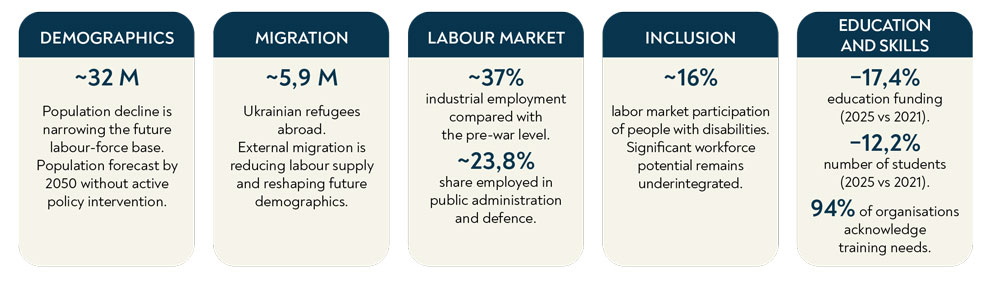
Yes. For many sectors, the shortage of labor is already as critical as the lack of financing or infrastructure constraints. Even when funding is available, projects are delayed because there are not enough specialists with the required qualifications, or because people are not ready to work in certain regions. Employment in industry has declined by approximately 37%, limiting the ability to scale production and implement major investment projects.
According to EY’s survey of Ukrainian company leaders, in 2025, 70% of CEOs identified employee mobilization as a key challenge, while 64% named the shortage of qualified personnel. The share of companies reporting difficulties with recruitment increased from 34% in 2024 to 44% in 2025. This means the labor shortage is no longer merely an HR issue. It has become a critical operational risk.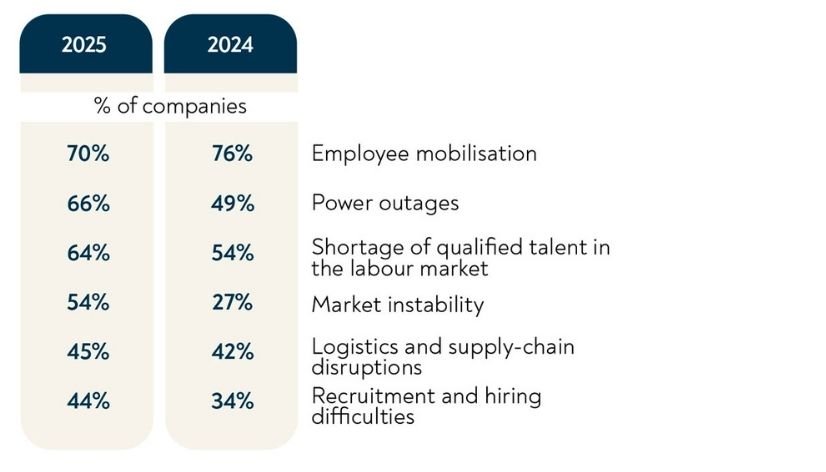
According to EY data, 70% of employers report staff shortages. The highest levels are recorded in banking, where 92% of companies report shortages, followed by consumer products at 87%, transportation and logistics at 83%, oil and gas at 80%, and retail at 79%.
At the same time, the scale of the shortage does not always reflect the strategic importance of a sector for recovery. Transport and logistics, industry, energy, agriculture, construction, healthcare, and education are particularly important. For example, 60% of industrial companies report staff shortages, but this sector is essential for the production of materials, exports, and the delivery of infrastructure projects.
Labor shortages create a domino effect. In banking, they complicate the support of investment projects. In logistics, they hinder the movement of goods and resources. In heavy industry as well as in oil and gas, they affect production and energy capacity.
In retail and pharmaceuticals, they influence access to basic goods and medicines. In agriculture, they affect food security and resilience.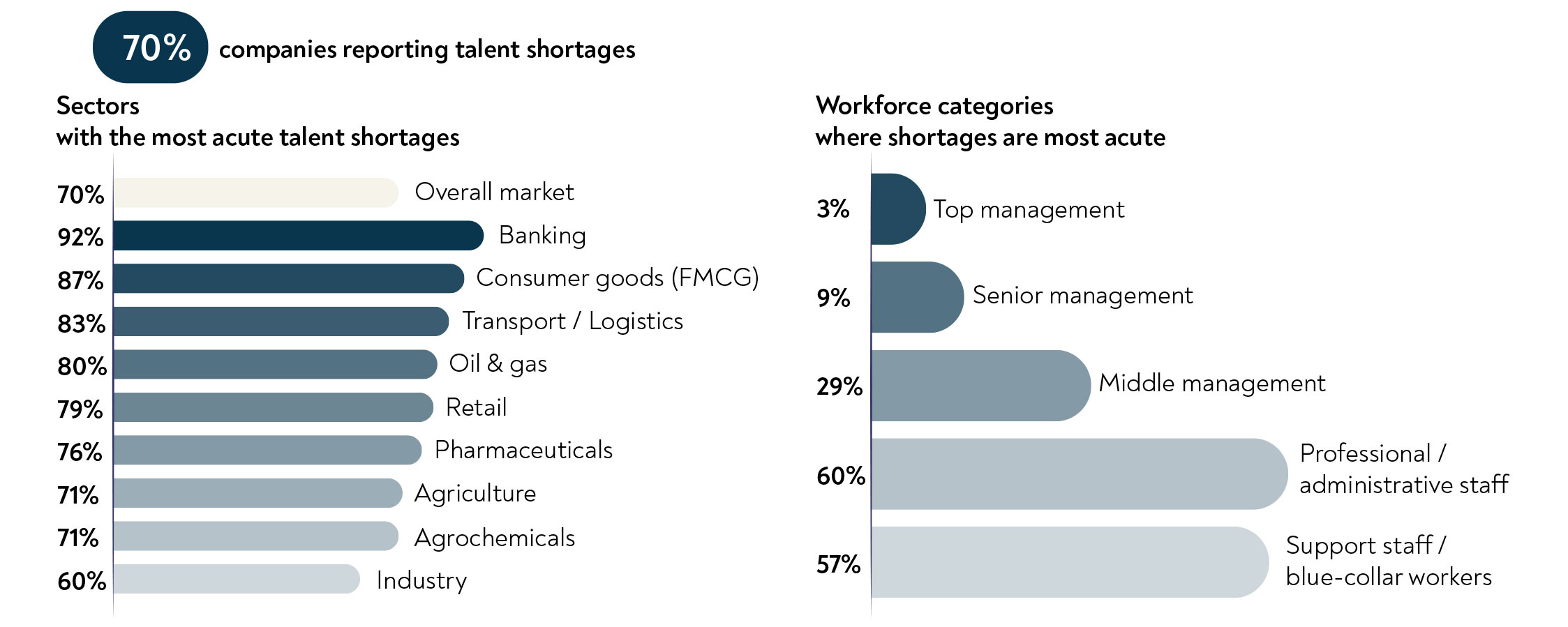
The war has changed not only the size of the workforce, but also its composition. Employment in public administration and defense has increased, while employment in production sectors has declined.
At the same time, the share of veterans and people with disabilities is growing. According to KSE estimates, after the end of hostilities, veterans and their family members who will require particular attention in terms of health and reintegration may account for around 15% of the population. People with disabilities already represent approximately 9%.
The expansion of cross-border and digital employment is also changing the profile of the employee and the way work is organized.
SKILLS, EDUCATION, AND RESKILLING
Do you see a structural gap between the skills available in the labor market and those required by business?
Yes. The gap between the skills available in the market and the needs of business is already clearly visible. The recovery economy requires a combination of technical, digital, managerial, and ESGrelated competencies, while a significant part of the workforce was formed around the previous structure of the economy. The problem is further exacerbated by reduced education funding, a decline in the number of students, and the slow renewal of educational programs.
Business is trying to compensate for this gap through training. According to EY, 88% of companies provide training for almost all categories of employees. Among blue-collar and support staff, this figure stands at 81%. On average, 70% of employees completed at least one training program during the year. However, among companies in the lowest decile, this figure is only 18%.
The issue is the lack of system-wide consistency. Only 29% of companies define a mandatory volume of training, 60% monitor employee learning needs, and 50% evaluate program effectiveness and link training to career development.
Closing the skills gap therefore requires integrating learning into strategic workforce planning, rather than simply increasing the number of stand-alone training sessions.
How deep is the reskilling challenge, and is the education system ready to respond quickly enough?
The reskilling challenge is systemic and sits at the intersection of education, the labor market, and social policy. Among companies experiencing staff shortages, 31% identify the lack of qualified workers as one of the reasons. The issue is therefore not only the number of people available, but whether their skills match the needs of business.
Existing vocational training programs are largely fragmented and do not provide the necessary scale. At the same time, in 2025, education funding declined by 17.4% compared with 2021, while the number of students fell by 12.2%. Under these conditions, formal education is adapting more slowly than market demand is changing.
Ukraine needs a joint model of cooperation between the state, business, and education to raise and renew qualifications systematically, following the logic of a European-style Skills Alliance.
RETURN MIGRATION, IMMIGRATION, AND THE ROLE OF BUSINESS
Should Ukraine count on the mass return of Ukrainians after the war, or is that more of an optimistic scenario?
A rapid and large-scale return of Ukrainians after the war should not be treated as the baseline scenario. People’s decisions will depend on security, housing availability, employment opportunities, income levels, the quality of education and healthcare, and confidence in the future.
EY’s “Best Employer of Ukraine 2025” study reflects the views of selected talent groups and is not representative of the entire population. Among professional candidates in Ukraine, only 11% say they are considering moving abroad. Among students, the figure is 23%, while another 36% remain undecided. Among respondents currently abroad, 26% of professional candidates and 44% of students plan to return, while around half have not yet made a final decision.
Human capital policy must therefore pursue several objectives simultaneously: retain those who have remained in Ukraine, create practical incentives for return, and engage Ukrainians abroad through remote employment, investment, expert cooperation, and targeted programs for critical occupations.
The focus should not be on a one-off wave of repatriation, but on a comprehensive system for retaining, returning, and engaging talent.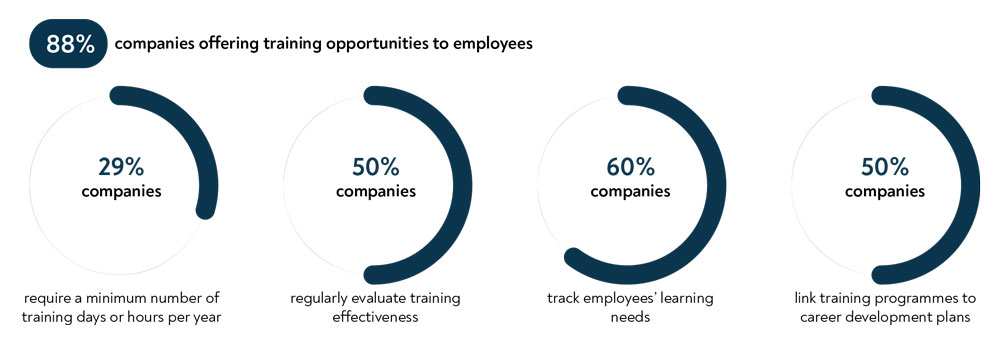
Yes. Ukraine should already be developing a policy for attracting foreign labor as part of its broader human capital strategy. Such a policy should not replace the return of Ukrainians, domestic training, or reskilling. Rather, it should complement these tools and help address structural shortages.
The greatest need is expected in construction, infrastructure, manufacturing, transportation and logistics, agriculture, and care services. Domestic resources may not be sufficient to provide these sectors with the required workforce quickly enough.
Labor immigration should be managed and targeted. It should be based on clearly defined priority occupations, transparent qualification requirements, proper employment procedures, recognition of diplomas, protection of workers’ rights, and integration into local communities. Its purpose should be to strengthen Ukraine’s national human capital, not displace it.
Is the role of business in developing human capital changing from consumer to co-creator?
Yes. Business is gradually moving from consuming ready-made talent to co-creating the system of skills and talent development. Demographic decline, migration, and rapid changes in required competencies are making the traditional recruitment model increasingly ineffective.
Companies are investing more actively in internal academies, upskilling and reskilling programs, and cooperation with universities and educational platforms. Employee development is moving beyond the HR function and becoming a strategic leadership priority.
However, individual employers cannot solve a shortage of this scale on their own. A shared model involving the state, business, and education is required. This should include modern professional standards, co-financing of training, incentives for employers, and a system for evaluating outcomes. Business must become one of the architects of the future labor market.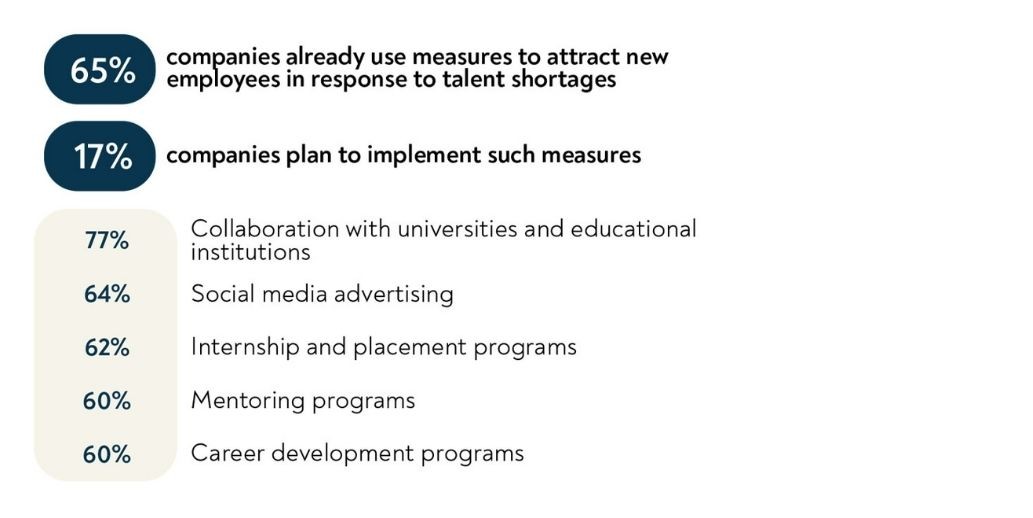
The most effective practices are those aimed at building a longterm talent pipeline, rather than simply filling current vacancies. Companies need to expand recruitment channels, adapt new employees quickly, develop internal talent, and retain critical competencies at the same time.
According to EY, 65% of companies are already taking measures to attract employees, while another 17% plan to do so. The most common tools include cooperation with universities at 77%, social media advertising at 64%, internships and practical placements at 62%, and mentoring and career development at 60% each.
The most resilient approach combines skills shortage forecasting, systematic training, flexible work formats, and dedicated programs for veterans, people with disabilities, and internally displaced persons. Human capital must be part of the leadership agenda, not only an HR responsibility.
Is Ukrainian business ready to invest in employee learning and development systematically, rather than selectively?
Ukrainian business is gradually moving from one-off training initiatives to more systematic employee development, although this transition is not yet complete. Some companies still view training as a cost, while employers focused on long-term growth increasingly see it as a strategic asset.
According to EY, the median annual training budget is UAH 6,906 per employee, but it varies significantly, from UAH 1,279 to UAH 38,352. This gap points to considerable unevenness in investment.
On average, training costs account for 1.9% of payroll, while the median figure is 0.8%. At the same time, training represents a significant share of HR budgets excluding payroll: 28% on average, with a median of 27%, and a range from 4% to 51%.
This means that training has already become a visible area of spending within the HR function. It will become truly systematic when learning is linked to workforce planning, career paths, performance assessment, and business objectives.
PRIORITIES, STRATEGY, AND THE INVESTMENT DIMENSION
Which professions and skills will be most in demand in the recovery economy?
The recovery economy will need not only engineers and construction professionals, but a broad range of specialists. According to EY, shortages already affect manufacturing, logistics, finance, IT, HR, quality management, sales, marketing, and management.
Five groups of professionals are likely to be in particularly high demand:
• Technical and production specialists: engineers, technologists, mechanics, electricians, welders, production operators, and specialists in energy and agriculture.
• Managers and project leaders capable of managing change, risk, and large-scale infrastructure programs.
• Finance professionals, auditors, analysts, risk managers, and investment planning specialists.
• IT specialists, developers, data analysts, digitalization experts, and cybersecurity professionals.
• Workers in core economic and social infrastructure: logistics professionals, drivers, healthcare workers, pharmacists, agronomists, quality specialists, sales and service professionals, and HR specialists.
In terms of skills, the most in-demand capabilities will include technical expertise, digital literacy, data skills, project management, financial planning, risk management, customer orientation, knowledge of quality and safety standards, and the ability to learn and adapt quickly.
The key advantage will lie in combining professional specialization with cross-functional skills. The recovery economy will need people who can not only perform a specific role, but also work effectively in complex, cross-sectoral teams.
If human capital is the key resource for recovery, what three decisions should the government make today?
First, Ukraine should approve a comprehensive human capital strategy that brings together demographic policy, the labor market, education, healthcare, social policy, and veteran policy, with clear objectives, indicators, and budgets.
Second, the country should modernize the labor market and the social support system by making assistance more targeted and expanding employment opportunities for vulnerable groups.
Third, Ukraine should shift towards results-based financing of education and healthcare, treating them as investments in productivity and economic growth.
In the short term, what matters more: bringing people back or increasing the productivity of those who have stayed?
In the short term, the priority should be to increase the productivity of those already working in Ukraine. Faster results can come from digitalizing processes, developing managerial and technical competencies, expanding inclusive employment, and improving working conditions.
Higher productivity will create the foundation for scaling the economy and will strengthen incentives for citizens to return and for investors to enter the market.
How much does human capital influence the decisions of international investors considering Ukraine?
Human capital is one of the key factors international investors consider when assessing both the risks and potential of Ukraine. They look not only at taxes, asset values, or access to financing, but also at the availability of qualified workers, strong management teams, technical and digital capabilities, and the ability of the education system to reproduce these skills over time.
In this context, the findings of the Elite Quality Index, or EQx, 2026 are particularly relevant. The index assesses countries not only in terms of institutions or economic outcomes, but also by the ability of elites to create long-term societal value rather than extract rents.
In the latest round of research, which included Ukraine, the country is described as being in the lower part of the global Elite Quality ranking because of the historical dominance of models based on redistribution and value extraction over models of value creation. At the same time, the authors emphasize that this should not be read as a judgment of failure, but rather as evidence of significant unrealized potential in a country that is simultaneously fighting a war and undergoing deep institutional transformation.
For investors, this has practical implications. They assess not just the size of the workforce, but the quality of human capital, productivity levels, the country’s ability to reskill people, retain talent, and integrate veterans, people with disabilities, internally displaced people, and other population groups into the labor market.
Equally important are the predictability of government policy in the areas of labor, education, and social protection, as well as the state’s ability to ensure a level playing field for all economic actors.
This is why human capital, investment confidence, and the quality of governance are now inseparable. According to the EQx analysis of Ukraine, one of the country’s biggest challenges remains the gap between relatively stronger indicators of institutional and economic capacity and significantly weaker indicators of long-term value creation.
Particularly critical factors include weak protection of property rights, limited regulatory predictability, insufficient control of corruption, and a very high level of human capital outflow, often described as brain drain. These factors directly affect investors’ willingness to enter the country or expand their presence.
Ukraine’s strengths include digital public services, electronic interaction with citizens, and decentralization. However, these strengths need to be translated into predictable rules, proper investment protection, and a stable regulatory environment.
Ultimately, Ukraine’s ability to retain and develop talent, raise productivity, and strengthen institutional trust will directly influence the scale of capital inflows.
CONCLUSION: FROM DIAGNOSIS TO THE ARCHITECTURE OF RECOVERY
The key question for Ukraine is not only whether funding for reconstruction can be secured. It is whether the country can transform the knowledge, skills, and potential of its people into productivity, innovation, and economic growth. Human capital is becoming as critical an infrastructure as energy, logistics, and financing.
Demographics, migration, the return of citizens, the reintegration of veterans, the inclusion of people with disabilities, education reform, business needs, and investor confidence are all elements of one system.
For the state, this means the need for a comprehensive strategy with clear goals and defined accountability. For business, it means moving from consuming ready-made talent to co-creating it through training, partnerships with educational institutions, and inclusive employment.
The coming years will determine whether Ukraine’s recovery remains limited to physical reconstruction or becomes a genuine transformation of the economy. The central test will be the country’s ability to consistently convert human potential into productivity, productivity into trust, trust into investment, and investment into sustainable growth and long-term competitiveness.
#HumanCapital #LaborMarket #EYUkraine #Workforce #UkraineRecovery #Business #Ukraine