
Ukraine is currently going through one of the most difficult periods in its modern history. The full-scale war, economic losses, population displacement, and the destruction of critical infrastructure have created complex, multi-layered challenges that affect every sphere of life. The state is compelled to simultaneously ensure national defense, maintain social programs, and rebuild communities – all of which demand enormous resources and time.
In these circumstances, the role of the civil society sector and charitable funds becomes particularly important. It is they who respond swiftly to needs that state institutions cannot always fully address – from humanitarian aid and support for families in difficult life situations to educational development, psychological assistance, and the restoration of social infrastructure.
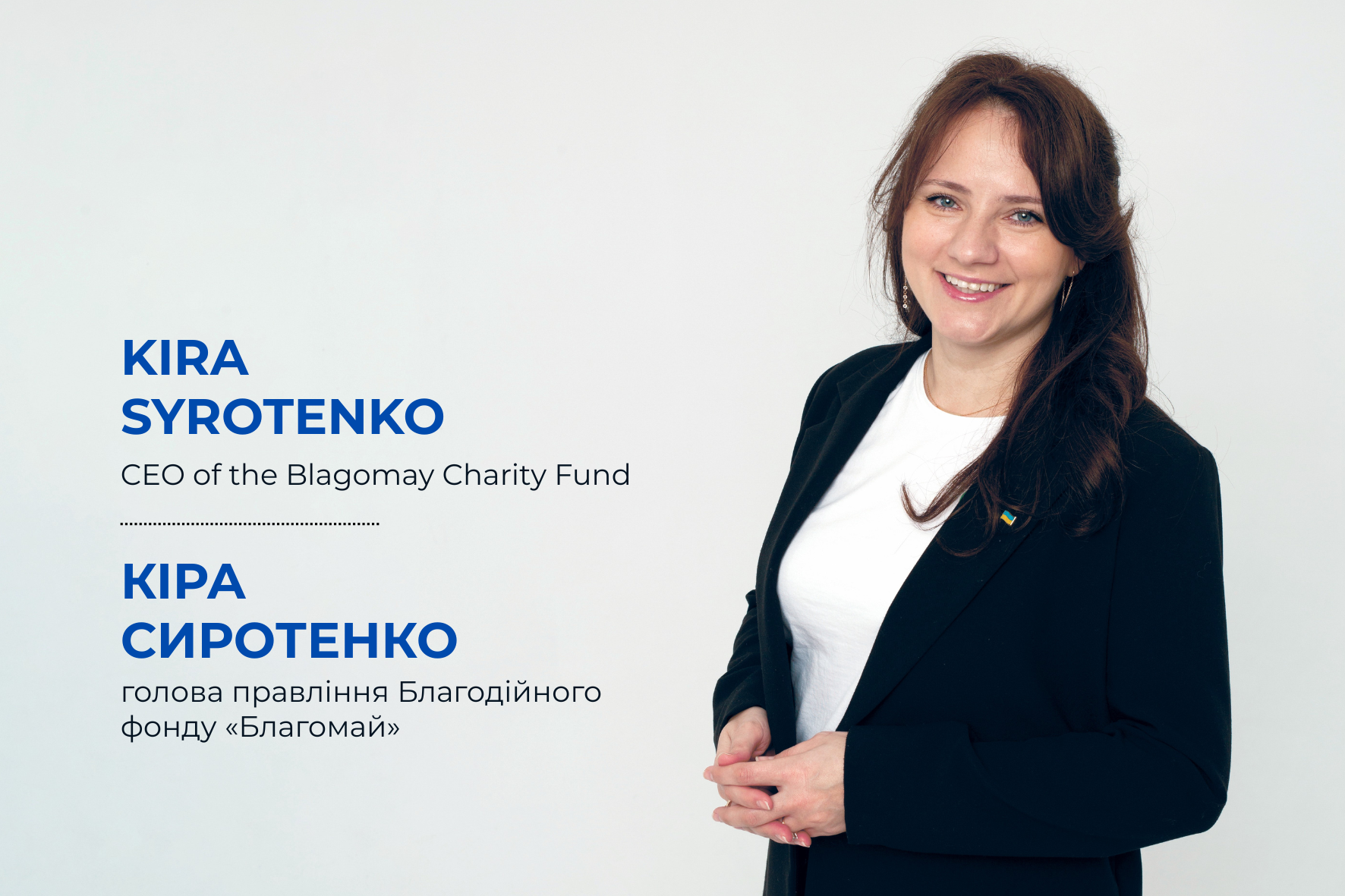
How charitable organizations have become a pillar of support for thousands of people – ensuring sustained assistance and transparency – is discussed by KIRA SYROTENKO, CEO of the Blagomay Charity Fund.
What was the key reason that motivated you to transform a private initiative to help children into a full-fledged charity fund that has been operating for more than 13 years?
The urgent need for swift, targeted, and compassionate support became the fund for establishing the charitable fund Blagomay. We saw that children and socially vulnerable groups were in critical need of attention and resources, and we made the decision to unite our efforts to provide consistent, long-term assistance.
This is how an initiative was born – one that has been contributing to the country’s future for over a decade by changing children’s lives and supporting the communities that need it most.
More than 13 years ago, orphanages and children’s homes in Ukraine were facing a severe lack of funding. In many of them, children were left without even the most basic necessities: sometimes there wasn’t enough food, warm clothing, or essential household supplies.
It was during this time that Blagomay’s co-founders, Tetyana Karapetyan and Kostyantyn Holubyatnikov, began helping children deprived of parental care on their own initiative. They worked together closely and stayed in constant contact. One day, Tetyana approached Kostyantyn with the idea of visiting a children’s home – bringing toys, treats, and simply spending time with the children.
Very quickly, word spread. Friends and acquaintances joined the effort, and what started as a single visit turned into a regular tradition – one that eventually evolved into a structured and impactful charitable fund.
How did you realize that one-off assistance to orphanages was not enough and that a systemic approach was needed, eventually leading to the creation of the organization?
At the time, the institutional care system in Ukraine was virtually the only model for raising orphaned children. It was a closed environment with minimal opportunities for socialization, and the transition into adulthood often came as a real shock for graduates. Years spent behind institutional walls rarely gave children a sense of self-confidence or the skills needed for independent living. On the contrary, many children regressed in their development due to the lack of a nurturing environment that supports personal growth and maturity.
The quality of care was directly tied to limited funding. Our experience working with childcare institutions revealed a harsh reality: there were cases when facilities had no funds even for basic necessities like food or warm clothing. The absence of school supplies, educational materials, and any kind of preparation for real life only deepened the problem.
I must admit, in the beginning, we didn’t fully grasp the depth and scale of the issue. But as we began visiting these institutions – first once every few weeks, then more often – it quickly became clear that the children’s needs weren’t going away. Occasional, ad hoc help was simply not enough. What was needed was a structured, systemic approach.
We started almost from scratch – with no financial reserves, no major donors. Everything we did was self-funded and supported by friends and like-minded individuals. At that time, we could hardly have imagined that just a few years later, we would be covering multimillion-hryvnia needs of children’s institutions across the country.
What were the first days like for you after the full-scale invasion began, and which tasks became the most urgent?
In the first days of the full-scale invasion, the Blagomay Charity Fund faced entirely new and urgent challenges. The most difficult task was finding drivers willing to evacuate children from frontline areas, where the security situation was deteriorating by the hour. This challenge was further complicated by a sudden spike in fuel prices, which caused transportation costs to soar within just a few days.
Once the issue of drivers and transport was resolved, another major obstacle emerged – the ban on men leaving the country, which had come into effect on the very first day of the invasion. Securing the necessary permits took an extremely long time, delaying evacuations that were already critically time-sensitive.
Despite the chaos, the team managed to evacuate several hundred children from various institutions during the first weeks of the war. Blagomay’s staff barely slept: phone calls, negotiations, logistics coordination, and paperwork took place around the clock, without pause.
It wasn’t until a few months later that team members were finally able to allow themselves a few hours of uninterrupted sleep. But once the processes were in place and operations stabilized, one thing became clear: after going through this, they would be capable of overcoming any challenge ahead.
How did the activities of Charity Fund Blagomay change after the start of the full-scale war, and which new areas have become defining for its work today?
How did the activities of the Blagomay Fund change after the start of the full-scale war, and which new areas have become central to its work today?
Following the outbreak of the full-scale invasion, the Blagomay Fund underwent a significant transformation to meet the demands of a rapidly changing reality and the vast scale of emerging needs. The organization broadened its scope, prioritizing support for children, healthcare institutions, and war-affected communities. This shift allowed Blagomay not only to respond swiftly to urgent humanitarian crises but also to develop long-term programs focused on Ukraine’s recovery.
One of the key innovations was the launch of the «Construction and Reconstruction» program. Through this initiative, Blagomay began restoring and rebuilding schools, social institutions, children's centers, residential facilities, and shelters for internally displaced persons.
In parallel, the «Medical Support» program was established to equip hospitals with modern devices, vital consumables, and critical medical tools – ranging from patient monitors and ventilators to specialized equipment for pediatric intensive care units. Thanks to these efforts, many healthcare facilities significantly improved their ability to save lives and operate effectively under wartime conditions.
Another essential area became the «Cultural Code of Ukraine» initiative – created to support the preservation of Ukraine’s cultural heritage, promote creative projects, and strengthen national identity. Blagomay supports initiatives that safeguard collective memory, foster artistic expression, and enhance the cultural resilience of Ukrainian society.
Together, these new directions have enabled the fund to dramatically scale up its charitable efforts, reaching an ever-expanding number of regions, institutions, and individuals during one of the most challenging periods in Ukraine’s modern history.
The fund also runs a wide range of educational initiatives. Could you tell us more about them?
Yes. One of these projects is Girl Power, an educational program for teenage girls from vulnerable backgrounds. This is not just a learning initiative, but an empowerment tool that helps girls gain knowledge about their rights, build self-confidence, and develop skills essential for adult life.
The program includes modules on leadership, gender equality, soft skills development, and career guidance. An important component is psychological support, which helps participants cope with stress and better understand their emotions. The results are already visible: many of the girls go on to enroll in leading universities and demonstrate achievements that seemed unattainable just a few years ago.
Another key focus area is «STEM: A Path to Innovation,» which develops technical and engineering skills among children and teenagers. Participants work with robotics, programming, 3D modeling, and other STEM disciplines.
The program provides access to modern education for children from regions affected by the war. In 2025 alone, more than 4,000 students in the Kyiv and Sumy regions received new STEM classrooms, equipment, and access to international educational platforms.
Understanding the importance of early career guidance, the organization launched the Career Guide program, which helps school pupils and students navigate a rapidly changing labor market. The program enables young people – especially those from socially vulnerable groups – to make informed and conscious career choices.
A separate platform, Career Expo, has also been created – a career forum that this year brought together more than 3,200 participants, 17 employers, and leading universities. It is a space where young people can interact with companies and take their first steps toward a professional future.
Your Blagomay HUB project is no less interesting. For many children, it has become not just an educational space, but a «second home.» What was the main motivation behind creating such a hub?
We created Blagomay HUB as a safe educational space for children who are going through difficult life circumstances. Since its opening in 2023, more than 11 thousand children have visited the hub – and for many of them, it became the first place where they truly felt heard, supported, and not judged.
At the hub, children study IT and English, work with psychologists, prepare for the External Independent Testing, and communicate with mentors. Many of them stay until late in the evening because they feel safe and comfortable there.
One of the hub’s key objectives is to provide access to educational and social services that children from residential care institutions or vulnerable families usually do not receive – from academic support to basic knowledge about health and self-care.
The hub’s greatest value lies in genuine human interaction. Children come here not only for knowledge, but for warmth, attention, and the opportunity to be themselves. It is this sense of humanity that makes Blagomay HUB a place they return to every day.
What key priorities and goals does the Blagomay Fund set for 2026?
In 2026, the Blagomay Fund aims to significantly scale up all areas of its work, reaching even more children, families, and social institutions across Ukraine.
The medical program will be a top priority. Blagomay plans to support 58 hospitals, deliver 20 neonatal incubators, and install over 1,000 units of medical equipment – enabling assistance for more than 800,000 people.
The organization also plans to create five new sensory rooms for children who require additional developmental support.
The humanitarian program will focus on the most vulnerable children. In 2026, Blagomay aims to support at least 30,000 children, providing essential items, nutritious food, and specialized support kits for families affected by the war.
The Construction and Recovery program will remain a core area. Planned initiatives include building over eight modern shelters, renovating at least ten medical facilities, and restoring more than ten educational institutions throughout the country.
Educational programs will continue to expand. Girl Power Ukraine will include 40 active groups, reaching over 2,000 girls. Blagomay will also open seven new educational hubs, organize two large-scale Career Expo events in Kyiv and Lviv, and host ten youth camps.
A special focus will be placed on mine safety education, with over 15,000 children receiving critical knowledge on protection, risk awareness, and safe behavior.
For Blagomay, 2026 is a year of transformative action – from strengthening medical systems and rebuilding infrastructure to creating safe spaces and empowering the next generation.
None of these goals would be possible without our incredible partners and donors. Every contribution becomes real, measurable help for those who need it most.
#Blagomay #Charity #ChildrenSupport #SocialImpact #Education #UkraineRecovery #Ukraine