
BUSINESS FORECASTS FOR 2026
CAUTIOUS OPTIMISM AND A BET ON INNOVATIONS
Despite the war, uncertainty, and economic risks, businesses in Ukraine continue to operate, invest, and even plan for growth. This is confirmed by the results of the European Business Association’s annual survey “Business Forecasts for 2026”, in which executives of the Association’s member companies took part. According to the data, businesses are cautious but confident, with expectations of positive dynamics, moderate revenue growth, and active implementation of new technologies prevailing.
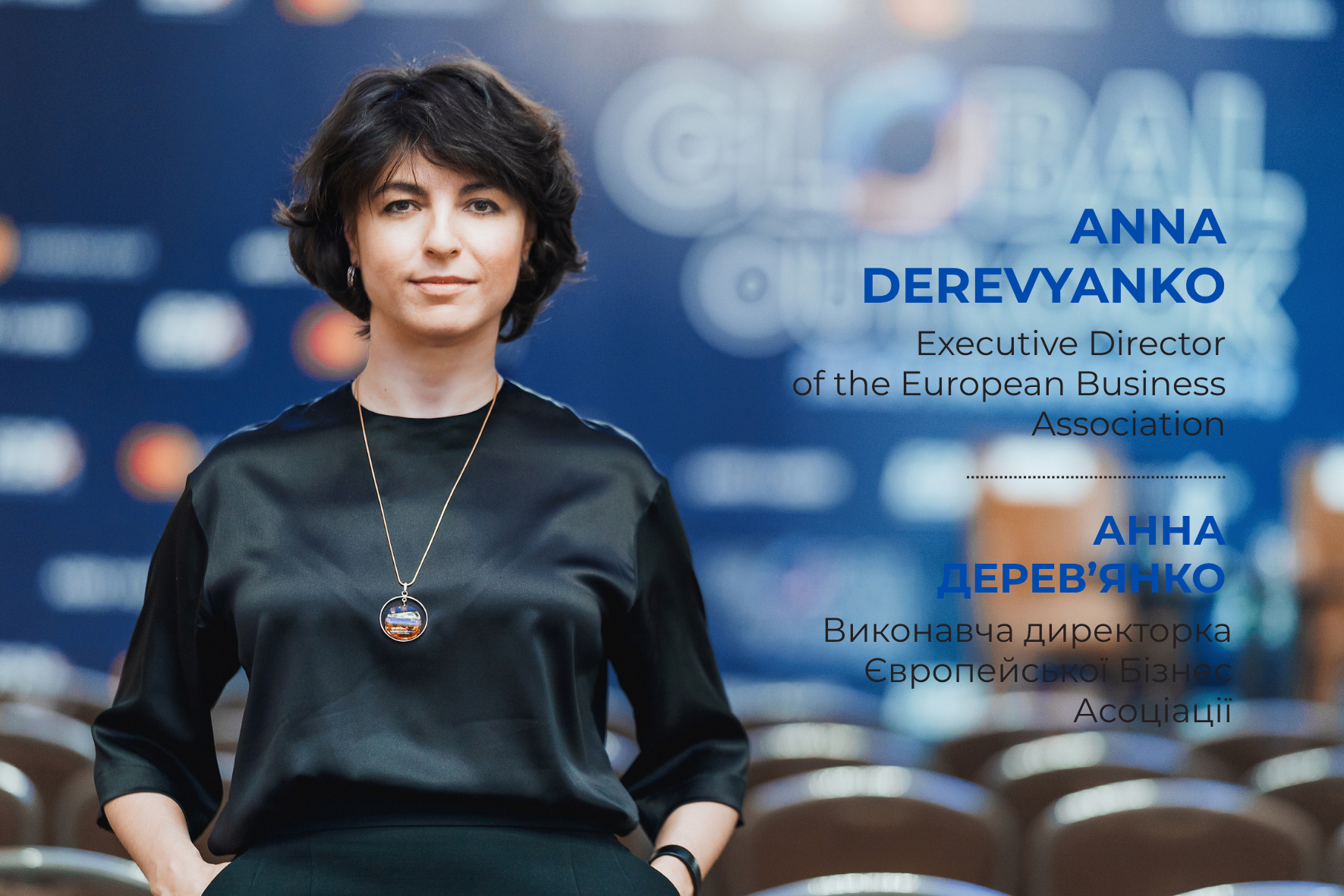
ANNA DEREVYANKO, Executive Director of the European Business Association
“We observe stable and cautiously optimistic forecasts for 2026 from businesses that continue to operate and plan in Ukraine. Despite entering the fifth year of full-scale war, companies are expecting improvements in financial performance and are expanding their investment ambitions. We hope the government will act as a partner and support the implementation of these plans, particularly by advancing reforms and fulfilling EU integration commitments, which business leaders emphasized in this survey.”
FINANCIAL STABILITY IS WITHIN FORECASTS
The average dollar exchange rate that executives are setting in their budgets for 2026 is UAH 46 per USD. For comparison, the rate used for 2025 was UAH 44, and UAH 41 in 2024.
Such numbers indicate not so much pessimism as conscious realism on the part of businesses. For most companies, the gradual devaluation of UAH does not appear to be a threat, but rather a predictable macroeconomic reality to which they can adapt.
Positive outlook remains: 55% of executives forecast growth for their companies in 2026. Last year, this indicator was slightly lower at 53%. Around 30% of business leaders expect no significant changes, while 15% foresee a negative trend. This means that businesses are gradually moving away from a “survival” model to a planning model.
GROWTH BASED ON EXPERIENCE
Research shows that businesses are not just hoping for stabilization, but are actually planning for revenue growth.
The share of executives expecting revenue growth in UAH terms rose from 72% to 77%, while those predicting a decline fell from 15% to 12%.
Interestingly, companies have become more realistic in their assessment of growth prospects: 30% of directors predict an increase in revenue of up to 10% in UAH, another 33% predict an increase of 11–20%, and 14% expect significant growth of over 21%.
This cautious optimism is confirmed by data on currency terms: 55% of companies forecast an increase in revenues in USD (in 2025, this percentage was only 43%).
INVESTMENTS ARE BACK
After several years of pause in investment activity, companies are starting to think strategically again. For example, the average cost of a single project has increased to USD 14 million, whereas a year ago this indicator stood at USD 9 million.
This demonstrates not only a gradual recovery in capital investment, but also growing confidence in the domestic market. Businesses are increasingly investing in manufacturing, infrastructure, and technology — industries that remain essential even in wartime.
However, not all industries are showing such dynamics. For the third year in a row, the share of companies financing social initiatives has been decreasing. In 2026, this percentage will be 55%, compared to 65% in 2024. And while companies previously allocated around 6% of their revenue to social projects, now they allocate only 3%.
ARTIFICIAL INTELLIGENCE AS A RESPONSE TO CHALLENGES
Another trend that will become apparent in 2026 is the rapid introduction of artificial intelligence (AI) tools.74% of companies plan to implement AI tools in 2026 to optimize or enhance business operations. This indicates the growing role of AI and automation in companies' operational processes, which may be a partial response to the growing problem of staff shortages. Mainly, companies will use AI tools for training, improving the efficiency of analytical work, simplifying routine tasks, planning purchases and sales, as well as in marketing, accounting, customer communications, etc.
BUSINESS AND EU INTEGRATION: A SHARED DIRECTION WITH THE STATE
The top priorities for the government for 2026 have been slightly updated. Top priorities for the Government in 2026 have slightly shifted. In addition to traditional concerns such as combating corruption (60%), judicial reform and rule of law (54%), and macroeconomic stability (35%), a new priority emerged: fulfilling Ukraine’s obligations as an EU candidate country (36%). This change underscores the importance of EU integration not only for Ukrainian society, but also for businesses operating in Ukraine.
OPTIMISM DESPITE UNCERTAINTY
29% of companies expect the fighting to end in 2026. 19% do not share this optimism, and half of the respondents refrain from making any predictions. However, even with such uncertainty, most businesses plan a year ahead, form budgets, expand markets, and implement technologies.
SUMMARY
The results of the study show that businesses have not simply adapted to the conditions of war — they have learned to plan for growth despite them.
Companies are moving from survival to growth, from caution to investment, from observation to action. And this process, as paradoxical as it may sound, is becoming the foundation of Ukraine's economic stability, which the world admires no less than its military courage.
#Business #BusinessOutlook #Investment #ArtificialIntelligence #Economy #EuropeanIntegration #Ukraine