
BEING A PILLAR OF STRENGTH
HOW THE ROLE OF LEADERSHIP AND BUSINESS HAS EVOLVED IN UKRAINE
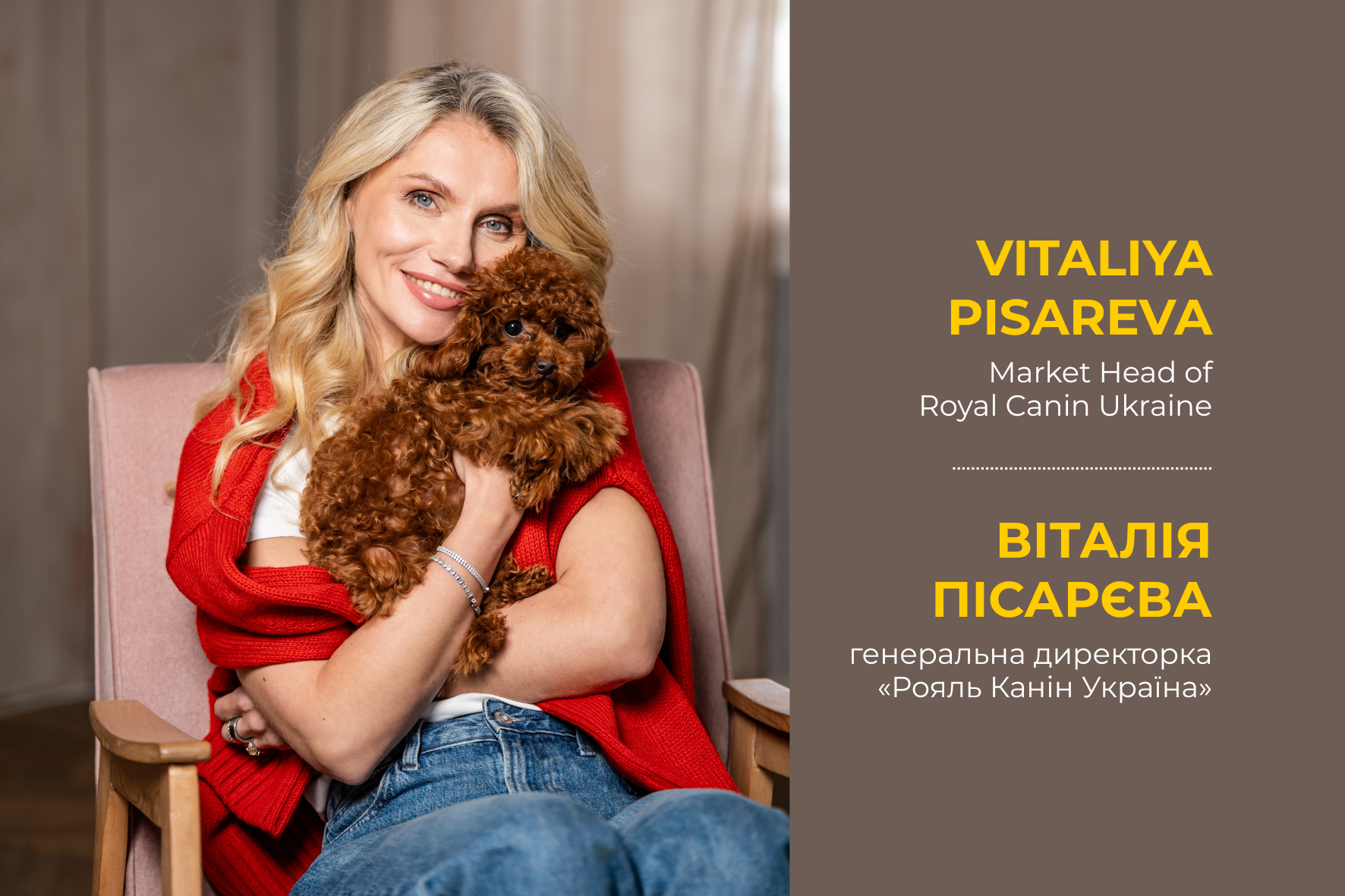
From the very first hours of the full-scale invasion, Ukrainian businesses stopped thinking in terms of quarterly plans, growth strategies, and market performance. For many companies, the central question became both much simpler and far more complex: how to protect their people, support their partners, and continue operating.
In this interview, VITALIYA PISAREVA, Market Head of Royal Canin Ukraine, reflects on how the war has reshaped the very understanding of leadership, why humanity has become an integral part of business strategy, and how initiatives that help people recover through interactions with pets come to life.
BUSINESS IN A STATE OF CONSTANT UNCERTAINTY
For Royal Canin Ukraine, the past few years have been a period of rapid change and continuous adaptation. During the first weeks of the full-scale invasion, the team operated almost entirely in manual mode while simultaneously rebuilding supply chains, communications, and day-to-day operations.
One of the greatest challenges was logistics. The delivery system had to be reorganised in real time, as many pets were left without access to their regular nutrition, while veterinary clinics and pet stores quickly ran out of stock due to disrupted supply.
The company's central warehouses were located outside major cities, while the usual transportation routes and logistics systems had ceased to function. Fuel was in short supply, supply chains were breaking down, and industrial warehouses were not designed to process individual customer orders.
To address these challenges, temporary collection points were quickly established across cities. Some products were distributed through specially arranged warehouse facilities, while others were handed out directly from trucks at pre-arranged locations.
This was just one of many unconventional decisions the team had to make in February 2022. In this new reality, our employees (we call them associates) learned to determine the next steps faster than instructions could be developed. Associates took on unfamiliar roles, partners contributed people and resources, and business continuity plans that had once seemed purely theoretical became practical tools for keeping the business running.
Within just a few days, Royal Canin Ukraine resumed product deliveries across all government-controlled territories of Ukraine. At the time, this was a critically important mission. Throughout this period, however, the company's priorities remained unchanged: ensuring the safety, wellbeing, and support of its associates. On these matters, there could be no compromise.
PEOPLE AS THE TOP PRIORITY
From the very first days of the full-scale invasion, the leadership team at Royal Canin Ukraine worked seven days a week. Every day began with status check-ins: Was everyone safe? Who needed assistance? Who required evacuation?
As the situation evolved, the company systematically redefined its approach to supporting associates. During widespread power outages, associates were provided with backup power stations to ensure uninterrupted work, while additional financial support helped them prepare for the challenging winter months.
The company also expanded its health insurance programme, extending coverage not only to associates but also to their family members. Preventive healthcare services were added, enabling people to take care of their health before serious issues arose.
Since 2023, Royal Canin Ukraine has offered a psychological support service available to associates and their families. At any time, they can seek support from a psychotherapist or coach. Importantly, these services are provided by Ukrainian specialists who have a deep understanding of the realities and psychological impact of the war.
At the same time, the company began to systematically develop its employee wellbeing initiatives. Their focus extends beyond physical and emotional health to strengthening the team's long-term resilience and inner capacity.
Driving these efforts is an internal initiative group, bringing together associates from different departments who share a common goal: supporting one another and helping colleagues remain resilient during challenging times. The group organises mental health initiatives, sports and wellness activities, as well as informal gatherings that encourage communication, knowledge sharing, and mutual support. Over the past few years, these initiatives have become an integral part of the company's culture, helping associates navigate prolonged periods of stress and uncertainty together.
This experience of caring for people has become one of the most important lessons of the war. It has transformed not only the company's approach to managing people, but also the very understanding of the leader's role.
HOW THE MEANING OF LEADERSHIP HAS CHANGED
In times of constant uncertainty, it is no longer enough to be a good manager or simply respond quickly to change. The experience of war has made one thing clear: in times of crisis, what matters is not only professional expertise and speed of response, but also a leader's ability to provide direction and create meaning, even when circumstances offer no clear points of reference.
Today, leadership is, to me, about purpose, clarity, humanity, and the ability to inspire. When people live with uncertainty every day, a leader's role extends beyond running a business. It is also about helping the team maintain hope for the future. It was during the war that my own purpose as a leader became fully defined: to transform dreams into value for people, business, and society through unlocking opportunities.
In difficult times, strategic vision, emotional resilience, the willingness to take responsibility, honesty in communication, and the ability to unite people around a shared purpose become especially important. Today, the effectiveness of decisions is measured not only by financial or business results, but also by their impact on people, partners, and long-term development.
The approach to decision-making has changed as well. The war has taught us to accept that complete information is often simply unavailable. Rather than waiting for the perfect moment, it is more important to make timely, well-informed decisions and adapt quickly as circumstances evolve.
In such an environment, the ability to combine available data and facts with different perspectives, a broader understanding of the context, as well as personal values and intuition becomes especially important.
One of the greatest discoveries of recent years for me has been the power of collective intelligence. Ideas that initially emerged as local initiatives led by individual associates gradually evolved into strategic priorities for the entire company. This experience has only strengthened my belief in how much stronger decisions become when people feel empowered to contribute, know their voices are heard, and work together to shape the future.
Leadership today involves less control and far greater trust. There may be fewer ready-made answers, but there is greater honesty in saying: "We don't know what tomorrow will bring, but we will face every challenge together."
As the understanding of leadership evolves, so does the role of business. While companies once focused primarily on their own operational efficiency, today they are increasingly taking responsibility for supporting society and contributing to its recovery.
BUSINESS AS A RESPONSIBLE MEMBER OF SOCIETY
The war has fundamentally reshaped expectations of business. Companies are increasingly recognising that their role extends beyond economic activity and that they are an integral part of the broader social ecosystem.
For Royal Canin Ukraine, this means providing ongoing support to pets left without proper care. The company works closely with pet shelters across the country, supplying nutrition for pets while supporting the organisations that care for their wellbeing every day.
Another important area of focus is promoting responsible pet ownership, which has become especially significant today. The growing number of stray cats and dogs, population displacement, damaged infrastructure, and limited access to veterinary services have all increased the risk of dangerous diseases, including rabies.
That is why, together with the NGO Dog&Duck, we implemented a project providing free sterilisation and rabies vaccination for pets in communities across six regions of Ukraine.
At the same time, we strive to create value far beyond our products, at the intersection of caring for people, pets, and society as a whole. This vision gave rise to an initiative to establish dog-assisted therapy centres, providing psychological support with the involvement of specially trained therapy dogs.
In 2023, our partner organisation, NGO Change Communications, received a grant from the Royal Canin Foundation to establish four dog-assisted therapy centres in Kyiv, Rivne, Chernivtsi, and Myrhorod. Since then, specialists working at these centres have provided support to more than 8,300 Ukrainians, including children, military personnel, and civilians.
Building on this initiative, another project was launched in Irpin: a rehabilitation centre for people and cats, implemented by the NGO Bearded Cat Mom with the support of the Royal Canin Foundation.
The centre will involve professional psychologists as well as cats rescued from frontline areas and combat zones that themselves require rehabilitation through interaction with people. In this way, the project creates a unique space for the mutual recovery and support of both people and pets.
Despite all the challenges of war, Ukrainian society continues to move forward. Behind this progress lies not only the resilience of individuals and organisations, but also the strength of unity and mutual support. We have experienced this especially clearly through our collaboration with our business partners.
RESILIENCE IS NOT ABOUT ENDURING AT ANY COST
The experience of recent years has shown that business resilience is determined not only by financial performance, the ability to withstand crises, or adapt to change. Today, it is also measured by a company's ability to sustain the energy and engagement of its people, maintain the trust of partners and customers, and continue investing in the future despite the pressures of the present.
One expression of this resilience has been the mutual support within our professional community. At the beginning of the full-scale invasion, we launched a support programme for our business partners, including veterinary clinics, breeders, and pet retail businesses affected by the war.
Since then, more than 1,100 small and medium-sized partner organisations have received a total of UAH 30 million to support their recovery and further development. For us, this was an investment in the resilience of our partner network and an opportunity to support businesses that, despite extraordinarily difficult circumstances, continue to operate, create jobs, support Ukraine's economy, and help pet parents care for the health and wellbeing of their pets.
We experienced another powerful example of this mutual support at the end of 2024, when the company's office was damaged in a missile attack. Our partners immediately began offering assistance, from providing temporary office space to financial support.
For us, this became a powerful demonstration of solidarity within the business community. Their willingness to stand by us during such a difficult time was incredibly meaningful. In my view, it is trust, mutual support, and the ability to unite in the face of shared challenges that help Ukrainian businesses remain resilient through the most difficult times.
An equally important part of resilience is having a clear purpose and understanding why a company exists. We believe that business should not only be effective but also meaningful.
The initiative to establish dog-assisted therapy centres in Ukraine is a good example of this. It emerged during the war not as a business project, but as a response to people's need to regain a sense of stability, connection, and humanity. At the same time, it has significantly strengthened trust in our brand, reinforced our team's sense of unity, and deepened our shared sense of purpose.
For me, resilience is not about enduring at any cost. It is reflected in the ability to remain human even when circumstances put us to the test. It is people, a shared purpose, trust, and mutual support that enable us to move forward, build the future, and find the strength to continue through the most difficult times.
ABOUT ROYAL CANIN®
ROYAL CANIN® is a global leader in health through nutrition for cats and dogs and is part of Mars, Incorporated. Founded in 1968 by French veterinarian Jean Cathary, the company develops precise, science-based nutritional solutions tailored to the individual needs of cats and dogs.
In Ukraine, alongside its core business, ROYAL CANIN® promotes responsible pet ownership and pet wellbeing by supporting pet shelters, implementing free sterilisation campaigns, and running a client support programme. The company also supports animal-assisted therapy initiatives funded by the Royal Canin Foundation, partnering with local organisations to help bring these projects to communities across Ukraine.
ROYAL CANIN UKRAINE'S SOCIAL IMPACT
Since the beginning of the full-scale invasion, Royal Canin Ukraine has been supporting pets, the professional pet care community, and Ukrainian society as a whole. The company has donated more than 297 tonnes of pet food, worth over UAH 86 million, to more than 500 organisations caring for homeless and abandoned animals. It also implements free sterilisation and vaccination programmes and has provided more than UAH 30 million in recovery and development support to over 1,100 business partners affected by the war.
With the support of the Royal Canin Foundation (RCF), four free dog-assisted therapy centres are currently operating in Ukraine, having already provided psychological support to more than 8,300 people, including children, military personnel, and families affected by the war. In 2026, with RCF's support, a feline-assisted therapy centre will also be completed. The centre will provide psychological support to people while helping cats rescued from frontline areas and combat zones undergo rehabilitation and socialisation.
The company also places a strong emphasis on employee wellbeing. Since 2023, Royal Canin Ukraine has offered a psychological support programme for employees and their family members, providing access to professional psychologists and coaches. Approximately 70% of employees use the service each month, with the total number of consultations already exceeding 3,000 sessions.
#RoyalCanin #Leadership #BusinessResilience #CorporateResponsibility #HumanCapital #PetTherapy #Ukraine