
FUNDS ARE READY TO COME IN. IS THE MARKET READY?
HOW TO MAKE UKRAINIAN ASSETS UNDERSTANDABLE FOR INVESTORS
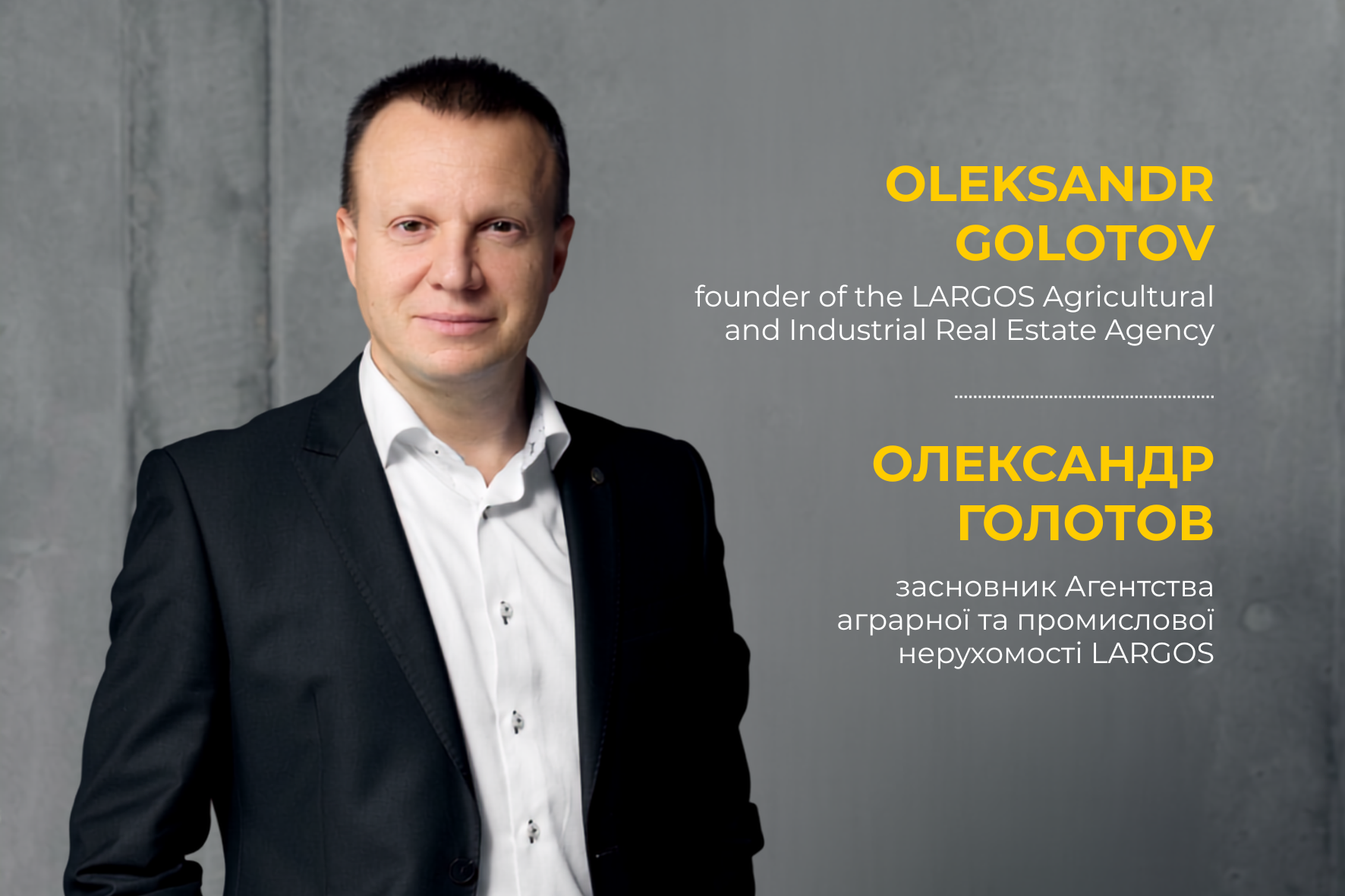
Why the Ukrainian market of agricultural and industrial assets still remains fragmented, what enterprises lack professional dialogue with investors, and under what conditions will funds begin to flow into Ukraine systematically – in this interview with the founder of the LARGOS Agricultural and Industrial Real Estate Agency, OLEKSANDR GOLOTOV.
You work in the agricultural and industrial assets market which remains quite closed in Ukraine. To what extent is this segment formed as a full-fledged market today?
Frankly speaking, this market in Ukraine has not yet been fully shaped – at least in the classical international sense. There are assets, owners, investors, supply and demand. At the same time, there is a lack of uniform standards for asset preparation, proper disclosure of information, and transparent procedures for concluding deals.
For many years, agricultural and industrial assets were sold mainly through personal contacts, closed negotiations, local reputation and informal arrangements. This model was acceptable for the domestic market for a while, but it is not enough for international capital.
A foreign investor expects a predictable process, proven data and a clear logic of the deal. Therefore, the market already exists in practice, but institutionally it is still in its infancy. Today, it is gradually moving from closed agreements to a more mature and structured model.
Why has a full-fledged culture of accounting and structured asset management not yet been formed in Ukraine, especially in the agricultural sector and industry?
The reason lies largely in the peculiarities of Ukrainian business formation. Agricultural and industrial enterprises have developed for decades in conditions of frequent legislation changes, corruption, tax pressure, raider seizures, economic crises, political risks, limited access to financing, and now a full-scale war.
Another factor was a limited access to systematic business education and established management practices. A significant part of Ukrainian entrepreneurs created companies practically from scratch, relying primarily on their own experience, intuition, willingness to take risks, and the ability to quickly respond to challenges.
In such circumstances, owners thought in terms of survival, control, and operational flexibility. The main task was to preserve the enterprise, land, production, jobs, and market access. Corporate governance, standardized accounting, independent evaluation, and proper documentation were often postponed to the undetermined future.
The result is lower value of the assets. Even strong businesses are valued at a discount if their data is fragmented, their structure is opaque, and their key metrics are difficult to verify. Therefore, accounting and transparency should be seen not as formalities, but as tools for capitalization.
Owners often believe that having land, a business, or an elevator automatically creates investment value. Why is this not enough for international capital?
A physical asset alone does not guarantee investment attractiveness. Land, an elevator, a factory or a warehouse are only the foundation. Value arises when it is clear how the asset earns, in which market it operates, what risks it has, whether it can be scaled and what will ensure profitability.
An international investor does not buy walls, hectares or production and storage capacities, but future cash flow, profit, strategic position and risk control.
An elevator can be simply a complex of silos, or it can be a logistics hub with access to grain producers, railways, exporters and ports. Similarly, a land bank can consist of short-term contracts with high legal risks or be a consolidated platform with long-term relationships with shareholders, equipment, a team and a clear agronomic model.
Therefore, the key question is not what the business owns, but how the assets work, what profitability they generate, and what their potential is over the next few years.
You talk about the readiness of the asset for the investor. What do Ukrainian enterprises most often lack in practice?
Often, a holistic investment picture is missing.
Assets, operating history, and documentation may exist separately, but not be combined into a clear system. An investor must quickly see the business model, asset composition, key indicators, liabilities, risks, development potential, and the logic of the stated value.
In practice, companies often lack a quality teaser, investment memorandum, structured virtual data room, confirmed indicators, results of legal and technical audit, and a clear scenario of interaction with a potential investor.
The owner may know his business perfectly, but the capital is not invested in verbal explanations. Knowledge must be transformed into data, documents and arguments that can be verified. Therefore, investment readiness is not a presentation design but the ability of an asset to go from first interest to closing the deal.
So, today the problem of the Ukrainian market is not only military risks?
Yes. War remains a key risk, but not the only barrier to capital raising. International investors can operate even in a challenging environment if the risks can be assessed, insured or otherwise limited.
Investment infrastructure is not just banks, funds, or government programs. It also includes insurance and guarantee mechanisms, predictable regulation, effective legal protection, and professional transaction support.
In Ukraine, some elements of this system already exist, but they often operate in a fragmented manner. As a result, even promising assets lose time, negotiating position, or the interest of potential investors.
What does a typical Ukrainian asset look like today through the eyes of an international investor and what do they fear most?
Most often, it is as a promising object and many remaining questions around it.
The investor sees land and production resources, a favorable geographical location, proximity to EU markets, export experience, logistics potential, and opportunities for modernization. At the same time, they assess the extent to which this potential is supported by facts.
What professional capital is most wary of is not high risk per se, but risk that cannot be identified or measured. These include hidden liabilities, complex control structures, the dependence of the business on one person, unconfirmed indicators, or uncertain technical condition.
Time is an equally important factor. If, after several months of negotiations, it turns out that the basic assumptions are not confirmed, this destroys confidence not only in a particular asset, but also in the market as a whole.
How critical a problem is the lack of a full due diligence and culture of business preparation for a deal?
Due diligence is not a formality or a legal obstacle but a stage at which the declared value of a business is compared with its actual state.
If a company is not ready for the audit, this directly affects the deal: negotiations may stall, the valuation may decrease, and the settlement structure may become more complicated due to additional guarantees, deferred payments, or other investor protection mechanisms.
A common mistake is to start preparations only after an interested buyer appears. In this case, the owner enters negotiations with a weakened position and is forced to respond to inquiries under time constraints.
Therefore, preparation for due diligence should begin before the asset is put on the market. Being prepared to inspect strengthens the seller's position, shortens the process, and reduces the scope for additional discounts.
You work with agricultural and industrial assets. Which segments have the greatest potential for international capital today?
The most promising are assets that combine real economy, strategic importance, and scaling potential.
The first segment is agrarian companies that are already operating and have a land bank, a formed team, equipment, warehouse facilities, and a proven production history. They allow you to enter the sector through a ready-made platform, rather than starting from scratch.
The second is grain elevator infrastructure: storage, processing, and transshipment capacities, access to railways, ports, and border crossings.
The third is processing and manufacturing enterprises. Most interesting may be mills, oil extraction plants, feed production, food processing, and bioenergy – anything that helps transition from a raw material model to products with higher added value.
Mining and other industrial enterprises have special potential, capable of modernizing, expanding capacity, and integrating into international supply chains.
The fourth direction is logistics and industrial sites with access to railways, key road corridors, ports or EU borders, suitable for relocation or placement of new production facilities.
All these segments respond not only to current demand, but also to the long-term needs of Ukraine's recovery, modernization, and integration into the European and global economy.
How important for the market today is trust and why has it become a separate economic category?
Today, trust is a fully-fledged economic asset. It shortens the duration of negotiations, reduces the need for additional guarantees, and increases the likelihood of closing a deal.
For an investor, trust means the correspondence of the declared information to the real state of the business, the openness of the owner and the predictability of the process. For a seller, it means confidentiality, controlled disclosure of data, maintaining operational stability and confidence in the real intentions of the potential buyer.
Trust is built long before documents are signed – from the first conversation, maintaining confidentiality, correct communication, and taking responsibility for commitments. Without it, even an economically strong deal may not happen.
You actually work at the intersection of interests of business owners, investors, and professional advisors involved in structuring deals. To what extent does Ukraine lack such ‘infrastructure players’?
Ukraine truly lacks participants capable of coordinating the entire process – from the initial valuation of the asset to negotiations and closing the transaction.
There are strong lawyers, auditors, appraisers, technical experts, and financial consultants on the market. The problem is that their work often remains fragmented: the owner is forced to independently combine separate areas, and the investor does not always get a holistic picture.
Therefore, we need not just intermediaries who introduce the seller to the buyer but transactional advisors who are able to form the architecture of the process, attract the necessary specialists, synchronize their work, and ensure professional communication between the parties.
LARGOS is the one performing this role. We do not replace specialized advisors, but combine their expertise into a single process. The quality of the environment that connects capital with assets is no less important for market development than the number of potential investors.
Let's summarize. What do you see as the future of the Ukrainian agricultural and industrial asset market after the war? And what is needed to make it attractive to systemic international capital?
Ukraine is no doubt entering a period of great economic restart. It has all the prerequisites to go from a country of raw material exports to a country of deep processing, modern production, logistics hubs and industrial platforms. Its future competitiveness will be formed not only around the export of grain, oilseeds or other raw materials, but also around products with high added value: finished food products, ingredients, feed, biofuels, biomaterials, industrial components, consumer goods, construction materials and engineering products for European and global markets.
However, the main change should occur not only in the infrastructure, but also in the mindset of the owners. Ukrainian businesses will increasingly prepare to attract a strategic or financial investor, joint development, scaling, technological renewal and entry into foreign markets. For the Ukrainian owner, this is a historic moment: the business that they have been creating for years should become a platform for a new stage of development – attracting capital, building new production facilities, producing value-added products and integrating into global supply chains.
I am convinced that Ukraine is capable of taking strong positions in many new niches. Even now, despite the war, new processing and manufacturing enterprises are being created, existing plants are being modernized, new generation export products are being launched, and a new culture of partnership between Ukrainian owners, strategic investors, and international capital is being formed.
For an international investor, Ukraine today is not just a market after a deep crisis. It is a market that can form one of the most powerful waves of economic growth in Europe. It combines significant unrealized potential, the need for modernization, a strong real sector, a strategic location and a new generation of owners who already think not only in terms of business preservation, but also in terms of scaling, partnership and global competition.
That is why the key task is to ensure that international capital sees Ukraine not as isolated opportunities, but as a mature and understandable market. A market where Ukrainian business is ready to move to a new level, and the country can become one of the new centers of agricultural and industrial growth in Europe.
#Investment #UkrainianAssets #Agribusiness #Industry #RealEstate #Investors #Ukraine